Subscribe
The latest psychology and neuroscience discoveries.
My Account
  • Mental Health
  • Social Psychology
  • Cognitive Science
  • Neuroscience
  • About
No Result
View All Result
PsyPost
PsyPost
No Result
View All Result
Home Exclusive Social Psychology Business

Home sweet messy home: How do consumers cope with disorder at home?

by University of Chicago Press Journals
June 29, 2014
in Business
Share on TwitterShare on Facebook

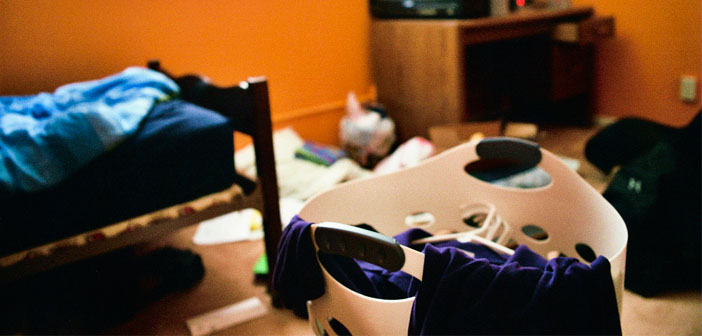
From hanging up our coats to organizing our bookshelves and kitchen cupboards, some people keep their homes tidy and others seem to live in complete chaos. According to a new study in the Journal of Consumer Research, understanding how we organize our homes can help us cope with contradictions and disruptions occurring in our daily lives.

“Tidying a home is an activity that goes beyond moving objects from one place to another or putting them in specific places. Rather, it is a process of building a meaningful domestic environment. Through their tidying activities, people define symbolic borders and guides that constrain their daily activities and interactions,” write authors Delphine Dion (Sorbonne Business School), Ouidade Sabri (Paris-Est University), and Valérie Guillard (University of Paris Dauphine).

To understand how tidiness practices are developed, participants were asked to take photos of both organized and unorganized areas in their homes. While looking at the photos in the lab, the authors asked specific questions in order to find out when that person could or couldn’t tolerate a mess.

Results showed that people create tidiness rules using classification systems that help them deal with the objects that keep coming into and moving around their homes. The authors found that while some people use a one-level classification system (all toys go in one box), others use second- and even third-level sub categories (like toys go in their own box, or sets of like toys go in another box).

To cope with disruptions to their classification systems, people react by either modifying the rules or tolerating the transgressions. Being aware of these rules and coping mechanisms can help us better deal with adversity.

“Understanding everyday tidiness practices helps us understand how consumers negotiate social norms regarding tidiness to cope with their daily constraints and opportunities. It enables us to understand the idea of ‘home sweet messy home,’ that is, how consumers can live in a messy home without feeling any anxiety about it,” the authors conclude.

Google News Preferences Add PsyPost to your preferred sources
Previous Post

Blackness ever blackening: My lifetime of depression

Next Post

When does rude service at luxury stores make consumers go back for more?

RELATED

Employees who feel attractive are more likely to share ideas at work
Attractiveness

Employees who feel attractive are more likely to share ideas at work

March 6, 2026
Scientists discover psychedelic drug 5-MeO-DMT induces a state of “paradoxical wake”
Business

Black employees struggle to thrive under managers perceived as Trump supporters

March 4, 2026
Major study reshapes our understanding of assortative mating and its generational impact
Business

A man’s psychological fit at work tends to increase when his financial values align with his partner’s

February 28, 2026
Emotionally intelligent women use more emojis when communicating with friends
Business

New study sheds light on the psychological burden of having a massive social media audience

February 20, 2026
AI outshines humans in humor: Study finds ChatGPT is as funny as The Onion
Artificial Intelligence

AI boosts worker creativity only if they use specific thinking strategies

February 12, 2026
Trump’s election fraud allegations linked to temporary decline in voter turnout
Business

Trump-related search activity signals a surprising trend in the stock market

February 5, 2026
The tendency to feel like a perpetual victim is strongly tied to vulnerable narcissism
Business

Researchers confirm the detrimental effects of psychopathic traits on job performance

January 27, 2026
Scientists reveal atypical depression is a distinct biological subtype linked to antidepressant resistance
Business

These two dark personality traits are significant predictors of entrepreneurial spirit

January 22, 2026

STAY CONNECTED

LATEST

How the wording of a trigger warning changes our psychological response

Dating and breakups take a heavy emotional toll on adolescent mental health

Abortion stigma persists at moderate levels in high-income countries

Brain scans reveal two distinct physical subtypes of ADHD

Employees who feel attractive are more likely to share ideas at work

New psychology research reveals that wisdom acts as a moral compass for creative thinking

Long-term ADHD medication use does not appear to permanently alter the developing brain

Using cannabis to cut back on alcohol? Your working memory might dictate if it works

PsyPost is a psychology and neuroscience news website dedicated to reporting the latest research on human behavior, cognition, and society. (READ MORE...)

  • Mental Health
  • Neuroimaging
  • Personality Psychology
  • Social Psychology
  • Artificial Intelligence
  • Cognitive Science
  • Psychopharmacology
  • Contact us
  • Disclaimer
  • Privacy policy
  • Terms and conditions
  • Do not sell my personal information

(c) PsyPost Media Inc

Welcome Back!

Login to your account below

Forgotten Password?

Retrieve your password

Please enter your username or email address to reset your password.

Log In

Add New Playlist

Subscribe
  • My Account
  • Cognitive Science Research
  • Mental Health Research
  • Social Psychology Research
  • Drug Research
  • Relationship Research
  • About PsyPost
  • Contact
  • Privacy Policy

(c) PsyPost Media Inc