
An analysis of UK Biobank data suggests that individuals undergoing accelerated biological aging face an increased risk of developing dementia. Those with both the most accelerated biological aging and the APOE ε4 gene variant had a 4.2 times higher risk of dementia compared to individuals with the slowest biological aging and without this gene variant. The study was published in Neurology.
Biological age refers to the condition of a person’s body and organs based on physiological and molecular markers, rather than the number of years they have lived. It reflects how well—or poorly—the body is functioning relative to what is typical for someone of the same chronological age. Unlike calendar age, which progresses uniformly, biological age can advance more rapidly or slowly depending on health, lifestyle, and genetics.
Researchers often estimate biological age using indicators such as telomere length, DNA methylation patterns, cardiovascular function, and certain biochemical markers. Because it captures underlying physiological wear and tear, biological age is considered a better predictor of mortality and age-related diseases than chronological age alone.
Lifestyle factors such as physical activity, diet, sleep quality, and stress management tend to influence biological aging. Environmental exposures like pollution and smoking can also accelerate the process. These differences may help explain why some individuals remain healthy into old age, while others experience early functional decline. The concept plays a growing role in longevity research and the development of interventions aimed at extending healthspan.
In the new study, lead author Yacong Bo and colleagues aimed to investigate the link between biological aging and dementia, as well as the potential role of brain structure in mediating this association. They used data from the UK Biobank, a large population-based longitudinal cohort that enrolled over 500,000 participants in England, Scotland, and Wales between 2006 and 2010.
After applying exclusion criteria (e.g., existing dementia diagnosis and missing data), the final sample included 280,918 participants who were dementia-free at baseline. The average age of participants in the analysis was 56.8 years, and 54.6% were female. Over a median follow-up of 13.6 years, 4,770 individuals were diagnosed with dementia.
Participants were followed from baseline until dementia diagnosis, death, dropout, or the end of the follow-up period. Biological age was estimated using two validated algorithms: the Klemera-Doubal Method Biological Age (KDM-BA) and PhenoAge.
“The KDM-BA algorithm is based on the forced expiratory volume in 1 second, systolic blood pressure, and seven blood chemistry parameters, including albumin, alkaline phosphatase, blood urea nitrogen, creatinine, C-reactive protein, glycated hemoglobin, and total cholesterol,” the authors explained. “Conversely, the PhenoAge algorithm was derived from nine blood chemistry parameters, four of which are shared with KDM-BA: albumin, alkaline phosphatase, creatinine, and C-reactive protein, along with glucose, mean cell volume, red cell distribution width, white blood cell count, and lymphocyte proportion.”
Dementia diagnoses were obtained from hospital inpatient and primary care records, while brain imaging data were available for a subset of participants via structural MRI.
The results indicated that individuals with faster biological aging—measured by either KDM-BA or PhenoAge—were more likely to develop dementia. Notably, individuals with both high biological age acceleration and the APOE ε4 genotype had a 4.2-fold increased risk of dementia compared to those with neither risk factor. The APOE ε4 allele is a well-established genetic risk factor for Alzheimer’s disease and other forms of dementia.
While genetic risk measured via polygenic risk scores (PRS) also predicted dementia, the researchers found no significant interaction between PRS and biological aging. In other words, PRS and accelerated aging appeared to contribute additively, not synergistically, to dementia risk. However, there was a significant interaction between PhenoAge acceleration and APOE ε4 status—suggesting that their combined presence may compound dementia risk more than either alone.
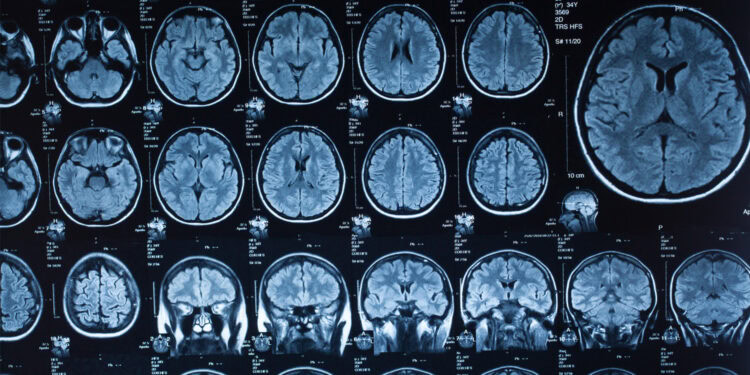
To better understand the mechanism linking biological aging to dementia, the researchers analyzed brain imaging data. Individuals with higher biological age acceleration showed widespread reductions in gray matter volume, cortical thickness, and surface area—features commonly associated with brain aging and neurodegeneration. These structural changes were themselves associated with an increased risk of dementia.
A mediation analysis provided evidence that brain atrophy may partly explain the link between accelerated biological aging and dementia risk. Specifically, reductions in gray matter volume mediated between 13% and 18% of the association, depending on the metric used. Cortical thickness and surface area also contributed to a lesser extent.
“This study provided compelling evidence linking accelerated BA [biological aging] to incident dementia. Our findings suggested that advanced BA may contribute to changes in brain structures, thereby increasing susceptibility to dementia,” the study authors concluded.
The study sheds light on the links between biological aging and dementia. However, it should be noted that the study relied on official diagnoses of dementia only and did not take into account the period between the time when participants developed dementia and when it was diagnosed. This means that at least some of the participants could already have had undiagnosed dementia at the start of the study period. Results could have been affected by this, as one of the requirements for inclusion of the analysis was that participants did not suffer from dementia at the start.
The paper, “Associations of Accelerated Biological Aging With Dementia and the Mediation Role of Brain Structure,” was authored by Yacong Bo, Liuqiao Sun, Shengsheng Hou, Fenghua Zhang, Haowen Zhang, Xueyi Feng, Sisi Zhuo, Shiyu Feng, Hui Chang, Xiaoan Zhang, Zhengbin Wang, Zengli Yu, and Xin Zhao.