Subscribe
The latest psychology and neuroscience discoveries.
My Account
  • Mental Health
  • Social Psychology
  • Cognitive Science
  • Neuroscience
  • About
No Result
View All Result
PsyPost
PsyPost
No Result
View All Result
Home Exclusive Mental Health

Neuroimaging study uncovers brain abnormalities linked to suicide attempts

by Eric W. Dolan
September 15, 2017
in Mental Health
(Photo credit: okrasyuk)

(Photo credit: okrasyuk)

Share on TwitterShare on Facebook

Neuroscience research published in The American Journal of Psychiatry has found some brain abnormalities that are associated with suicide attempts in those with bipolar disorder.

“Suicide is a major cause of death in adolescents and young adults. We studied adolescents and young adults with bipolar disorder as their risk for suicide is especially high,” explained study author Hilary Blumberg, a medical doctor and the inaugural John and Hope Furth Professor of Psychiatry at the Yale School of Medicine.

(If you are experiencing suicidal thoughts, call the National Suicide Prevention Lifeline at 1-800-273-8255 or follow this link to their online chat.)

The study used magnetic resonance imaging and diffusion tensor imaging to compare the brain structures of 26 participants with bipolar disorder who had a prior suicide attempt to 42 participants with bipolar disorder without a suicide attempt.

The researchers found differences between the two groups in the frontolimbic neural system.

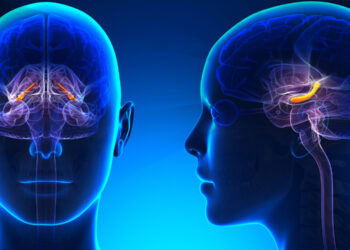
The researchers found suicide attempters had reduced gray matter volumes in certain areas of the brain, particularly the right orbitofrontal cortex and hippocampus, and bilateral cerebellum. Suicide attempters also had diminished integrity of white matter in the uncinate fasciculus, ventral frontal, and right cerebellum regions and decreased functional connectivity between the amygdala and left ventral prefrontal and right rostral prefrontal regions.

The findings suggest that brain regions associated with the processing and regulating of emotional information were impaired among the participants who had attempted suicide.

“The study is important as it identified differences in brain circuitry in adolescents and young adults with bipolar disorder who made attempts,” Blumberg told PsyPost. “This new information is key to understanding the brain differences that underlie suicide attempts, and our next step in the research is to develop new strategies to identify individuals at high risk to prevent suicide.”

Google News Preferences Add PsyPost to your preferred sources

The research helps identify brain abnormalities associated with suicide attempts, but future studies would benefit from larger sample sizes and longitudinal methodologies.

“The causes of suicide are complex,” Blumberg remarked. “Studies like this provide important pieces of the puzzle and the pieces of the puzzle are starting to come together. Researchers in the field have great momentum but there is still a lot of work to be done. I am very hopeful we will soon have new ways to prevent suicide.”

The study, “Multimodal Neuroimaging of Frontolimbic Structure and Function Associated With Suicide Attempts in Adolescents and Young Adults With Bipolar Disorder“, was also co-authored by Jennifer A.Y. Johnston, Fei Wang,Jie Liu, Benjamin N. Blond, Amanda Wallace, Jiacheng Liu, Linda Spencer, Elizabeth T. Cox Lippard, Kirstin L. Purves, Angeli Landeros-Weisenberger, Eric Hermes, Brian Pittman, Sheng Zhang, Robert King, Andrés Martin, and Maria A. Oquendo.

Previous Post

Study: Worries about modernity linked to medical conspiracy theories

Next Post

Losers are more likely to believe in conspiracy theories, study finds

RELATED

A healthy lifestyle predicts heightened sexual satisfaction nine years later
Mental Health

Moving in boosts happiness for older couples, but marriage adds no extra spark

February 19, 2026
Alcohol use disorder may exacerbate Alzheimer’s disease through shared genetic pathways
Alzheimer's Disease

Scientists discover a liver-to-brain signal that mimics exercise benefits

February 19, 2026
Brain imaging study finds large sex-differences in regions tied to mental health
Addiction

Neural signatures of impulsivity and neuroticism are largely distinct in youth

February 19, 2026
Psychologists developed a 20-minute tool to help people reframe their depression as a source of strength
ADHD Research News

Video games may offer small attention benefits for children with ADHD

February 18, 2026
Lonely individuals show reduced cardiovascular adaptability under social stress
Mental Health

Study finds a disconnect between brain activity and feelings in lonely people

February 18, 2026
Psychologists developed a 20-minute tool to help people reframe their depression as a source of strength
Psychedelic Drugs

Ibogaine appears to trigger an accelerated “auto-psychotherapy” process during PTSD treatment

February 18, 2026
Psychologists developed a 20-minute tool to help people reframe their depression as a source of strength
Depression

Psychologists developed a 20-minute tool to help people reframe their depression as a source of strength

February 18, 2026
Early adversity linked to altered hippocampal growth in children
Depression

Larger left hippocampus predicts better response to antidepressant escitalopram

February 17, 2026

STAY CONNECTED

LATEST

Viral AI agent OpenClaw highlights the psychological complexity of human-computer interaction

Moving in boosts happiness for older couples, but marriage adds no extra spark

Scientists discover a liver-to-brain signal that mimics exercise benefits

Big five personality traits predict fertility expectations across reproductive age

Neural signatures of impulsivity and neuroticism are largely distinct in youth

New psychology research reveals how repetitive thinking primes involuntary memories

The neuroscience of limerence and how to break the cycle of romantic obsession

What was Albert Einstein’s IQ?

PsyPost is a psychology and neuroscience news website dedicated to reporting the latest research on human behavior, cognition, and society. (READ MORE...)

  • Mental Health
  • Neuroimaging
  • Personality Psychology
  • Social Psychology
  • Artificial Intelligence
  • Cognitive Science
  • Psychopharmacology
  • Contact us
  • Disclaimer
  • Privacy policy
  • Terms and conditions
  • Do not sell my personal information

(c) PsyPost Media Inc

Welcome Back!

Login to your account below

Forgotten Password?

Retrieve your password

Please enter your username or email address to reset your password.

Log In

Add New Playlist

Subscribe
  • My Account
  • Cognitive Science Research
  • Mental Health Research
  • Social Psychology Research
  • Drug Research
  • Relationship Research
  • About PsyPost
  • Contact
  • Privacy Policy

(c) PsyPost Media Inc