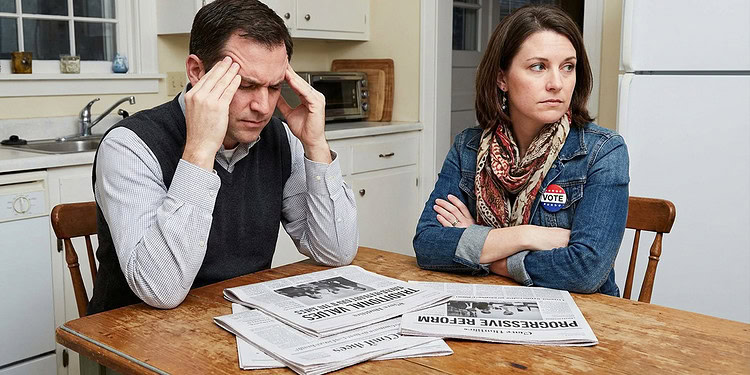
Recent research suggests that the widening political divide in the United States has begun to ripple into the private lives of romantic partners. An extensive analysis reveals that while most Americans select partners with similar political views, those who enter relationships with differing viewpoints experience a modest reduction in relationship quality. These findings were published in the Journal of Personality and Social Psychology: Interpersonal Relations and Group Processes.
The political landscape in the United States has shifted significantly over the past few decades. This change is characterized not merely by disagreement on policy issues but by a phenomenon known as affective polarization. Affective polarization involves an increasing sense of animosity and distrust toward members of an opposing political party.
Amie M. Gordon and Annika From of the University of Michigan, alongside Maria Luciani of the University of California, Berkeley, investigated the extent to which this societal friction infiltrates romantic bonds. They sought to determine the prevalence of cross-party relationships in the modern era. They also aimed to understand the consequences of political disagreement for the longevity and happiness of couples.
Historically, romantic partners have tended to share demographic characteristics and beliefs. This tendency is known in social science as assortative mating. Previous studies indicated that political similarity between spouses has increased since the 1970s.
The researchers utilized a massive pool of data to examine these dynamics. They combined information from eleven separate datasets collected between 2020 and 2022. This aggregate sample included over 4,000 individual participants.
Within this large group, the study captured data from more than 500 romantic couples. The investigators assessed political leanings through both cross-sectional surveys and longitudinal daily diaries. This approach allowed them to observe broad trends as well as daily fluctuations in relationship satisfaction.
The first major finding concerns the frequency of politically dissimilar relationships. The data showed that couples in the United States exhibit high levels of political similarity. The researchers referred to this alignment as political homophily.
Approximately 23 percent of the couples in the sample were cross-partisan, meaning they did not identify with the same political group. However, this figure includes independents and third-party affiliations. When looking strictly at the two major parties, the numbers were much lower.
Fewer than eight percent of the couples consisted of one Democrat and one Republican. This scarcity suggests that relationships spanning the primary political divide are relatively rare. Most individuals appear to screen for political alignment during the dating process.
The research team attempted to identify specific characteristics that might predispose individuals to enter these rare cross-party relationships. They examined eighteen potential correlates. These included demographic factors like age, education, and household income.
They also looked at personality traits such as openness and neuroticism. The analysis revealed very little evidence that stable individual traits predict who ends up in a politically dissimilar relationship. There was no specific “type” of person who appeared more willing to date across the aisle.
One consistent predictor did emerge from the data regarding values. Individuals who placed less importance on sharing beliefs with their partners were more likely to be in politically dissimilar relationships. This suggests that for some, prioritizing shared values is a filter that removes politically different prospects early on.
The study then turned to the question of relationship quality. The researchers analyzed whether couples with differing political views were as happy as those who agreed. They measured quality through ratings of satisfaction, closeness, and conflict.
The results showed a consistent association between perceived political dissimilarity and lower relationship quality. People who believed their partner held different views reported being slightly less satisfied. This effect remained significant even when the researchers accounted for general feelings of overall similarity.
The authors distinguished between perceived similarity and actual similarity. Perceived similarity refers to how much a person thinks they resemble their partner. Actual similarity is determined by comparing the specific political reports of both partners.
The negative association with relationship quality was strongest when looking at perceived similarity. When the researchers looked at actual differences in party affiliation, the link to lower satisfaction was weaker. It appears that feeling different from a partner matters more than checking different boxes on a survey.
However, the daily diary portion of the study revealed a more nuanced picture. For two weeks, participants reported on their relationship quality each night. In this day-to-day analysis, actual differences in political ideology did predict lower relationship quality.
This finding implies that abstract labels may matter less than the specific ideological stances partners hold. When partners sit at different points on the liberal-conservative spectrum, it creates a small but measurable drag on their daily happiness. The effect size was small, but it was statistically robust.
The researchers also sought to identify factors that might buffer couples against this friction. They hypothesized that prosocial relationship behaviors might mitigate the stress of political disagreement. They specifically examined the roles of gratitude and perspective-taking.
The data indicated that appreciation acts as a protective factor. Individuals who felt more appreciated by their partners were less affected by political differences. Similarly, those who actively tried to understand their partner’s perspective experienced less dissatisfaction.
These positive behaviors attenuated the link between dissimilarity and lower quality. They did not eliminate the effect entirely. Even among highly appreciative couples, political differences still correlated with slightly reduced satisfaction.
Another important moderator identified in the daily diary study was stress. The researchers tracked how much stress participants felt regarding politics and current events each day. The impact of political dissimilarity depended heavily on this external context.
When individuals reported feeling stressed by politics, dissimilar couples experienced lower relationship quality. In contrast, when political stress was low, cross-party couples reported satisfaction levels comparable to same-party couples. This suggests that political differences may lie dormant until external events trigger tension.
The authors also explored the concept of self-silencing. This occurs when an individual withholds their opinions to avoid conflict. Surprisingly, the study did not find that self-silencing acted as a consistent moderator of relationship quality in this context.
The study also addressed the accuracy of partners’ perceptions. Participants were generally accurate in identifying their partner’s political affiliation. There were very few instances where a person mistakenly believed their Republican partner was a Democrat, or vice versa.
The implications of these findings extend beyond the happiness of individual couples. The high rate of political homophily suggests that Americans are increasingly sorting themselves into like-minded bubbles. This extends the political echo chamber into the home.
When parents share identical political views, their children are less likely to be exposed to diverse perspectives. This intergenerational transmission of beliefs can reinforce societal polarization. Politically mixed households theoretically offer a check against this cycle.
The researchers noted some limitations to their work. The samples were drawn heavily from the United States. It is unclear if these patterns would hold in nations with multiparty systems or less polarized climates.
Additionally, the study is correlational. It cannot definitively prove that political differences cause lower satisfaction. It is possible that unhappy couples are simply more likely to focus on their differences.
The effect sizes observed in the study were generally small. Political similarity is not the primary driver of relationship success. Factors like trust, commitment, and communication style explain much more of the variance in relationship quality.
Nevertheless, the consistency of the findings across multiple datasets is notable. In a highly polarized era, politics has become a relevant factor in romantic life. It shapes who people choose to date and how they get along.
Future research could investigate specific policy disagreements. It may be that differences on moralized issues, such as reproductive rights, carry more weight than differences on tax policy. The authors also suggest looking at how these dynamics evolve over long-term marriages.
The study, “I Love You but I Hate Your Politics: The Role of Political Dissimilarity in Romantic Relationships,” was authored by Amie M. Gordon, Maria Luciani, and Annika From.