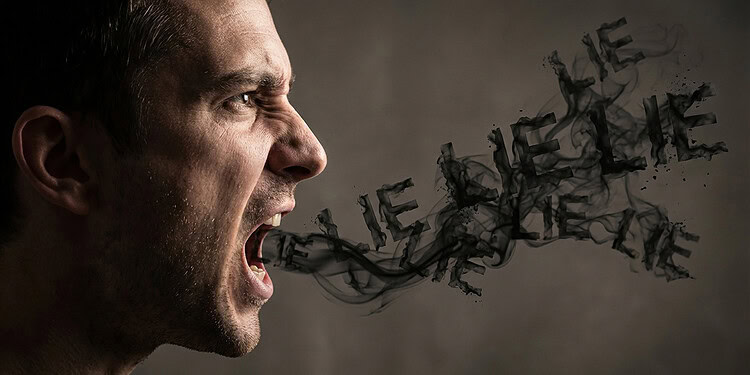

Why do some people endorse claims that can easily be disproved? It’s one thing to believe false information, but another to actively stick with something that’s obviously wrong.
Our new research, published in the Journal of Social Psychology, suggests that some people consider it a “win” to lean in to known falsehoods.
We are social psychologists who study political psychology and how people reason about reality. During the pandemic, we surveyed 5,535 people across eight countries to investigate why people believed COVID-19 misinformation, like false claims that 5G networks cause the virus.
The strongest predictor of whether someone believed in COVID-19-related misinformation and risks related to the vaccine was whether they viewed COVID-19 prevention efforts in terms of symbolic strength and weakness. In other words, this group focused on whether an action would make them appear to fend off or “give in” to untoward influence.
This factor outweighed how people felt about COVID-19 in general, their thinking style and even their political beliefs.
Our survey measured it on a scale of how much people agreed with sentences including “Following coronavirus prevention guidelines means you have backed down” and “Continuous coronavirus coverage in the media is a sign we are losing.” Our interpretation is that people who responded positively to these statements would feel they “win” by endorsing misinformation – doing so can show “the enemy” that it will not gain any ground over people’s views.
When meaning is symbolic, not factual
Rather than consider issues in light of actual facts, we suggest people with this mindset prioritize being independent from outside influence. It means you can justify espousing pretty much anything – the easier a statement is to disprove, the more of a power move it is to say it, as it symbolizes how far you’re willing to go.
When people think symbolically this way, the literal issue – here, fighting COVID-19 – is secondary to a psychological war over people’s minds. In the minds of those who think they’re engaged in them, psychological wars are waged over opinions and attitudes, and are won via control of belief and messaging. The U.S. government at various times has used the concept of psychological war to try to limit the influence of foreign powers, pushing people to think that literal battles are less important than psychological independence.
By that same token, vaccination, masking or other COVID-19 prevention efforts could be seen as a symbolic risk that could “weaken” one psychologically even if they provide literal physical benefits. If this seems like an extreme stance, it is – the majority of participants in our studies did not hold this mindset. But those who did were especially likely to also believe in misinformation.
In an additional study we ran that focused on attitudes around cryptocurrency, we measured whether people saw crypto investment in terms of signaling independence from traditional finance. These participants, who, like those in our COVID-19 study, prioritized a symbolic show of strength, were more likely to believe in other kinds of misinformation and conspiracies, too, such as that the government is concealing evidence of alien contact.
In all of our studies, this mindset was also strongly associated with authoritarian attitudes, including beliefs that some groups should dominate others and support for autocratic government. These links help explain why strongman leaders often use misinformation symbolically to impress and control a population.
Why people endorse misinformation
Our findings highlight the limits of countering misinformation directly, because for some people, literal truth is not the point.
For example, President Donald Trump incorrectly claimed in August 2025 that crime in Washington D.C. was at an all-time high, generating countless fact-checks of his premise and think pieces about his dissociation from reality.
But we believe that to someone with a symbolic mindset, debunkers merely demonstrate that they’re the ones reacting, and are therefore weak. The correct information is easily available, but is irrelevant to someone who prioritizes a symbolic show of strength. What matters is signaling one isn’t listening and won’t be swayed.
In fact, for symbolic thinkers, nearly any statement should be justifiable. The more outlandish or easily disproved something is, the more powerful one might seem when standing by it. Being an edgelord – a contrarian online provocateur – or outright lying can, in their own odd way, appear “authentic.”
Some people may also view their favorite dissembler’s claims as provocative trolling, but, given the link between this mindset and authoritarianism, they want those far-fetched claims acted on anyway. The deployment of National Guard troops to Washington, for example, can be the desired end goal, even if the offered justification is a transparent farce.
Is this really 5-D chess?
It is possible that symbolic, but not exactly true, beliefs have some downstream benefit, such as serving as negotiation tactics, loyalty tests, or a fake-it-till-you-make-it long game that somehow, eventually, becomes a reality. Political theorist Murray Edelman, known for his work on political symbolism, noted that politicians often prefer scoring symbolic points over delivering results – it’s easier. Leaders can offer symbolism when they have little tangible to provide.
This article is republished from The Conversation under a Creative Commons license. Read the original article.