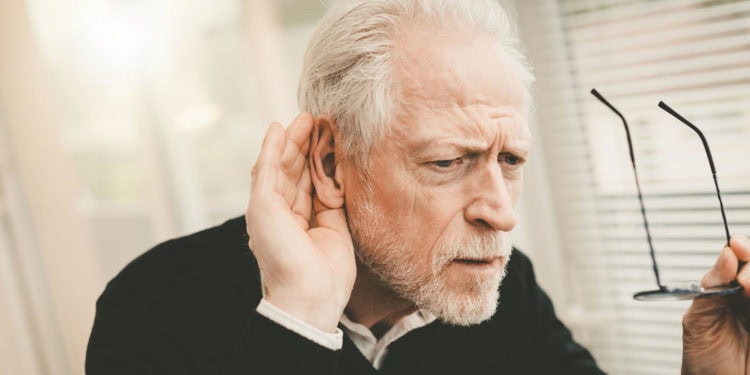
New research provides evidence that sensory and cognitive changes associated with aging can both increase listening-related fatigue and protect against such fatigue. People who experience listening-related fatigue feel worn out from everyday communications and feel the need to expend a lot of energy to listen and understand others. The new findings have been published in Psychological Science.
It is well known that aging is associated with reduced hearing sensitivity and changes in cognitive functioning. But surprisingly little is known about how these psychological variables interact with one another.
“Speech understanding is a highly complex process that continues to evolve across the human lifespan. Our brains must filter the multitude of irrelevant sounds that we encounter in our everyday lives (e.g., traffic noise, background conversations) to execute this skill successfully,” said study author Ronan McGarrigle, a lecturer in psychology at the University of Bradford.
“While these ‘backstage operations’ go largely unnoticed for many people, for others (e.g., individuals with a hearing loss), this process may come at a cost. For around a decade now, I have been interested in better understanding how to characterize and measure these costs, which often include feelings of tiredness and fatigue from listening.”
“I found it both fascinating (and, frankly, a little concerning) that we know so little about an experience that feels very intuitive and familiar to most of us, yet which can seriously impact quality of life in those most affected.”
In the study, 281 adults between the ages of 18 and 85 years completed an auditory attention task that assessed their ability to follow one speaker while simultaneously ignoring another. The participants also completed subjective assessments of listening-related fatigue, memory ability, mood states, sensory-processing sensitivity, and hearing impairment.
Older adults tended to report higher levels of hearing impairment, which in turn was associated with increased listening-related fatigue. But after controlling for perceived hearing impairment, auditory attention ability, and perceived memory ability, the researchers found that older adults actually tended to report less listening-related fatigue than younger adults. This reduction in listening-related fatigue among older adults appeared to be related to age-related reductions in mood disturbance and sensory-processing sensitivity.
The researchers also found that older adults had lower auditory attention ability compared to their younger counterparts, which was associated with less listening-related fatigue, but only for those with high sensory-processing sensitivity.
“Our hearing sensitivity and cognitive capacities fluctuate with age in a variety of ways,” McGarrigle told PsyPost. “Some of the most well-documented age-related changes include memory and hearing declines in older adulthood. However, the current study findings suggest that lower levels of mood disturbance and dampened sensitivity to environmental stimuli may help to protect us against listening-related fatigue as we age.”
The researchers excluded potential participants who suffered from health conditions that can cause fatigue and individuals with clinically significant hearing loss.
“We were interested in exploring the prevalence of listening-related fatigue in the normal healthy aging population,” McGarrigle said. “As a result, the study sample did not include individuals with a clinically-diagnosed hearing loss, who are likely among those most susceptible to listening-related fatigue. We also know relatively little about the prevalence of listening-related fatigue in other populations, including individuals with a language or cognitive deficit or those who routinely communicate in their non-native language.”
“A limitation of the current study is that it is based largely on self-report data, which means that we cannot rule out the possibility of subjective biases in participant responses. Finally, the results are correlational in nature. Future research examining causal factors underlying listening-related fatigue is warranted.”
The study, “Predictors of Listening-Related Fatigue Across the Adult Life Span“, was authored by Ronan McGarrigle, Sarah Knight, Benjamin W. Y. Hornsby, and Sven Mattys.