Subscribe
The latest psychology and neuroscience discoveries.
My Account
  • Mental Health
  • Social Psychology
  • Cognitive Science
  • Neuroscience
  • About
No Result
View All Result
PsyPost
PsyPost
No Result
View All Result
Home Exclusive Social Psychology Political Psychology Donald Trump

Perceptions of Trump’s trustworthiness became more polarized and extreme from 2016 to 2019, study finds

by Eric W. Dolan
December 19, 2020
in Donald Trump
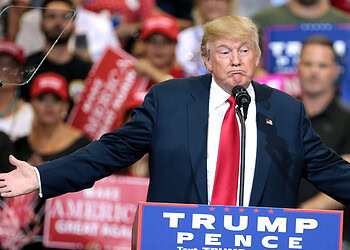
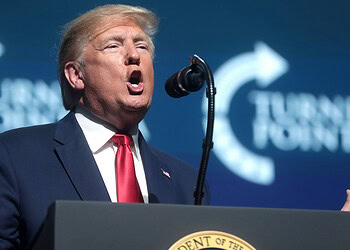
(Official White House Photo by Shealah Craighead)

(Official White House Photo by Shealah Craighead)

Share on TwitterShare on Facebook

Donald Trump was viewed as a low-trust individual as a presidential candidate and this perception did not improve overall after he entered the highest office in the United States, according to new research published in American Behavioral Scientist.

Despite the lack of an overall trend, the study did find evidence of divergent changes within specific demographic groups, suggesting an increasingly polarized population.

“As our clocks turned from one century to the next, 1999 to 2020, I worked with a number of notable communication scholars who had long been interested in the nature of ‘trust.’ We were fortunate to receive major funding to investigate the topic internationally,” explained study author Pamela S. Shockley-Zalabak, chancellor emerita at the University of Colorado – Colorado Springs.

“Our research efforts resulted in identifying five drivers of trust, put simply, five reasons why any of us trust or don’t trust one another, trust institutions, trust government, or trust our leaders. Those five underlying drivers of trust — honesty and openness, concern for others, competence, reliability, and identification — intrigued us, such that we tested their applicability and relevance in multiple countries such as Poland, Russia, and of course, the United States.”

For their new study, Shockley-Zalabak and her colleague, Sherwyn P. Morreale, examined how voter’s perceptions of Trump’s trustworthiness changed from 2016 to 2019.

The researchers commissioned two surveys in 2016, one immediately before the first presidential debate and the second immediately after the third debate, to measure trust in Trump and his rival Hillary Clinton. They conducted yet another survey in March of 2019 to assess perceptions of Trump as president. Each survey included a census-representative sample of 1,500 registered voters.

Both Clinton and Trump received relatively low trust ratings during the 2016 presidential campaign. Both candidates scored poorly on measures of perceived competence, openness and honesty, concern for others, reliability, and identification.

The situation did not improve for Trump after he became president. Although registered Republicans increased their trust in Trump from 2016 to 2019, there was no change among registered Independents and there was a decrease in trust among registered Democrats. A similar trend was observed for other demographic factors.

Google News Preferences Add PsyPost to your preferred sources

“The demographic divides evidenced in 2016 remained in 2019 and shifted to more polarized and more extreme positions. In other words, those who in 2016 had evaluated Trump most favorably increased their favorability ratings while those distrusting Trump increased in that distrust,” Shockley-Zalabak and her colleagues wrote in their study.

Shockley-Zalabaktold PsyPost that the findings highlight “how crucial it is to understand what trust is and why it’s present or not present, in relationships, communities, leaders, and government.”

The lack of trust in Trump likely had an adverse impact on his handling of the global COVID-19 pandemic and nationwide protests against racial injustice. “It is possible to conclude (and needs more study) from the 2020 crises, when a leader has low-trust entering a crisis, it will be difficult to lead the public to positive actions,” the researchers said.

“As researchers, we have worked to call attention to the profound need to rebuild trust – in one another, relationally, in our communities, in our government, and in our country. We believe the most important question, the difficult task at hand is to engage in rebuilding trust,” Shockley-Zalabaktold explained.

“Think for a moment about the polarization that exists contemporarily in the U.S., often referred to as a critical divide among U.S. citizens, based on politics and party affiliation, race and ethnicity, and so forth. Researchers, the media, and the general public need to better understand and consider how to bridge this divide,” she added.

“We are just completing a book that provides insights into the historical dimensions of this divide and offers a roadmap for rebuilding trust and collaboratively rediscovering the illusive notion of ‘one nation…'”

The study, “Voters’ Perceptions of Trust in Donald Trump in 2016 and 2019: Implications for Presidential Leadership in the Crises of 2020“, was published November 30, 2020.

Previous Post

Women overestimate men’s attraction to thin female fashion models, study finds

Next Post

Study suggests the link between disgust and interracial romance is not strong or widespread

RELATED

A single Trump tweet has been connected to a rise in arrests of white Americans
Donald Trump

Texas migrant buses boosted Donald Trump’s vote share in targeted cities

March 12, 2026
Scientists discover psychedelic drug 5-MeO-DMT induces a state of “paradoxical wake”
Business

Black employees struggle to thrive under managers perceived as Trump supporters

March 4, 2026
The power of the point: The science of Donald Trump’s gestures
Donald Trump

Donald Trump gained 2024 votes in areas where inflation was worse, study finds

February 25, 2026
What scientists found when they analyzed 187 of Donald Trump’s shrugs
Donald Trump

Donald Trump’s 2024 election win increased the social acceptability of prejudice, study suggests

February 24, 2026
Trump support in 2024 linked to White Americans’ perception of falling to the bottom of the racial hierarchy
Donald Trump

Trump support in 2024 linked to White Americans’ perception of falling to the bottom of the racial hierarchy

February 17, 2026
The psychological puzzle of Donald Trump: Eye-opening findings from 20 studies
Donald Trump

Donald Trump is fueling a surprising shift in gun culture, new research suggests

February 14, 2026
Trump’s election fraud allegations linked to temporary decline in voter turnout
Business

Trump-related search activity signals a surprising trend in the stock market

February 5, 2026
Female Trump supporters exhibit slightly elevated subclinical psychopathy, study finds
Donald Trump

New research reveals the policy recall gap that gave Donald Trump a hidden edge

January 25, 2026

STAY CONNECTED

RSS Psychology of Selling

  • Political conservatives are more drawn to baby-faced product designs, and purity values explain why
  • Free gifts with no strings attached can boost customer spending by over 30%, study finds
  • New research reveals the “Goldilocks” age for social media influencers
  • What today’s shoppers really want from salespeople, and what drives them away
  • The salesperson who competes against themselves may outperform the one trying to beat everyone else

LATEST

Can psychopaths change? New research suggests tailored treatments might work

Maternal exposure to short-chain PFAS causes persistent memory problems in adult rats

Early life stress fundamentally alters alcohol processing in the brain

Autism associated with age of maternal grandparents in new study

A common antidepressant shows promise in treating methamphetamine dependence

A smaller social network increases loneliness more drastically for those with depression

Social media analysis links polarized political language to distorted thought patterns

Genetic study unravels the link between caffeine intake and sleep timing

PsyPost is a psychology and neuroscience news website dedicated to reporting the latest research on human behavior, cognition, and society. (READ MORE...)

  • Mental Health
  • Neuroimaging
  • Personality Psychology
  • Social Psychology
  • Artificial Intelligence
  • Cognitive Science
  • Psychopharmacology
  • Contact us
  • Disclaimer
  • Privacy policy
  • Terms and conditions
  • Do not sell my personal information

(c) PsyPost Media Inc

Welcome Back!

Login to your account below

Forgotten Password?

Retrieve your password

Please enter your username or email address to reset your password.

Log In

Add New Playlist

Subscribe
  • My Account
  • Cognitive Science Research
  • Mental Health Research
  • Social Psychology Research
  • Drug Research
  • Relationship Research
  • About PsyPost
  • Contact
  • Privacy Policy

(c) PsyPost Media Inc