Political conservatism was associated with heightened susceptibility to believing fake news about COVID-19 in the early stages of the outbreak in the United States, according to new research published in Social Psychological and Personality Science. The study provides preliminary evidence that support for President Donald Trump plays a role in viewing COVID-19 as less of a personal threat and less severe in general.
“When we launched the project in early March, Dustin Calvillo (the first author) and I were talking about the discrepancy with which the threat was being viewed by different people,” said study author Abraham M. Rutchick, a professor of psychology at California State University, Northridge.
“I’d just begun a pretty strict self-quarantine, and I was struck by how varied people’s attitudes and behaviors were. Given the polarization of political leadership and politicized media, we thought this might be worth investigating.”
The researchers used Amazon’s Mechanical Turk to conduct two online studies that included 990 participants in total. The first study was conducted on March 8, while the second was conducted on March 17, just a few days after a national emergency was declared in the United States.
As part of the research, the participants were asked to view and rate the accuracy of 16 news headlines. Eight of the headlines included real information taken from USNews.com, while the remaining eight were fake headlines derived from fact-checking websites.

Rutchick and his colleagues found that those who scored higher on a measure of political conservatism tended to be less accurate at distinguishing between real and fake headlines about COVID-19. Conservatism was also associated with perceiving less personal vulnerability and rating COVID-19 as less severe. More conservative participants were also more likely to believe that COVID-19 was the result of a conspiracy and that the media had exaggerated its risks.
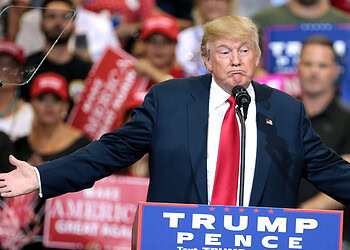
More conservative participants also tended to view President Trump’s performance more positively. Approval of Trump was in turn associated with less knowledge about COVID-19, which predicted greater susceptibility to fake news headlines.
The findings indicate that “our responses to the threat are strikingly different depending on our political beliefs. This is probably due to people taking their cues from the president (or refusing to do so), and differences in the media from which people get their news. More broadly, the study shows how hard it is to get aligned on any issue with political overtones, even when it’s a matter of public health that affects everyone,” Rutchick told PsyPost.
When it came to media consumption habits, the researchers found significant differences based on party affiliation. About 32% of Republicans and 63% of Democrats reported obtaining some of their news from CNN; 20% of Republicans and 50% of Democrats reported obtaining some of their news from The New York Times; and 51% of Republicans but only 14% of Democrats reported obtaining some of their news from Fox News.
“The more news participants got from Fox News, the less vulnerable they felt, and the more they agreed that the pandemic is a result of a conspiracy and that the media is exaggerating the threat. The more news participants got from CNN, the more severe they believed COVID-19 was, and the less they agreed that the media is exaggerating the threat,” the researchers said.
But the study — like all research — includes some limitations.
“The sampling was nonrepresentative and imperfect. And the analyses we used to examine the reasons why political ideology predicts threat perceptions – the idea that it’s via presidential approval, knowledge, and fake news discernment – is definitely a speculative one. The study was also conducted at one specific point in time – it’s a snapshot of what was going on in early March. We don’t know (from this study) much about how these processes unfold over time,” Rutchick explained.
“I’d argue that it’s essential for people to read unbiased media (and track media using things like allsides.com). We’re in a challenging age – it used to be that people would agree on what the truth was but disagree about what to do about it. Now, we can’t even agree on the truth on the ground, which is a grave threat to a functioning democracy,” he added.
The study, “Political Ideology Predicts Perceptions of the Threat of COVID-19 (and Susceptibility to Fake News About It)“, was authored by Dustin P. Calvillo, Bryan J. Ross, Ryan J. B. Garcia, Thomas J. Smelter, and Abraham M. Rutchick.