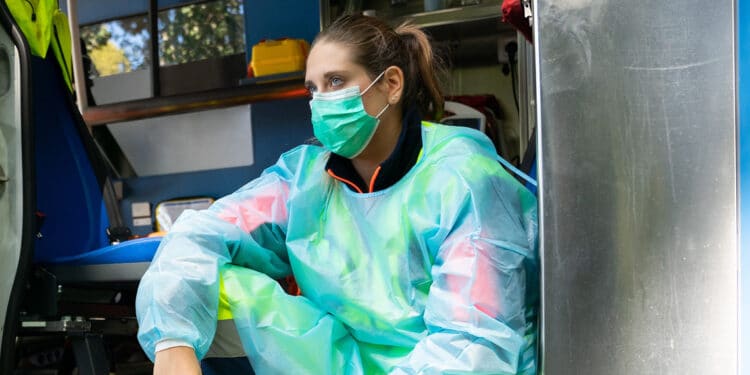

Both religious and non-religious medical students volunteered to help battle the COVID-19 pandemic in Poland, according to new research published in the Journal of Religion and Health. But the study found that altruistic motivations were more common among religious students, while egoistic motivations were more common among the non-religious.
“Our research was a part of a larger project that aims to investigate motivations and experiences of future healthcare professionals’ voluntary service during the COVID-19 pandemic in Poland,” said study author Jan Domaradzki, an assistant professor of medical sociology at the Poznan University of Medical Sciences.
“As an academic teacher working with nursing, physiotherapy or medical students I was moved and inspired that despite their worries so many of them have decided to engage in the fight against the COVID-19 outbreak. At the same time, I was wondering what were the motivations behind the students’ engagement in volunteering and what factors might have influenced their decision to volunteer.”
“The reason for this was that it is widely assumed that modernization, globalization and economic development have restructured the nature of volunteering and that volunteers’ motivations are changing as the traditional forms of volunteering (long-term, based on membership, inspired by altruistic values and the importance of social interactions and connected to religious or political communities) are being replaced by the modern type of volunteering (project-oriented, based on career development and personal growth and not rooted in a local community),” Domaradzki explained.
“Thus, I was wondering whether future healthcare professionals perceive their voluntary service as a unique vocation and moral service or as an opportunity to enhance their professional resume and spend time in a useful way.”
For their study, the researchers surveyed 417 healthcare students regarding their reactions to the pandemic and their motivations for volunteering.
“Our study shows that in the times of the COVID-19 epidemic, medical students’ involvement in volunteering has been mainly driven by altruism and the ethical imperative to serve their community, their fellow healthcare professionals and their patients,” Domaradzki told PsyPost.
“Thus, their commitment constitutes a good example of active citizenship and civic responsibility: while students were primarily motivated by the will to relieve the healthcare system, student’s engagement in volunteering reinforced such important medical values as altruism, public service and professional solidarity.”
The majority of participants (65.5%) identified themselves as Christians and approximately 34% reported being practicing believers. However, only 11.5% said that religion played a significant role in their life.
Domaradzki and his colleagues found no evidence that religion was a key predictor of students’ volunteering behavior. But whether or not religion played a significant role in their life was associated with different reactions to the pandemic and different motivations to volunteer.
Religious students were more likely than non-religious students to report fearing for their loved ones after hearing about the COVID-19 outbreak. On the other hand, non-religious students were more likely than religious students to report feeling angry, worrying that the pandemic would hurt their economic situation, and fearing the healthcare system may collapse.
“Our research shows that religion is still important driving force that influences personal decisions and choices,” Domaradzki explained. “Even though students’ religiosity was not a significant predictor of volunteering during the COVID-19 pandemic, it played a key role in determining their motivations to join the fight against the pandemic, i.e. students who felt strongly attached to their religion were motivated by pro-social reasons and altruistic values more often while non-religious students wanted to enhance their professional resume more often.”
But “even in the case of students who defined themselves as deeply religious, pure altruism was not the only motivation, as most respondents volunteered to gain skills, connections or some kind of psychological satisfaction,” the researchers noted. “Thus, it should be acknowledged that the motivations of many students were often a mixture of altruistic and egoistical drivers.”
As with all research, the new study has some limitations. All of the participants were enrolled in the Poznan University of Medical Sciences. “Thus, it would be advisable to also include other Polish universities” in future research, Domaradzki said. “Moreover, to understand better students’ motivations and lived experiences further in-depth studies using qualitative methods would be required. Especially that we did not ask specific questions regarding students’ religious attendance and beliefs.”
“I wish to thank all students in the country and around the world for their service and sacrifice,” Domaradzki added. “I believe that they have passed their most important ‘life exam’ perfectly and they give us hope that the healthcare system’s future is in good hands.”
The study, “Does Religion Influence the Motivations of Future Healthcare Professionals to Volunteer During the COVID-19 Pandemic in Poland? An Exploratory Study“, was authored by Jan Domaradzki and Dariusz Walkowiak.