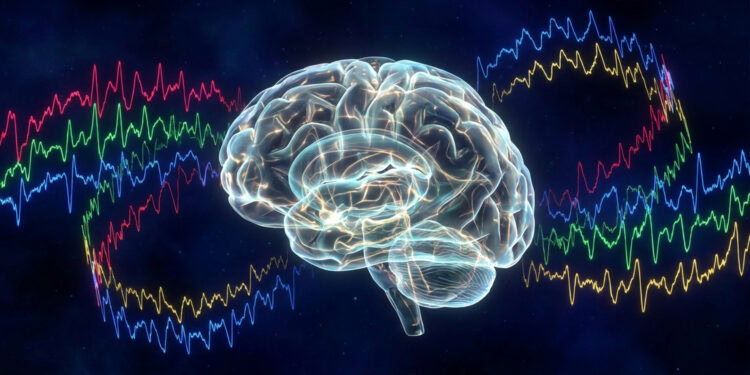

A recent study in rats suggests that during the rapid eye movement (REM) phase of sleep, the brain uses repeating chains of rapid electrical waves to organize and replay memories in a highly specific manner. These high-frequency brainwave chains appear to foster communication between different brain regions and help regulate activity in the memory centers of the brain. The research was published in eLife.
Memory consolidation is the biological process of turning fleeting recent experiences into stable long-term memories. This process heavily relies on the interaction between two major brain areas. The hippocampus is a seahorse-shaped structure deep in the brain that initially records new memories, while the prefrontal cortex is a region at the front of the brain responsible for complex thinking and long-term storage.
While scientists have long known that sharp electrical waves coordinate memory replay between the hippocampus and the cortex during deep non-REM (NREM) sleep, how REM sleep contributes to this dialogue remained murky. For instance, a 2016 study covered by PsyPost demonstrated that during deep sleep, sharp-wave ripples in the hippocampus dictate slow brainwave rhythms in the cortex to drive memory replay.
More recently, a 2024 study indicated that rapid ripples of electricity originating in the prefrontal cortex during NREM sleep actually suppress hippocampal activity. Other research, such as a 2012 study, found that REM sleep adjusts the overall excitability of hippocampal neurons.
The new study connects these threads by exploring how rapid-fire brainwave chains in the prefrontal cortex during REM sleep organize a distinct replay of memories and regulate hippocampal brain activity. The research, led by Justin D. Shin and Shantanu P. Jadhav, aimed to determine exactly how prefrontal and hippocampal dynamics differ during high-frequency electrical events across both NREM and REM sleep stages.
“Decades of research has established the role of reactivation in hippocampal and cortical regions of the brain during NREM sleep,” Jadhav, a professor in the Department of Psychology and the Volen Center for Complex Systems at Brandeis University and head of the Jadhav Lab, told PsyPost. “REM sleep stages, which are typically associated with dreaming, are known to be important for memory consolidation, but whether and how memory reactivation occurs in REM sleep is still unknown and debated.”
“The motivation for our study was to address this gap,” Jadhav explained. “We used spatial learning tasks in rodent models to investigate memory reactivation in REM sleep, and its relationship to NREM sleep reactivation, to shed light on sleep memory processes.”
To investigate this, the scientists monitored the brain activity of 10 adult rats as they learned a spatial memory task. The rats navigated a W-shaped maze to receive rewards, an activity that requires active communication between the hippocampus and the prefrontal cortex. During the learning phase and the subsequent sleep sessions, the researchers continuously tracked the animals’ brain activity.
They surgically implanted arrays of microelectrodes, known as tetrodes, into both the prefrontal cortex and the CA1 region, a major subfield of the hippocampus that serves as a primary output zone for memory signals. This allowed the team to record both the broad electrical rhythms of the brain and the firing patterns of individual neurons. Using the ratio of different brainwave frequencies, the researchers categorized the rats’ sleep into NREM and REM stages.
During NREM sleep, the prefrontal cortex produces brief, rapid bursts of electrical activity known as ripples. The researchers noticed that these NREM ripples triggered massive, synchronous bursts of firing among prefrontal neurons. During REM sleep, the researchers detected similar rapid events, which they termed high-frequency oscillations (HFOs).
Unlike the single bursts seen in NREM sleep, REM HFOs tended to occur in repeating chains. These chains repeated roughly every 130 milliseconds, a timing that perfectly aligns with a slower, steady brain rhythm called the theta wave, which is highly active during REM sleep.
The neuron firing patterns during these REM HFO chains were highly structured. Instead of the massive bursts of widespread activity seen in NREM sleep, the overall background noise of the prefrontal cortex quieted down. Against this suppressed background, specific small groups of neurons fired in sparse, sequential patterns. This indicates that the prefrontal cortex replays memories in a much more precise and orderly sequence during REM sleep.
“A particularly surprising finding was that neural reactivation in REM sleep is organized differently compared to NREM sleep,” Jadhav said. “REM reactivation was sparse, involving smaller specific subsets of neurons in cortical regions, and temporally extended, lasting on the order of ~1 second. In contrast, NREM reactivation occurs in bursts of activity lasting ~100 msec.”
During these REM HFO chains, the prefrontal cortex and the hippocampus showed increased synchronization in the theta frequency range. The REM HFO chains also engaged a specific subset of neurons in the hippocampus. Interestingly, these were the exact same hippocampal neurons that were most strongly silenced during the prefrontal ripples of NREM sleep.
By tracking these specific hippocampal neurons over time, the researchers observed that they gradually increased their baseline firing rates across the sleep session. This provides evidence that the alternating stages of NREM and REM sleep work together to adjust and tune the excitability of memory circuits. The findings are in line with research covered by PsyPost in 2025, which similarly found that memory consolidation during REM sleep relies on sparse, highly coordinated neural replay, though that study focused on fear memory rather than spatial learning.
“Our results show clear qualitative as well as quantitative differences in memory reactivation patterns in REM vs. NREM sleep in cortical-hippocampal regions,” Jadhav noted. “These findings suggest new mechanisms for how the two major sleep stages, NREM and REM sleep, together reactivate memories of daily experiences for selectively storing and integrating long-term memories.”
To better understand the biological mechanics driving these differences, the researchers built a computational model of the brain network. They focused on acetylcholine, a neurotransmitter that is highly concentrated in the brain during REM sleep but practically absent during NREM sleep.
“The study also included a modeling component, in which we were able to replicate the experimental results of distinct reactivation patterns in REM and NREM sleep using a model cortical network, based on known differences in the amount of a specific neuromodulator called acetylcholine,” Jadhav explained.
When the model simulated the low acetylcholine levels of NREM sleep, a small input triggered widespread, explosive bursts of neural activity. But when the model simulated the high acetylcholine levels of REM sleep, the network became more restrained. The high acetylcholine limited the spread of activity, perfectly recreating the sparse, sequential firing seen during the actual REM HFO chains.
There are a few things to keep in mind regarding this study. The researchers could not directly link these REM-specific memory replay events to behavioral improvements on the spatial task. Future studies using tasks known to heavily depend on REM sleep might be necessary to map these brainwaves directly to learning outcomes.
“Our study provides phenomenological evidence for distinct physiological signatures of reactivation in REM and NREM sleep, but we have yet to show a direct link between this novel form of REM reactivation and memory consolidation,” Jadhav clarified.
Moving forward, the research team aims to test this direct link. “A major long-term goal is to establish that this REM reactivation process is required for memory consolidation, and dissect the complementary roles of REM and NREM sleep reactivation in long-term memory storage,” Jadhav stated. “Indeed, how these two sleep stages work together to mediate memory consolidation is a major outstanding question in the field.”
Additionally, the researchers could not perfectly separate REM sleep into its more granular sub-stages, known as tonic and phasic REM, because they did not record the rats’ eye movements. The data was also collected over a few hours rather than a full 24-hour cycle, which means the study did not capture how these sleep dynamics might shift over a full day and night.
“A second major line of research is to investigate the role of neuromodulators, chemicals in the brain which are largely responsible for the vastly different activity signatures seen in REM and NREM sleep,” Jadhav added.
The study, “REM sleep prefrontal high-frequency oscillation chains mediate distinct cortical – hippocampal reactivation patterns compared to NREM sleep,” was authored by Justin D. Shin, Michael Satchell, Paul Miller, and Shantanu P. Jadhav.