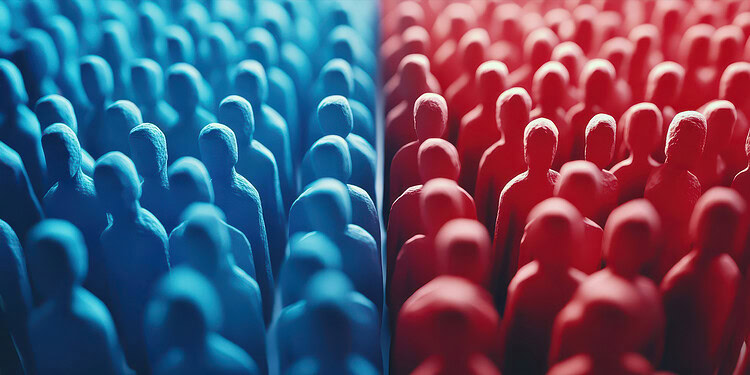

What do immigration, inheritance taxation and cannabis legalisation have in common? Not much, actually. Yet if we know somebody’s stance on one of these issues, we can make a good guess about their view on the others.
Politics often seems to work in one dimension: parties and politicians are located on a spectrum stretching from from far left to far right. Knowing someone’s opinion on a single wedge issue is often enough to place them on this ideological dimension, which in turn makes it possible to predict their positions on other issues. And in countries such as the US we’ve seen more and more people polarised into opposing political camps at either end of this spectrum.
One-dimensional politics can seem as natural to us as an apple falling from a tree – it’s simply how we think about politics. But just like gravity, the mysterious force shaping our politics in this way does warrant a scientific explanation.
My colleagues and I wanted to understand how people end up so profoundly divided, and the study we published earlier this year proposes a model for how it might work. It suggests the less we are able to separate politics from personal relations, the more polarised we become.
This is more than just an academic matter. If politics is reduced to a single ideological dimension it can keep us from finding innovative solutions to our most urgent problems.
If, for example, the best solution to a housing crisis were a combination of deregulation and public investment, it might not be possible to enact if each half of the solution were rejected by one side of the political spectrum. That makes understanding how politics can become so polarised important on a very practical level.
The problem is that, no matter how far we look into the past, we overwhelmingly find politics organised along one main dimension of ideological conflict: before left v right, it was Catholics v Protestants, Roundheads v Cavaliers, all the way back to Optimates v Populares in ancient Rome.
The issues may have changed, but the basic dichotomy has remained stable. This makes it very difficult to investigate the origins of one-dimensional politics. After all, we can’t experiment with whole societies – at least not in real life.
Simulating societies
To overcome this limitation, we decided to opt for an unusual approach. We created virtual societies, each populated by a multitude of simulated people, known as agents.
Each agent had a variety of opinions, represented as coordinates in a space with several dimensions. We didn’t give specific meanings to the coordinates or the dimensions, but you can think of them as representing disconnected issues like defence spending, railway nationalisation or abortion rights.
At the start of each simulation, the agents’ positions were purely random and not organised along a single ideological dimension of left versus right. But over time, the agents interacted and influenced each other, organising themselves into new collective states.
These simulated societies therefore provided us with a testbed for different theories used in political science, such as the assumption that people are rational, to see whether they could explain one-dimensional politics and the emergence of political polarisation.
To do this, we translated these theories into computational protocols that governed the agents’ interactions and the way they adapted their opinions. We then checked whether these protocols were enough to trigger the emergence of a single ideological dimension.
Initially, we modelled our agents as rational decision makers in the tradition of mainstream political science. When encountering other agents, they would either meet them halfway, or reject them, But either way, this did not give rise to a single ideological dimension. Agents would either converge on a consensus or remain scattered.
However, politics isn’t a purely rational affair. It’s often characterised by gut feelings and anger. But political science hasn’t always been successful in integrating emotion into decision-making models. So for inspiration we looked to one of the founders of social psychology.
In the 1950s, Austrian-born psychologist Fritz Heider coined the term cognitive balance theory, which claims that people strive for consistency in their mental patterns. For example, we find it disconcerting when two of our friends hate each other, or a friend is in love with someone we despise. Similarly, we try to avoid disagreeing with people we like just as much as we avoid agreeing with people we dislike.
We translated this balance mechanism into our simulation. When two of our agents encountered each other, they first determined how much they agreed or disagreed on various political issues. Then, they translated agreement into sympathy and disagreement into dislike. Finally, they adjusted their issue positions in a way that increased consistency.
If they met someone with whom they mostly agreed, they adjusted their opinions to defuse the remaining disagreements. In the opposite case, they tried to make their disagreement stronger.
All this happened in tiny increments every time agents met. But through a myriad of interactions, agents finally self-organised into single ideological dimensions – no matter how many issue dimensions we started the simulation with.
Where exactly individual agents ended up on this ideological continuum depended on one crucial factor: the strength of the connection between disagreement on issues and personal dislike.
If this connection is weak – meaning agents could dislike each other but still agree, or like each other and disagree – agents remained close to the centre. If it was strong, the simulated society broke into two opposed camps – it became polarised.
This suggests polarisation is linked to people’s ability to connect to others on a personal level. When we lose sight of the fact that those we disagree with are usually decent human beings with good intentions, we may find ourselves diverging more and more on political issues, with less room for compromise.
This is notable at a time when so much political debate is conducted online through impersonal or anonymous social media accounts. The real world is much more complex than a one-dimensional view of politics would suggest. And people are much more than the political views they share online.
In the end, we will never be able to eliminate the force of cognitive balance – just as we can’t get rid of gravity. But we can find ways to increase the personal connection between people who hold different political views.
This article is republished from The Conversation under a Creative Commons license. Read the original article.