
A new paper published in the journal Current Biology suggests that the complex paired eyes of humans and other vertebrates evolved from a single, central eye located on the top of an ancient ancestor’s head. The authors propose that the light-sensing tissue inside our eyes predates the eyes themselves, with remnants of this original visual system still functioning deep inside the human brain. This research provides evidence for a radically different evolutionary path for vertebrate vision compared to the rest of the animal kingdom.
The eyes of animals generally rely on two distinct types of light-detecting cells, known as photoreceptors. Animals with bilateral symmetry, meaning their bodies have distinct left and right halves, typically feature both groups of these cells. The first group is called rhabdomeric photoreceptors. These cells traditionally make up the paired eyes on the sides of an invertebrate animal’s head and are used for visual navigation and image processing.
The second group is called ciliary photoreceptors. These cells are usually found deeper in the brain or in a single spot on top of the head. Rather than forming images, they help the animal regulate daily biological rhythms and track ambient light levels. Insects, crabs, and octopuses all follow this standard biological blueprint.
Vertebrates, a group that includes humans, birds, reptiles, and fish, break this evolutionary rule completely. The human eye uses ciliary cells to capture light, but then passes those signals to neurons with rhabdomeric characteristics to process the resulting image. This unique blending of two different cellular systems does not appear anywhere else in nature.
The scientific community has lacked a comprehensive explanation for how human eyes acquired this unusual hybrid structure. “What is the original solution to vision, and to what extent have different species just copied or modified it to make it their own?” Thomas Baden, a neuroscientist at the University of Sussex and study co-author, told BBC Science Focus. “What really are the patterns? As you do this over time, you start to wonder, what is the original eye?”
To solve this evolutionary puzzle, scientists analyzed the placement and function of light-sensing cells across 36 major animal groups. They mapped out the evolutionary timeline and identified a pattern pointing to an ancient, worm-like ancestor that lived approximately 600 million years ago. This tiny creature likely had both paired lateral eyes on the sides of its head and a central median eye on top.
“We don’t know whether the paired eyes in our branch of the evolutionary tree were just light-sensitive cells or simple image-forming eyes. We only know that the organism later lost them,” Dan-Eric Nilsson, professor emeritus in sensory biology at Lund University, said in a press release.
The authors hypothesize that the ancestors of vertebrates eventually adopted a highly sedentary lifestyle. They began to burrow into the sediment on the ocean floor to filter food particles from the water. In this scenario, because they were no longer swimming around, maintaining complex paired eyes for navigation became an unnecessary biological expense.
As a result, the researchers suggest the side eyes vanished over time. The only visual system that remained was the single patch of light-detecting cells on top of the head. “The need to know what time of day it is, or where is up and down if you’re in deep water. That doesn’t go away,” Baden said. “So, we speculate that that’s when we lost the original side eyes, but we kept the original median eye, because that’s what it’s good for.”
According to the paper, millions of years later, these creatures abandoned their burrows and returned to swimming in the open water. Navigating the ocean required complex vision once again. Because the animal had already lost its lateral eyes, the researchers propose that evolution repurposed the only available light-sensing equipment it had left.
The model suggests the single median eye gradually became more complex, forming cup-like extensions that could detect the direction of incoming light. These cups eventually split and migrated to the sides of the head. This migration would have formed the new paired eyes that all vertebrates use today.
“Now we finally understand why the eyes of vertebrates differ so radically from the eyes of all other animal groups, such as insects and squid. The film of our eyes – the retina – developed from the brain, whereas the eyes of insects and squid originate in the skin on the sides of the head,” Nilsson said.
The researchers argue that this evolutionary detour explains the strange cellular makeup of the human eye. The original median eye is thought to have been a mixed system containing both ciliary and rhabdomeric cells. When it split to form our modern eyes, it likely took this hybrid circuitry with it, creating a multilayered retina.
“For the first time, we now also understand the origin of the neural circuits that analyze the image in our retina,” Nilsson added. A vital connecting piece in this new system was the bipolar cell. Bipolar cells act as a structural bridge between the two ancient photoreceptor types.
The authors suggest that this retinal complexity developed long before the eye itself fully formed on the sides of the head, and that bipolar cells themselves have two distinct evolutionary origins. “The thing on top of the head originally is not one eye; it’s more like a series of sensors, multiple patches of photoreceptors,” Baden explained. Because of this, “the retina predates the eye, if that makes sense. I always thought that was a cute tagline.”
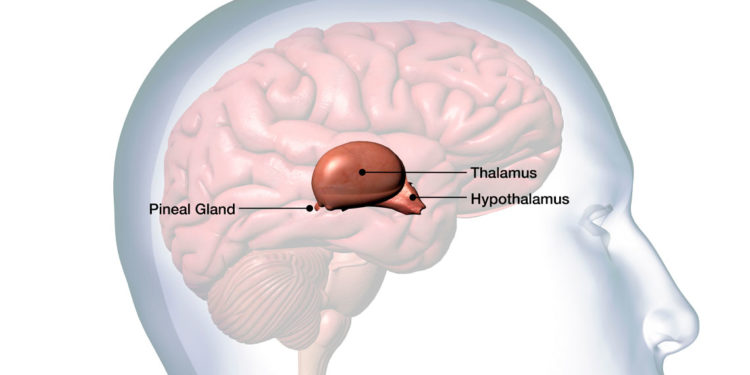
The authors propose that the original median eye never entirely disappeared. Instead, it persists today as the pineal gland, a small organ buried deep within the human brain. While it no longer detects light directly in mammals, the pineal gland still uses light signals relayed from our eyes to produce melatonin and regulate sleep cycles.
In some modern animals, this ancestral third eye structure is still visible. The tuatara, a lizard-like reptile from New Zealand, actually has a functioning third eye on the top of its head, complete with a lens and retina. In fish, the pineal gland remains a simpler organ that can directly detect light passing through the skull.
“It’s mind-boggling that our pineal gland’s ability to regulate our sleep according to light stems from the cyclopean median eye of a distant ancestor 600 million years ago,” Nilsson said. “The results are a surprise. They turn our understanding of the evolution of the eye and the brain upside down.”
While this study presents a detailed hypothesis regarding vertebrate visual evolution, it relies heavily on comparing the cellular and genetic traits of modern animals to reconstruct ancient history. The fossil record from half a billion years ago is sparse, meaning scientists cannot directly observe the exact sequence of structural changes in the soft tissues of these extinct ancestors.
The researchers note that it is difficult to cleanly categorize all modern retinal cells into strict evolutionary lineages. Over millions of years, some of these cells appear to have blended traits from both ancient groups, a process known as chimerization. This blending makes it challenging to trace the exact origins of every single neural circuit in the modern human eye.
Future research will likely focus on gathering more genetic data from a wider variety of animals to test these hypotheses. Scientists hope to use advanced mapping techniques to compare the microscopic structures of the pineal gland with those of the retina in greater detail.
“The central testable bits that we’ve put forward – I think with some funding and a few years – you can get a yes-no answer,” Baden said. By studying the genetic profiles of simpler marine animals, researchers aim to determine if these early light-sensing systems first integrated and eventually split to give us the vision we rely on today.
The study, “Evolution of the vertebrate retina by repurposing of a composite ancestral median eye,” was authored by George Kafetzis, Michael J. Bok, Tom Baden, and Dan-Eric Nilsson.