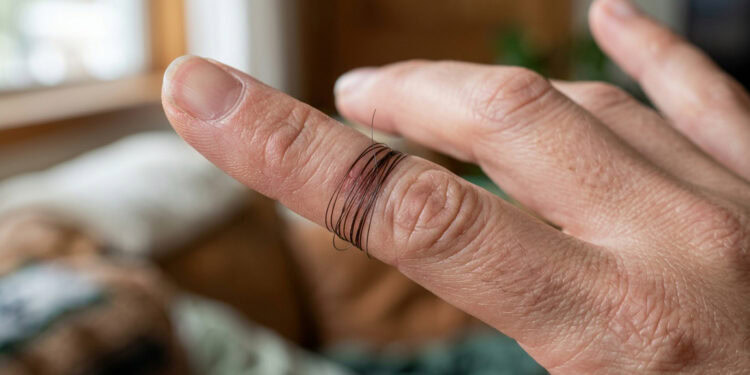

Two recent case reports and a review article published in the journals Cureus, Frontiers in Surgery, and Medical Reports summarize the severe physical and psychological dimensions of hair-thread tourniquet syndrome. These scientific papers indicate that underlying behavioral conditions often increase the risk of stray hairs cutting off blood circulation to body parts. The findings suggest that increased awareness of both the mental and physical aspects of this injury provides evidence for the importance of quick medical intervention.
According to a comprehensive review authored by Amr Y. Arkoubi and Sajad Ahmad Salati, hair-thread tourniquet syndrome happens when a bodily appendage becomes tightly constricted by a wrapped piece of hair or thread. This constriction cuts off the local blood supply, which tends to cause intense pain, severe swelling, and eventually tissue death. The review authors explain that human hair stretches when wet and shrinks as it dries, acting like a sharp rubber band that slices into the patient’s skin.
While this condition frequently affects sleeping infants accidentally, Arkoubi and Salati point out that a variety of psychiatric and behavioral factors heavily influence the risk of occurrence. The review authors indicate that conditions causing cognitive impairment, such as dementia and Alzheimer’s disease, predispose elderly patients to these strangulation injuries. In these instances, the authors note that the patients may lack the cognitive ability to recognize or communicate their physical distress.
Behavioral and developmental conditions also play a significant role in pediatric populations. Arkoubi and Salati explain that children with autism might engage in repetitive physical movements that increase the chances of getting tangled in loose threads found in socks or mittens. The review authors also highlight that gratification disorder, a behavioral condition involving repetitive self-stimulation, tends to be a leading factor for genital hair tourniquets in young children.
In their review, Arkoubi and Salati connect the syndrome to Sigmund Freud’s phallic phase of psychosexual development, noting that children between four and eleven years old tend to experience genital tourniquets caused by clothing threads rather than maternal hair. For adult populations, the authors suggest that genital tourniquets might be intentionally self-inflicted to enhance sexual experiences or to manage psychological distress related to bedwetting.
Another prominent psychological dimension involves intentional child abuse and systemic neglect. Arkoubi and Salati report that the presence of multiple tight knots, the involvement of several body parts, or a history of parental neglect provides evidence of non-accidental injury. The authors point out that certain cultural beliefs, such as the practice of wrapping hair around a child’s appendages to ward off evil spirits, also contribute to the prevalence of the syndrome.
The first case report was authored by scientists Alaa A. Alshurafa and Khaled Alshawwa. They detailed an unusual presentation of hair-thread tourniquet syndrome affecting the nipple of a 52-year-old woman in Gaza.
According to Alshurafa and Alshawwa, the patient visited a primary healthcare clinic after experiencing two days of swelling and discoloration in her left breast. She had noticed a piece of hair wrapped tightly around the area and had managed to remove it herself. Even after removing the visible hair, the patient’s symptoms continued to worsen over the following days, the authors report.
The scientists explain that due to evacuation orders related to the ongoing war in Gaza, the patient could not access a surgical clinic immediately. Alshurafa and Alshawwa report that by the time she saw a surgeon, the lack of blood flow had caused her nipple to undergo autoamputation, a medical process where dead tissue spontaneously detaches and falls off. During the examination, the surgeon discovered that a microscopic remnant of the original hair thread was still constricting the dying tissue, according to the case report.
Alshurafa and Alshawwa emphasize the psychological aspects of this unusual case, noting that medical professionals must consider underlying behavioral conditions when adults present with this syndrome. The authors suggest that trichotillomania, a psychiatric disorder where people compulsively pull out their own hair, provides a possible explanation for an abundance of loose hair in a patient’s environment. The scientists note that repeated self-attempted hair removal might indicate an underlying behavioral pattern that requires psychological evaluation.
The second case report was authored by researchers Sikandar Ajmal Abbasi, Muhammad Usama bin Shabbir, Muhammad Soban Bin Salman Meer, and Awab-ur-Rehman. They documented a rare instance of the syndrome affecting the reproductive organs of a 12-year-old boy.
According to Abbasi and colleagues, the young patient arrived at a pediatric clinic experiencing worsening genital pain and physical discomfort. Four days earlier, his parents had discovered a tuft of hair wrapped tightly around the head of his penis and had managed to remove it. The authors note that the pressure from the tightened hair had sliced directly into his underlying urinary tract, creating an unintended opening through which he was urinating.
Abbasi and colleagues evaluated the situation for psychosocial factors, specifically working to rule out the possibility of child abuse. The researchers determined that the parents’ account matched the physical findings, providing evidence that the injury was accidental rather than intentionally inflicted. The authors note that circumcised males tend to be more vulnerable to this condition because they lack protective skin, making accidental entanglement more likely.
The medical team thoroughly cleaned the area and prescribed topical antibiotics to prevent secondary bacterial infections, according to the case report. Abbasi and colleagues report that after six months, the affected area had healed completely without any permanent complications. The authors suggest that this positive outcome provides evidence that early recognition and medical intervention can prevent devastating tissue loss.
While these case reports provide specific insights into rare medical and psychological events, Arkoubi and Salati explain that this type of scientific literature comes with built-in limitations. A case report only observes a single patient, meaning the specific psychiatric and physical findings cannot easily be generalized to the broader public. According to the scientific standards discussed across these papers, single observations lack comparison groups and cannot definitively prove cause and effect in human behavior.
The authors also note that clinical assessments rely heavily on patient or caregiver recall, which tends to be incomplete or influenced by psychological stress. Without broader epidemiological studies, it remains difficult to track exactly how often psychiatric disorders directly cause hair-thread tourniquets. The lack of standardized psychological testing in emergency settings means that underlying mental health conditions might go completely undocumented.
Despite these constraints, case reports and literature reviews offer essential insights into unusual medical phenomena that bridge the gap between physical injury and mental health. By documenting the intersection of physical trauma and psychological behaviors, these scientists help doctors recognize atypical presentations of known diseases. These papers assist medical professionals in generating new hypotheses and improving patient care in high-stress emergency settings.
The paper, “Hair-Thread Tourniquet Syndrome: A Comprehensive Review,” was authored by Amr Y. Arkoubi and Sajad Ahmad Salati.
The paper, “Hair tourniquet syndrome leading to nipple autoamputation in an adult female: a case report,” was authored by Alaa A. Alshurafa and Khaled Alshawwa.
The paper, “Hair-thread tourniquet syndrome,” was authored by Sikandar Ajmal Abbasi, Muhammad Usama bin Shabbir, Muhammad Soban Bin Salman Meer, and Awab-ur-Rehman.