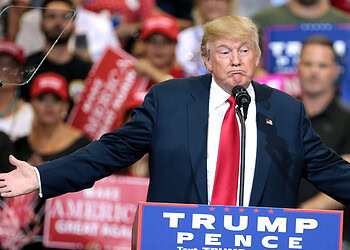
If you want to predict which political party someone will support, take note of the person’s height.
The taller a person is, the more likely he or she is to support conservative political positions, support a conservative party and actually vote for conservative politicians, according to a new study using data from Britain.
“If you take two people with nearly identical characteristics – except one is taller than the other – on average the taller person will be more politically conservative,” said Sara Watson, co-author of the study and assistant professor of political science at The Ohio State University.
The researchers found that a one-inch increase in height increased support for the Conservative Party by 0.6 percent and the likelihood of voting for the party by 0.5 percent.
The results aren’t as strange as they might appear, Watson said. Many studies have found that taller people generally earn more income than do shorter people and researchers have thought income could be linked to voting.
Watson said they conducted this study because, while political scientists have long theorized about an income-voting relationship, studies using real-world data have shown mixed results. Some researchers find a link, while others see little or no effect.
“We were thinking about why there were so many seemingly contradictory findings. One reason might be that income fluctuates from year to year, so that a relationship between your overall economic well-being and your political beliefs can be hard to uncover,” she said.
“That’s why we decided to see if height might be a good way to assess the link between income and voting.”
Researchers in anthropology and economics have long used height as a measure of economic well-being, especially among historical populations for which we have little or no income data.
Watson added that a number of recent studies have extended this work and have found that across modern labor markets, taller people get paid more.
“I’ve always been struck by this research because I am 5 feet tall and I’m typically the shortest person in the room,” she said with a laugh. “It seemed unfair that shorter people seem to pay a penalty in the labor market.”
Watson conducted the study with Raj Arunachalam, senior economist at Bates White, LLC. Their article is published online in the British Journal of Political Science.
The researchers used data from the 2006 British Household Panel Study, a survey which includes self-reported height, detailed income data and a number of questions about political beliefs for just over 9,700 adults.
They found that taller people were not only more likely to support the Conservative Party and vote for Conservative candidates, but also were more likely to support conservative positions. For example, taller people are less likely to support the statement that major public services and industries ought to be in state ownership, or that the government ought to place an upper limit on earnings.
The findings stood up even after the researchers performed more detailed analyses to investigate whether the effect of height on political beliefs could be explained through other channels, including race, years of schooling, marital status and religion.
“It was important to us to figure out if the effect of height on voting could be explained by factors that have nothing to do with income,” Watson said.
The researchers also took into account potential explanations such as such as cognition and utilization of public health care. But no matter what they controlled for, the link between height and voting remained.
“It was a robust finding,” Watson said.
The authors discovered that the link between height and political views occurred in both men and women, but was roughly twice as strong for men. For men, each additional inch of height generates a 0.8 percent increase in the likelihood of Conservative support, whereas for women the effect is 0.4 percent. However, Watson cautioned that results on gender differences were not statistically significant.
Because the data used by the researchers follows households over time, they were able to examine whether the effect of a person’s height varied depending on the year in question.
“There was some year-to-year variation, but the effect never disappeared,” said Watson.
In a second part of the study, the researchers used height in what is called an “instrumental variable” strategy, to assess the relationship between income and voting.
“Height is useful in this context because it predicts income well,” Watson explained. “Because we only expect height to affect political behavior through income, we can use it to investigate the effect of income on voting.”
The authors found that each additional inch in height was associated with about 350 pounds of income (approximately $665 at the time of the survey), and that a ten percent increase in income increased the likelihood of voting Conservative by about 5.5 percent.
Watson said it was beyond the scope of this study to examine why height is related to income. Some researchers have pointed to discrimination in favor of tall people, while others emphasize self-confidence or cognitive advantages.
Watson emphasized that a lot of factors affect a person’s political views and not just income – or height.
“Income and height play a role, but they are not political destiny,” she said.