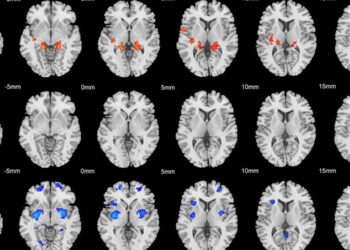
A study of infants during their first year of life found that those coming from households where parents felt their income was inadequate to support the family’s needs tended to show delayed brain development. More specifically, on EEG, these children tended to show slower rates of change in alpha peak frequency, alpha power, and beta power. The paper was published in PNAS.
During the first year of life, a baby’s brain grows faster than at almost any other time. This period lays the groundwork for how a child will think, feel, and relate to others in the future. Although most brain cells are already present at birth, the connections between them increase at an astonishing rate.
In the early months, the brain forms millions of new connections every second, helping the baby learn from sights, sounds, and touch. The brain also begins to insulate its nerve pathways (myelination), which allows messages to travel more quickly and efficiently.
As babies see faces, hear voices, and experience movement, their sensory systems become more refined. Loving and responsive caregiving plays an important role in shaping the parts of the brain involved in emotions and relationships. Even though areas responsible for planning and self-control are still immature, the foundations for these abilities begin to form.
During this time, the brain is especially flexible and responsive to experience. Positive experiences, such as talking, cuddling, and play, strengthen healthy brain development, while severe stress or neglect can interfere with it.
Study co-first authors Haerin Chung and Carol L. Wilkinson, along with their colleagues, wanted to identify the psychosocial factors most strongly associated with altered early trajectories of brain activity during the first year after birth within a group of infants facing high rates of adversity. Because financial strain and psychological stress are often tangled together, the team used a novel network-based approach to examine how multiple family conditions interact, rather than examining risk factors one by one. They utilized data from an ongoing longitudinal study called Baby Steps, which uses electroencephalographic (EEG) recordings of infants’ brain activity.
They analyzed data from 293 infants recruited at the Boston Children’s Hospital Primary Care Clinic. While the broader Baby Steps study follows these infants until 2 years of age, the current research focused on data collected during their first year. The sample faced significant economic hardship: 28% of infants came from households with less than $2,100 in monthly income, and 58% came from families with a household income of up to $4,400 per month. Demographically, 155 of the infants were boys, 39% were Black, and 60% were Hispanic or Latino. English was the primary language in 57% of the infants’ families.
When the infants were 4, 9, and 12 months old, researchers completed 5-minute resting-state EEG recordings of their brain activity. Infants’ parents completed surveys, and researchers reviewed the infants’ medical records. The parent surveys asked about demographic and raw income information, as well as a crucial subjective question: whether they felt their household income was sufficient to meet their family’s needs.
The surveys also gathered information on recent stressful life events (the Recent Life Events Questionnaire), maternal appraisal of stress (the Perceived Stress Scale), depression symptoms (the Edinburgh Postnatal Depression Scale), and an assessment of neighborhood opportunity levels. The neighborhood assessment evaluated education opportunities, health and environment (e.g., the availability of healthy food and green spaces), and economic opportunities (poverty and homeownership rates).
Using their network-based analysis, the researchers found that income sufficiency acted as a central “hub” linking various stressors. Results showed that mothers who reported their income was not sufficient to meet their needs were more likely to have lower educational attainment, report lower actual income, experience higher levels of stress, and face more adverse life events.
Controlling for these interconnected variables, income insufficiency was uniquely associated with delayed brain development in the infants. More specifically, infants developing in households where parents felt their income was inadequate to support the family’s needs exhibited slower rates of change in alpha peak frequency, alpha power, and beta power.
Alpha peak frequency is the dominant rhythm within the alpha frequency band of brain activity. It typically increases during the first year of life, reflecting the maturation of cortical networks and improving neural connectivity. Alpha and beta power represent the strength of neural oscillations in their respective frequency ranges.
Developmental increases or reorganizations in these measures are generally interpreted as markers of synaptic growth, myelination, and the increasing functional organization of the infant brain. Therefore, slower rates of change in these indicators point to slower or delayed brain development.
“Together, these findings provide a framework of understanding and visualizing how early adversity impacts neurodevelopment and provides evidence for the potential utility of maternal income sufficiency as an additional screening tool to accelerate identification of populations most vulnerable and in need for early intervention,” the study authors concluded.
This study contributes significantly to the scientific understanding of how multifaceted stress affects infant brain development. However, it should be noted that the study’s observational design does not allow for definitive causal inferences. While it is highly possible that income insufficiency leads to delayed brain development in infants, it is also possible that other unmeasured factors (such as biological or environmental variables) affect both family income and the pace of an infant’s brain development.
The paper, “Income insufficiency impacts early brain development in infants facing increased psychosocial adversity: A network-based approach,” was authored by Haerin Chung, Carol L. Wilkinson, Asher Liu, Alex Job Said, Brianna Francis, Gabriela Cañaveral, Kathleen Conroy, Helen Tager-Flusberg, and Charles A. Nelson.