Subscribe
The latest psychology and neuroscience discoveries.
My Account
  • Mental Health
  • Social Psychology
  • Cognitive Science
  • Neuroscience
  • About
No Result
View All Result
PsyPost
PsyPost
No Result
View All Result
Home Exclusive Mental Health

Study ‘opens gate’ to understanding depression

by Michigan State University
December 1, 2015
in Mental Health
Photo credit: Daniel Oines

Photo credit: Daniel Oines

Share on TwitterShare on Facebook

A new scientific model that incorporates the myriad drivers of depression could lead to more precise treatment for an illness that affects 350 million worldwide.

Developed by scientists at Michigan State University and Massachusetts Institute of Technology, and funded by the National Institute of Mental Health, the model provides a better understanding of depression and the foundation for creating a pioneering tool to attack the complex disorder.

A paper outlining the research team’s findings is published online in the journal Psychological Medicine.

“Clinicians who treat depression tend to work on a trial-and-error basis, whereas this model could give them a more systematic and effective method for making decisions about treatment,” said Andrea K. Wittenborn, associate professor in MSU’s Department of Human Development and Family Studies and lead investigator on the study. “Most importantly, this model provides a method for personalizing treatment to each unique patient.”

Depression is likely caused by multiple biological, psychological, social and environmental drivers, and these factors often overlap, such as cortisol hormone levels going up in response to stress from troubled relationships or economic hardship. Yet most previous research on depression focused on only one or two factors, and not how the many factors intersect and unfold over time.

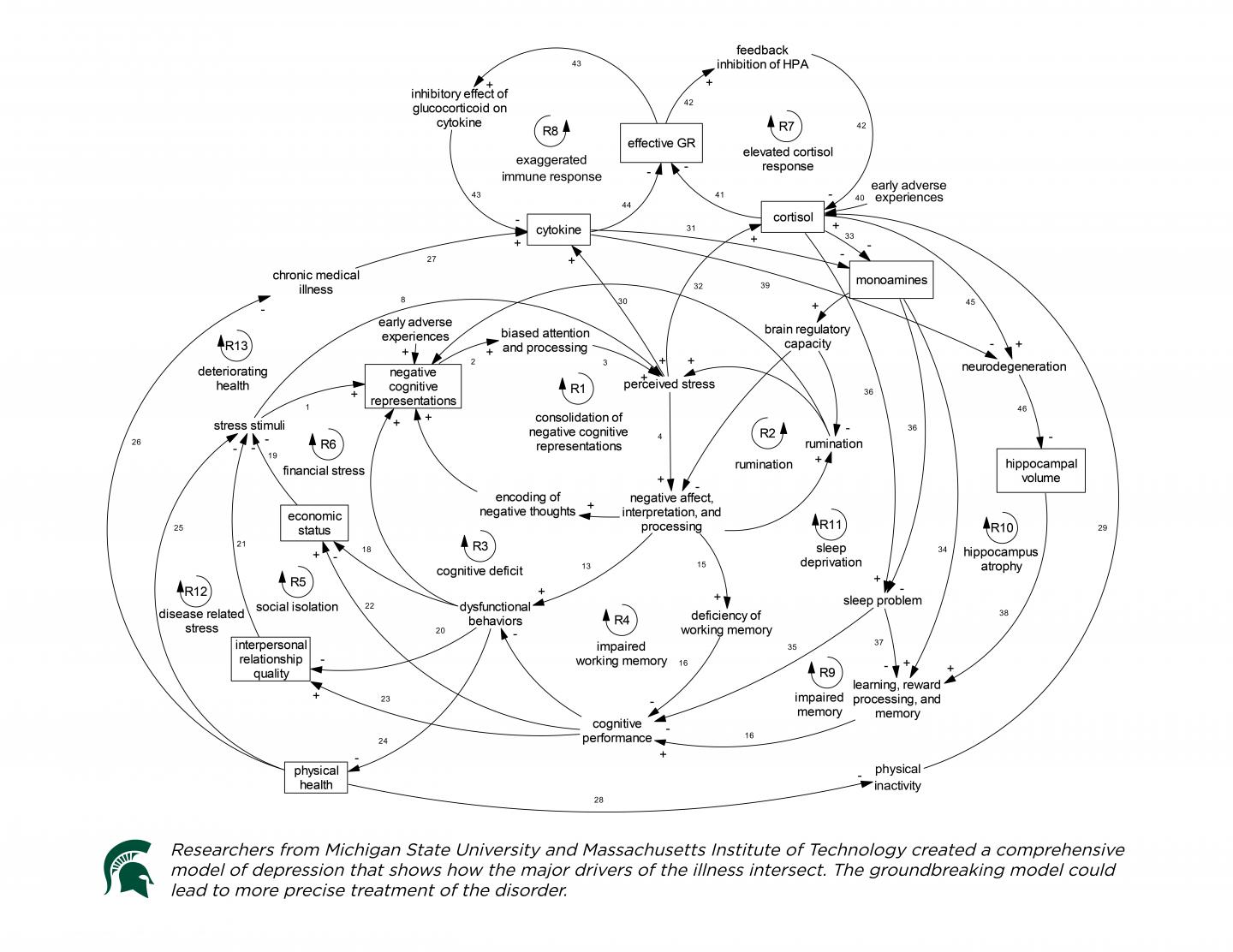
Wittenborn and colleagues analyzed nearly 600 scientific articles on depression and incorporated the major drivers of depression discussed in the research into a complex model that essentially diagrams how one driver affects another. Depression drivers range from sleep problems to social isolation to inflammation of the brain.
104399_web

Study co-author Hazhir Rahmandad, an MIT scholar, is an expert in a process called system dynamics that’s more common to engineering and business. The team used this approach to create a comprehensive model of depression. While future research is needed to further validate the model, it’s a vital first step in better understanding depression and potentially improving care for the illness.

Google News Preferences Add PsyPost to your preferred sources

Thanks to the findings, therapists or even patients one day could plug depression triggers into a smartphone app and receive a recommendation for the most appropriate treatment.

Despite decades of intervention, research and public awareness efforts, depression remains a remarkably destructive public health problem that costs the United States more than $210 billion a year, Wittenborn said. While psychotherapy and antidepressants help some people, response varies widely and only leads to meaningful improvement for about half of patients.

“This model opens the gate to understanding depression as it relates to the whole person and all of his or her experiences,” Wittenborn said. “It helps us understand how depression varies by person – because we know depression varies widely across people, and we think that has something to do with why treatment is not always effective.”

Previous Post

Unique study maps political orientation of all 50 US states over time

Next Post

New research sheds light on neuronal communication

RELATED

Moderate coffee consumption during pregnancy unlikely to cause ADHD in children
Anxiety

Two to three cups of coffee a day may protect your mental health

March 11, 2026
Researchers identify two psychological traits that predict conspiracy theory belief
Cognitive Science

The hidden brain benefit of getting in shape that scientists just discovered

March 11, 2026
RNA viruses affecting the human brain and mental health, highlighting the impact of viruses on neurological and psychological well-being.
COVID-19

How viral infections disrupt memory and thinking skills

March 10, 2026
New psychology research uncovers surprisingly consistent misjudgments of tattooed individuals
Mental Health

Women with tattoos feel more attractive but experience the same body anxieties in the bedroom

March 9, 2026
Misophonia is strongly linked to a higher risk of mental health and auditory disorders
Mental Health

Misophonia is strongly linked to a higher risk of mental health and auditory disorders

March 9, 2026
Science has uncovered the role of light in mood changes and mental disorders
Mental Health

Massive global study links the habit of forgiving others to better overall well-being

March 9, 2026
Scientists studied ayahuasca users—what they found about death is stunning
Climate

Common airborne chemicals are linked to suicidal thoughts in a new public health study

March 8, 2026
New psychology research untangles the links between valuing happiness and well-being
Dementia

Eating ultra-processed foods is not linked to faster mental decline, study finds

March 8, 2026

STAY CONNECTED

LATEST

Two to three cups of coffee a day may protect your mental health

The difficult people in your life might be making you biologically older

The hidden brain benefit of getting in shape that scientists just discovered

A surprising number of men suffer pain during sex but are less likely than women to speak up

Finger length ratios offer clues to how the womb shapes sexual orientation

Study links parents’ perceived financial strain to delayed brain development in infants

Genetic factors drive the link between cognitive ability and socioeconomic status

How viral infections disrupt memory and thinking skills

PsyPost is a psychology and neuroscience news website dedicated to reporting the latest research on human behavior, cognition, and society. (READ MORE...)

  • Mental Health
  • Neuroimaging
  • Personality Psychology
  • Social Psychology
  • Artificial Intelligence
  • Cognitive Science
  • Psychopharmacology
  • Contact us
  • Disclaimer
  • Privacy policy
  • Terms and conditions
  • Do not sell my personal information

(c) PsyPost Media Inc

Welcome Back!

Login to your account below

Forgotten Password?

Retrieve your password

Please enter your username or email address to reset your password.

Log In

Add New Playlist

Subscribe
  • My Account
  • Cognitive Science Research
  • Mental Health Research
  • Social Psychology Research
  • Drug Research
  • Relationship Research
  • About PsyPost
  • Contact
  • Privacy Policy

(c) PsyPost Media Inc