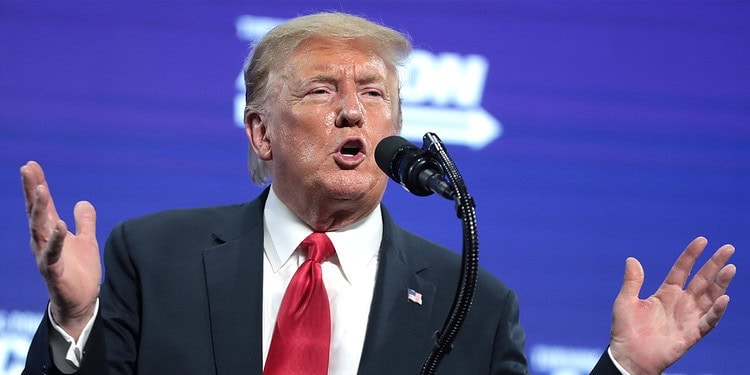

The July 2024 attempted assassination of former President Donald Trump did not fuel a surge in support for partisan violence, according to new research published in the Proceedings of the National Academy of Sciences. Instead, the findings indicate that Republicans, including those who strongly identify with former President Trump’s movement, became less inclined to back violent actions against Democrats and felt more united within their own group. In short, even an event that many feared would widen political divides appeared to have a unifying effect on Republicans without stoking extra hostility toward the opposing party.
The attempted assassination of former President Donald Trump sent shockwaves through the political landscape. The attempt, which mirrored past episodes of political violence such as the one involving President Ronald Reagan in 1981, was widely seen as a dangerous escalation in political conflict. Although the plot did not succeed, it raised immediate concerns about whether such extreme acts might deepen the already wide divides between political groups or even lead to further violence.
The researchers conducted this new study to better understand the immediate impact of the attempted assassination on public attitudes toward political violence and group loyalty. Given that political violence can have far-reaching effects, including destabilizing political institutions and deepening divisions within society, the researchers wanted to see if an event of this nature would prompt citizens to endorse violent actions against those of the opposing party.
“The media are full of claims that Americans are on the verge of another civil war. Immediately after the Trump assassination attempt, pundits and many academics argued that America was going to enter a spiral of violent escalation of partisan conflict. We wanted to test these claims with data,” explained study author Sean Westwood, an associate professor and director of the Polarization Research Lab at Dartmouth College.
To conduct their study, the researchers used data from a large, ongoing national survey conducted by YouGov, a survey research firm. The survey was in progress when the assassination attempt occurred, allowing the researchers to compare responses from before and after the event. They focused on a specific time frame: 26 days before the attempted assassination and 4 days after. During this period, they collected responses from 3,572 people before the event and 703 people after. In addition to this, they also looked at a smaller group of 345 individuals who had participated in the survey both before and after the assassination attempt. This allowed them to track changes in attitudes within the same individuals over time.
All survey participants were asked a standard set of questions designed to measure their political attitudes. These questions covered several areas. To measure feelings toward political parties, participants were asked to rate their feelings toward Democrats and Republicans on a scale from 0 to 100, where 0 meant very unfavorable, 100 meant very favorable, and 50 meant neither favorable nor unfavorable.
Participants were also asked if they identified as a MAGA Republican, a Never Trumper, or neither. To assess support for democratic norms, the survey included questions about various actions that could undermine democratic principles, such as reducing polling places in areas supporting the opposing party, prioritizing party loyalty over election rules, ignoring court decisions made by judges appointed by the opposing party, and government censorship of media critical of their own party. Participants indicated their agreement or disagreement with these actions on a scale from strongly agree to strongly disagree.
The survey also measured support for political violence. Participants were presented with six scenarios describing different violent acts committed by a person against the opposing political party. These scenarios ranged in severity from protesting without a permit and vandalism to assault, arson, assault with a deadly weapon, and murder. For each scenario, participants were asked to indicate their level of support or opposition, from strongly support to strongly oppose.
Finally, to gauge perceptions of out-party violence support, participants were asked to estimate what percentage of voters from the opposing party would support a hypothetical murder of a prominent member of their own party.
The researchers found that among Republicans, there was a significant decrease in support for political violence in the immediate aftermath of the attempted assassination. This reduction in support was observed across multiple forms of violence, including extreme acts like murder. This decrease was even more pronounced among Republicans who identified as MAGA Republicans.
At the same time, Republicans did not become more hostile toward Democrats. In fact, their feelings toward their own party, the Republican party, became significantly more positive. This suggests that the event led to increased unity and stronger in-group feelings among Republicans.
In contrast, the researchers found no significant changes in attitudes among Democrats. Their support for political violence, their feelings toward both Democrats and Republicans, and their perceptions of out-party violence support remained largely stable.
The panel data analysis, which tracked the same individuals over time, confirmed these findings, strengthening the conclusion that the assassination attempt led to a decrease in support for partisan violence among Republicans and an increase in their party unity.
“Our results show that Americans are nearly entirely against political violence,” Westwood told PsyPost. “An event like an assassination attempt does not, counter to expectations, motivative aggrieved partisans to seek revenge but instead tempers what little support for violence exists in the public. Political violence is a problem in the United States, but concern about political violence may be overstated.”
However, “the major caveat is that the decrease in support for violence we observed was fleeting,” Westwood noted. “The aversion to violence we identified among Republicans did not persist.”
Westwood’s Polarization Research Lab, which he co-founded with Yphtach Lelkes, runs America’s Political Pulse—a real-time, interactive dashboard that tracks American attitudes toward political violence, partisan animosity, and democratic norms through weekly survey interviews.
“The goal of this project is to accurately track American public support for political violence and to offer a warning when public support trends upward,” Westwood explained. “People can explore the data we used in the paper (and see where America stands today) on our dashboard: https://americaspoliticalpulse.com/citizens/.”
The study, “The July 2024 Trump assassination attempt was followed by lower in-group support for partisan violence and increased group unity,” was authored by Derek E. Holliday, Yphtach Lelkes, and Sean J. Westwood.