![[Adobe Stock]](https://sp-ao.shortpixel.ai/client/to_webp,q_glossy,ret_img,w_750,h_375/https://www.psypost.org/wp-content/uploads/2026/07/left-vs-right-750x375.jpg)

A new psychological study published in Political Psychology suggests that people on the political left do not value distant strangers more than their own friends and family. Instead, the research indicates that liberals simply extend their moral concern further outward while still prioritizing those closest to them. These findings help explain how different ideological groups balance local loyalties with global compassion.
Human beings naturally display ingroup bias, which is the tendency to favor family, friends, and familiar community members over outsiders. Social identity theory proposes that people derive a strong sense of self-worth from their group memberships, fostering deep loyalty toward insiders. Evolutionary biology models suggest that this trait helped early humans survive in small, tightly knit groups by ensuring mutual protection and resource sharing.
Over time, human societies have grown more interconnected, prompting discussions about how people expand their moral circle. The moral circle is a concept describing the psychological boundary of who or what a person considers worthy of ethical care. In 2019, a paper titled “Ideological differences in the expanse of the moral circle” by Adam Waytz and colleagues explored this concept.
In one phase of their 2019 research, the authors asked participants to allocate moral concern across concentric circles ranging from immediate family to all things in existence. The study produced data that eventually became a viral visual on social media. Memes featuring two heatmap charts, one labeled “conservatives” and the other “liberals,” began appearing in political discussions online.
Right-wing commentators — and even the U.S. Department of Homeland Security under the Trump administration — have used the heatmap to claim that liberals care more about strangers and animals than about their immediate friends and family.
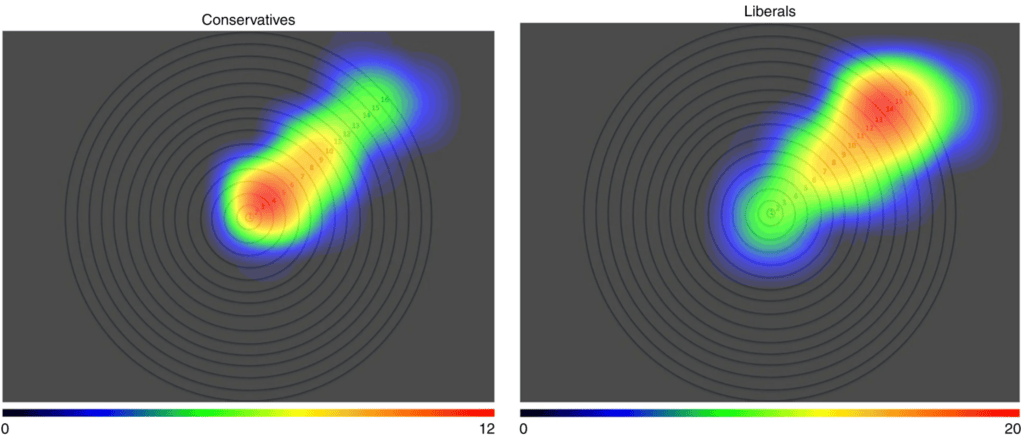
Kyle Fiore Law, an assistant professor of psychology at the University of Utah and director of the Morality, Altruism, and Prosociality Lab, noticed this narrative taking shape. “A specific claim had been circulating in public discourse, that people on the political left have come to value distant others more than their own family, neighbors, and community, effectively reversing the usual ordering of moral concern,” Law said.
“That ‘inversion’ framing showed up in political rhetoric and in a widely shared social media chart. It’s an empirically testable descriptive claim, so we wanted to test it directly.”
The previous research methods had some structural limitations regarding how people could express their priorities. “The most cited prior work here shows that liberals tend to draw a broader moral circle than conservatives, but those tasks were built in a way that assumes concern expands outward step by step, which made them poorly suited to detect whether concern for distant others actually trades off against concern for close others,” Law explained. “We used a measure that lets people structure their own moral circles independently, so that tradeoff could show up if it existed.”
The research team, led by Law and Stylianos Syropoulos of Arizona State University, conducted three separate analyses. In the first phase, known as Study 1a, they examined a nationally representative sample of 1,000 adult participants in the United States. The participants completed a short version of the Moral Expansiveness Scale, alongside a measure of their political ideology ranging from very liberal to very conservative.
This scale measures how much moral concern a person attributes to various entities, allowing participants to structure their own moral circles independently. Participants rated targets like genetic relatives, individuals of different religions, plants, animals, and villains. They assigned each target a score from zero to three, where zero meant the entity fell outside their moral boundary and three placed it in their inner circle.
The findings from Study 1a provided evidence that concern for distant entities does not reduce concern for close ones. Rating human outgroups highly on the moral scale actually correlated positively with caring for genetic relatives. Across almost all political affiliations, participants consistently granted the highest level of moral concern to their own inner circle. Surprisingly, very conservative participants showed a slightly smaller gap between family and outgroups, primarily because they reported slightly lower concern for genetic relatives compared to other political groups.
“In the nationally representative sample, the most conservative participants were the one group that didn’t show a clear gap between concern for ingroups and outgroups, and that came from somewhat lower concern for close others rather than heightened concern for outgroups,” Law told PsyPost. However, he noted that the “pattern did not hold in our preregistered replication, so I’d read it as a lead for future work rather than a firm result.”
For Study 1b, the scientists analyzed combined data from four previous online samples, totaling 3,201 adult participants from the United States. This phase utilized a longer version of the same moral scale. The list featured a wider variety of targets, including romantic partners, friends, opposing political members, coral reefs, and artificial intelligence constructs like supercomputers.
The results from Study 1b supported the first study. Both liberals and conservatives overwhelmingly prioritized their family and friends over outgroups, nature, and artificial intelligence. Liberals did exhibit a larger overall moral circle, but this expansion was driven by increased concern for marginalized humans and the environment. It did not stem from a lack of concern for their close social ties. Interestingly, conservatives in this sample showed slightly higher moral concern for artificial intelligence than liberals did.
To confirm these patterns under different conditions, the authors conducted a new, preregistered experiment called Study 2. They recruited 899 adults from an online platform, intentionally gathering roughly equal numbers of liberals, moderates, and conservatives. This study measured moral concern in two distinct ways to capture different psychological realities.
First, participants completed the unconstrained rating scale using updated categories. These categories included future generations alongside close others, human outgroups, animals, plants, technological agents, and criminals. In this unconstrained format, the findings replicated the earlier results. Every ideological group placed their close relationships at the absolute top of their moral hierarchy.
Second, the scientists introduced a fixed-resource allocation task. Participants received 100 moral concern points to distribute across the different entity categories. This setup mimics real-world scenarios where time, money, and attention are strictly limited resources that must be divided.
When resources were constrained to 100 points, tradeoffs naturally emerged. Giving points to distant targets mathematically required taking points away from close ones. Under these strict limits, liberals distributed more points to plants and future generations than conservatives did, which resulted in them allocating slightly fewer points to their close family and friends.
But even with this resource limitation in place, the inner circle remained the dominant priority across the entire political spectrum. The data suggests that liberals and conservatives largely agree on who matters most in a general sense. They simply differ on exactly how much of a limited resource should be shared with the broader world when sacrifices are necessary.
“Across a nationally representative sample, four large online samples, and a preregistered replication, people across the whole political spectrum placed their closest relationships at the top of their moral concern,” Law explained. “We found no evidence of an inverted hierarchy on the left. What differed by ideology was how far concern reached outward. Liberals, on average, extended more concern to distant targets like human outgroups, animals, and future generations, which is why their overall moral circles look larger, and that did not come with reduced concern for close others. When we forced people to divide a fixed pool of concern, tradeoffs did appear, but ingroups still came first for everyone. The more accurate summary is broader scope sitting alongside strong concern for those close to home.”
“The ingroup-first pattern was large and highly consistent, with very sizable effect sizes in the online samples. That’s the robust headline. The ideological differences in concern for distant targets were real but modest, often on the order of one to three percent of the variance. I’d encourage readers to hold both facts together. Prioritizing close others is close to universal and strongly expressed, and the liberal-conservative gap is a smaller difference layered on top of that shared pattern.”
While the findings challenge the idea of a liberal moral inversion, the researchers are careful to bound their conclusions. “The most important thing to flag is that this is descriptive work,” Law noted. “We’re not making any claim about whether prioritizing close or distant others is the morally right thing to do. That’s a question for ethics and for society, and it sits outside our data.”
The research does have limitations, particularly regarding its reliance on self-reported attitudes rather than physical behaviors. Rating how much you care about an entity on a survey might not perfectly reflect how you would spend your actual money or time. The fixed-resource point task helps bridge this gap, but it still functions as a hypothetical scenario rather than an incentivized behavioral measure.
Looking ahead, the authors plan to expand their methodology to better capture physical behaviors rather than self-reported attitudes. “We’d like to test whether these patterns hold when allocations carry real costs, using incentivized behavioral tasks rather than self-report,” Law explained. “Longitudinal designs would help us understand how moral concern and political identity shape each other over time.”
The research team also hopes to explore the nuances of political affiliation beyond a simple spectrum. “We’re also interested in more specific political identities that a single left-right item can miss, and in running a large nationally representative study with the full measure,” Law said.
“The idea I’d most like readers to walk away with is that debates about ‘moral inversion’ tend to blur two separate questions, how widely someone extends moral regard, and whether extending concern widely necessarily means smaller concern for those who are close,” Law concluded. “Our data seem to show that circles can be wide and also strong at the center at the same time. Keeping those two questions apart makes a lot of the disagreement clearer.”
The study, “Ideological differences in moral concern reflect circle expansion, not inversion,” was authored by Kyle Fiore Law, Seoyeon Bae, Liane Young, and Stylianos Syropoulos.