Misinformation is found in every element of our online lives. It ranges from fake products available to buy, fake lifestyle posts on social media accounts and fake news about health and politics.
Misinformation has an impact not only on our beliefs but also our behaviour: for example, it has affected how people vote in elections and whether people intend to have vaccinations.
And since anyone can create and share online content, without the kind of verification processes or fact checking typical of more traditional media, misinformation has proliferated.
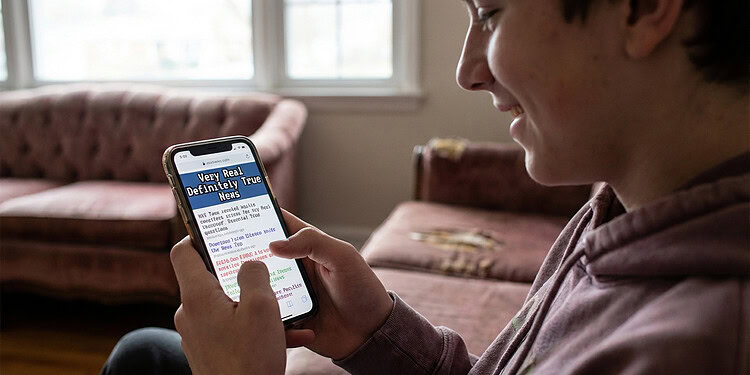
This is particularly important as young people increasingly turn to social media for all kinds of information, using it as a source of news and as a search engine. But despite their frequent use of social media, teenagers struggle to evaluate the accuracy of the content they consume.
A 2022 report from media watchdog Ofcom found that only 11% of 11 to 17 year olds could reliably recognise the signs that indicated a post was genuine.
My research has explored what teenagers understand about misinformation online. I held focus groups with 37 11- to 14-year-olds, asking them their views on misinformation.
I found that the young people in the study tended to – wrongly – believe that misinformation was only about world events and scams. Because of this, they believed that they personally did not see a lot of misinformation.
“[My Instagram] isn’t really like ‘this is happening in the world’ or whatever, it’s just kind of like life,” one said. This may make them vulnerable to misinformation as they are only alert for it in these domains.
There was also wide variation in how confident they felt about spotting misinformation. Some were confident in their skills. “I’m not daft enough to believe it,” as one put it.
Others admitted to being easily fooled. This was an interesting finding, as previous research has indicated that most people have a high level of confidence in their personal ability to spot misinformation.
Most did not fact-check information by cross-referencing what they read with other news sources. They relied instead on their intuition – “You just see it, you know” – or looked at what others said in comment sections to spot misinformation. But neither of these strategies is likely to be particularly reliable.
Relying on gut instinct typically means using cognitive shortcuts such as “I trust her, so I can trust her post” or “the website looks professional, so it is trustworthy”. This makes it easy for people to create believable false information.
And a study by Ofcom found that only 22% of adults were able to identify signs of a genuine post. This means that relying on other people to help us tell true from false is not likely to be effective.
Interestingly, the teens in this study saw older adults, particularly grandparents, as especially vulnerable to believing false information. On the other hand, they viewed their parents as more skilled at spotting misinformation than they themselves were. “[Parents] see it as fake news, so they don’t believe it and they don’t need to worry about it,” one said.
This was unexpected. We might assume that young people, who are often considered digital natives, would see themselves as more adept than their parents at spotting misinformation.
Taking responsibility
We discussed whose role it was to challenge misinformation online. The teens were reluctant to challenge it themselves. They thought it would not make a difference if they did, or they feared being victimised online or even offline.
Instead, they believed that governments should stop the spread of misinformation “as they know about what wars are happening”. But older participants thought that if the government took a leading role in stopping the spread of misinformation “there would be protests”, as it would be seen as censorship.
They also felt that platforms should take responsibility to stop the spread of misinformation to protect their reputation, so that people don’t panic about fake news.
In light of these findings, my colleagues and I have created a project that works with young people to create resources to help them develop their skills in spotting misinformation and staying safe online. We work closely with young people to understand what their concerns are, and how they want to learn about these topics.
We also partner with organisations such as Police Scotland and Education Scotland to ensure our materials are grounded in real-world challenges and informed by the needs of teachers and other adult professionals as well as young people.
This article is republished from The Conversation under a Creative Commons license. Read the original article.