Subscribe
The latest psychology and neuroscience discoveries.
My Account
  • Mental Health
  • Social Psychology
  • Cognitive Science
  • Psychopharmacology
  • Neuroscience
  • About
No Result
View All Result
PsyPost
PsyPost
No Result
View All Result
Home Exclusive Social Psychology Political Psychology Donald Trump

Study: Trump voters desire power over others, are motivated by wealth, and prefer conformity

by Eric W. Dolan
March 18, 2018
in Donald Trump, Political Psychology
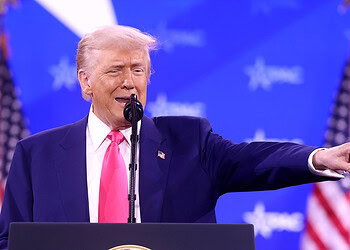
Donald Trump speaking with supporters at a campaign rally at Veterans Memorial Coliseum at the Arizona State Fairgrounds in Phoenix, Arizona. (Photo credit: Gage Skidmore)

Donald Trump speaking with supporters at a campaign rally at Veterans Memorial Coliseum at the Arizona State Fairgrounds in Phoenix, Arizona. (Photo credit: Gage Skidmore)

Share on TwitterShare on Facebook

People with similar values to Donald Trump were more likely to support his candidacy for president.

A new study on the personal values of Trump supporters suggests they have little interest in altruism but do seek power over others, are motivated by wealth, and prefer conformity. The findings were published in the scientific journal Personality and Individual Differences.

“While all presidential elections are important in terms of their consequences, the 2016 primary season seemed particularly unusual in no small part because Donald Trump — a well known real-estate mogul and celebrity — was leading the Republican Primary. Although most pundits gave him no shot at winning, he continued to perform well in the primary elections. Thus, I wondered — who is supporting Donald Trump?” said Ryne A. Sherman, an associate professor at Texas Tech University and author of the study.

Using an online survey of 1,825 American adults, Sherman found that Trump supporters tended to have little interest in supporting social welfare programs, a strong desire for power over others, a strong desire to make money, a preference for financial risk taking, and a preference for strictly adhering to social traditions.

Trump supporters were more likely to agree with statements such as “People who are poor just need to work harder”, “In life, winning is the only thing that matters”, “A company’s main focus should be profits”, “Art shows are boring”, and “Dress codes are good and should be followed strictly.”

On the other hand, Trump supporters tended to disagree with statements such as “Building relationships is more important than building profit”, “Happiness is more important than money”, “Protestors are the most patriotic citizens”, and “Applying the scientific method is the best way to discover the truth.”

Sherman found these values predicted support for Trump even after controlling for the effects of party affiliation and political ideology.

“Values are key drivers of human behavior and represent our philosophy on life,” he explained to PsyPost. “As a result, we tend to like people (and organizations) that share our values.”

“This study demonstrated that shared values (i.e., values perceived to be shared with Donald Trump) were a key driver of support for Donald Trump during the primary. This was true of both Republicans and Democrats, regardless of political ideology. Those who felt more similar to Trump in terms of his values were more likely to support him.”

The study, however, has some limitations.

“This was an internet sample and not necessarily representative of the US population,” Sherman explained. “Thus, the generalizability of this finding may be questionable. Despite this, the study did measure attitudes and values from more than 1,800 adults from every state in the US. It would be interesting to have measured similar attitudes and values regarding other primary candidates, including Hillary Clinton. Perhaps future studies should consider doing this.”

The study was titled: “Personal values and support for Donald Trump during the 2016 US presidential primary“.

RELATED

Conservative college students don’t face greater barriers to campus resources
Political Psychology

Conservative college students don’t face greater barriers to campus resources

January 28, 2026
Female Trump supporters exhibit slightly elevated subclinical psychopathy, study finds
Donald Trump

New research reveals the policy recall gap that gave Donald Trump a hidden edge

January 25, 2026
Donald Trump weaponizes humor through “dark play” to test boundaries
Donald Trump

Donald Trump weaponizes humor through “dark play” to test boundaries

January 24, 2026
Narcissism study sheds new light on the relationship between grandiose and vulnerable subtypes
Anxiety

General anxiety predicts conspiracy beliefs while political anxiety does not

January 23, 2026
People who support authoritarianism tend to endorse election conspiracy beliefs
Authoritarianism

People who support authoritarianism tend to endorse election conspiracy beliefs

January 22, 2026
Democrats dislike Republicans more than Republicans dislike Democrats, studies find
Political Psychology

Both Democrats and Republicans justify undemocratic actions that help their party

January 21, 2026
Election fraud claims heighten support for violence among Republicans but not Democrats
Conspiracy Theories

Collective narcissism fueled the pro-Trump “Stop the Steal” movement on Twitter

January 21, 2026
New study identifies a “woke” counterpart on the political right characterized by white grievance
Authoritarianism

New study identifies a “woke” counterpart on the political right characterized by white grievance

January 19, 2026

STAY CONNECTED

LATEST

Social anxiety has a “dark side” that looks nothing like shyness

Memories of childhood trauma may shift depending on current relationships

Aristotle was right: virtue appears to be vital for personal happiness

ADHD diagnoses are significantly elevated among autistic adults on Medicaid

Long-term antidepressant effects of psilocybin linked to functional brain changes

Scientists identify key brain structure linked to bipolar pathology

Psychology study reveals how gratitude can backfire on your social standing

Surprising link found between hyperthyroidism and dark personality traits

RSS Psychology of Selling

  • Surprising link found between greed and poor work results among salespeople
  • Intrinsic motivation drives sales performance better than financial rewards
  • New research links faking emotions to higher turnover in B2B sales
  • How defending your opinion changes your confidence
  • The science behind why accessibility drives revenue in the fashion sector
       
  • Contact us
  • Privacy policy
  • Terms and Conditions
[Do not sell my information]

Welcome Back!

Login to your account below

Forgotten Password?

Retrieve your password

Please enter your username or email address to reset your password.

Log In

Add New Playlist

Subscribe
  • My Account
  • Cognitive Science Research
  • Mental Health Research
  • Social Psychology Research
  • Drug Research
  • Relationship Research
  • About PsyPost
  • Contact
  • Privacy Policy