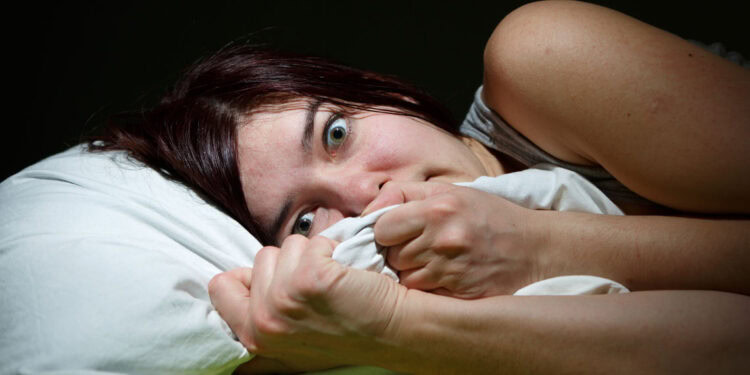

People who have had COVID-19 tend to report having more nightmares than people who have not been infected by the virus, according to research published in Nature and Science of Sleep.
Previous research has indicated that the COVID-19 pandemic coincided with changes in sleep and dream activity among healthy individuals. A study published in 2021, for example, found that pandemic-related stress was associated with a higher likelihood of having nightmares revolving around specific apocalyptic themes.
But Luigi De Gennaro, a professor at the University of Rome Sapienza, and his colleagues noted that whether dream activity in COVID-19 patients differed from dream activity in healthy people had not yet been investigated.
“We are beginning to understand some of the long-term consequences of the virus including physical, cognitive, and mental health changes,” the researchers said. “Given these changes, it is very likely that there are notable differences in sleep and dreaming that come subsequently to infection. Importantly, nightmares have been linked with many forms of psychopathology such as anxiety and depression, borderline personality disorder, and suicidal behavior and mortality, even when accounting for the effects of post-traumatic stress disorder and related disorders. Thus, the development of nightmares is clinically relevant.”
The data for the current research comes from the International COVID-19 Sleep Study (ICOSS), which collected information from thousands of individuals in Austria, Brazil, Canada, Hong Kong, Province Jilin (China), Finland, France, Italy, Japan, Norway, Sweden, Poland, the United Kingdom, and the United States between May and July 2020, during the first wave of the pandemic. The sample included 544 participants who had COVID-19 and 544 matched-controls.
In the study, the participants completed measures of anxiety, depressive symptoms, stress, PTSD, psychological wellbeing, insomnia, quality of life, and quality of health. The participants also completed the Basic Nordic sleep questionnaire, an assessment of sleep problems. The participants were asked to indicate the frequency of dream recall and nightmares during the pandemic and before the pandemic.
During the pre-pandemic period, there was no significant difference in dream recall or nightmares between participants who had COVID-19 and those who had not. During the pandemic, however, nightmare frequency was significantly higher in the COVID-19 participants compared to the controls.
The researchers also found that symptoms of anxiety, depression, and PTSD tended to be higher in COVID-19 participants compared to controls. Importantly, greater nightmare frequency was associated with greater dream recall frequency, heightened PTSD symptoms, heightened anxiety symptoms, heightened insomnia symptoms, lower sleep duration, and younger age. Higher COVID-19 disease severity also predicted greater nightmare frequency.
“The so-called ‘pandemic dreams’ have provided a unique window on the psychological and physiological effects of the pandemic,” De Gennaro told PsyPost. “We increased our rate of dream recall, our lucid dreams, and above all, our nightmares. These changes have been observed without in different countries and in different periods of the pandemic. This is also relevant, due to the fact that nightmares are a common symptom of PTSD, and the phenomena points to a relevant and long-lasting symptoms of PTSD.”
“There is another relevant phenomenon concerning people with long COVID,” De Gennaro continued. “The ICOSS group, which is working on the prevalence and incidence of sleep and circadian rhythm disorders/symptoms and daytime fatigue in relation to pandemic, is now analyzing which health and wellbeing factors are associated with different COVID-19 infection severity levels, such as long-term COVID-19 symptoms. Although not yet published, I anticipate that nightmares also are one of the most frequent reported symptom in this syndrome.”
“One of the most relevant question which needs to be addressed and/or clarified is the role of sleep alterations in determining these changes in dreams. In other words, if the broad changes in dreams characteristics are an independent phenomenon or the consequence of poor sleep quality (i.e., more awakenings, sleep fragmentation, more frequent sleep disorders). To this aim, only laboratory studies can disentangle the issue.”
“In my opinion, too little attention has been paid to the long-lasting consequences of the pandemic,” De Gennaro added. “The so-called long COVID seems to be a chronic disorder affecting a quite relevant proportion of people who have been infected. One of the unanswered question is why the severity of long COVID symptoms does not necessarily depend on the severity of the original COVID infection.”
The study, “Nightmares in People with COVID-19: Did Coronavirus Infect Our Dreams?“, was authored by Serena Scarpelli, Michael R. Nadorff, Bjørn Bjorvatn, Frances Chung, Yves Dauvilliers, Colin A. Espie, Yuichi Inoue, Kentaro Matsui, Ilona Merikanto, Charles M. Morin, Thomas Penzel, Mariusz Sieminski, Han Fang, Tainá Macêdo, Sérgio A. Mota-Rolim, Damien Leger, Giuseppe Plazzi, Ngan Yin Chan, Markku Partinen, Courtney J. Bolstad, Brigitte Holzinger, and Luigi De Gennaro.