![[Adobe Stock]](https://sp-ao.shortpixel.ai/client/to_webp,q_glossy,ret_img,w_750,h_375/https://www.psypost.org/wp-content/uploads/2023/07/happy-father-with-his-child-750x375.jpg)
Childhood stress is linked to decreased hippocampal volume — a brain region important for memory and learning, according to new research published in PNAS Nexus. The study indicates that positive parenting practices act as a protective factor, but only when perceived positively by the youths themselves. The new findings contribute to our understanding of the impact of childhood stress and the factors that can promote resilience in children’s neurodevelopment and psychological functioning.
Previous research has shown that childhood stress can affect brain regions like the amygdala and hippocampus, leading to potential mental health issues. On the other hand, positive parenting has been linked to better outcomes for children, both behaviorally and neurobiologically.
“It’s well known that stress experienced in childhood (e.g., chronic illness, death of a loved one) has negative effects on the brain and behavior of a developing child,” explained study authors Isabella Kahhale, a clinical and developmental psychology graduate student, and Jamie Hanson, an assistant professor at the University of Pittsburgh.
“Our team has seen this really consistently for two brain regions involved with learning, memory and emotion– the hippocampus and the amygdala. When kids are stressed, parents and caregivers often want to know what they can do about it (i.e., how they can support youth in times of challenge). We sought to explore what role positive parenting – that is, warm and supportive caregiving, like providing praise for doing something well – would have in attenuating links between stress and negative effects on the brain.”
“This is often seen for behavior, but few people have investigated it in the brain. We have previously found smaller volumes in the hippocampus and the amygdala after stress, but we wondered if this relation between stress and the brain would be different if there was a great deal of positive parenting in a child’s environment.”
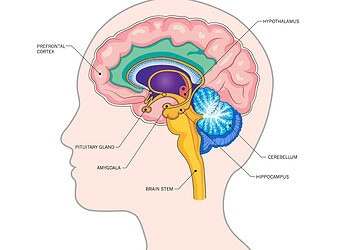
To conduct the study, the researchers gathered data from 482 participants aged 10 to 17 years. They used structural brain imaging to examine the volumes of the amygdala and hippocampus. The amygdala and hippocampus are two important structures in the brain that play significant roles in emotion processing, memory formation, and behavioral regulation.
The amygdala is a small, almond-shaped structure located deep within the brain’s temporal lobe. It is often referred to as the “emotional center” of the brain because of its critical role in processing emotions, especially negative emotions like fear, anxiety, and aggression. The hippocampus is another brain structure located in the medial temporal lobe, adjacent to the amygdala. It plays a crucial role in memory formation, learning, and spatial navigation.
Childhood stress was measured using a checklist of negative life events, with the participants rating their distress in response to these events. Positive parenting was assessed through both youth and caregiver reports. Youth behavioral functioning was measured through a well-validated instrument assessing problem behaviors.
The researchers found that childhood stress was related to smaller hippocampal volumes, but not to differences in amygdala volumes. Positive parenting acted as a buffer against the negative effects of childhood stress on hippocampal volumes. In other words, youths who reported high levels of positive parenting did not show smaller hippocampal volumes even when they experienced higher levels of stress.
Interestingly, only the youth’s perspective on positive parenting mattered for this buffering effect; caregiver reports of positive parenting did not show the same relationship with neurobiology. This highlights the importance of considering youth perspectives in understanding how their experiences shape their brain development and psychological well-being.
“One of the biggest takeaways is that youth perception of support matters!” Kahhale and Hanson told PsyPost. “We found that positive parenting protected against an association between childhood stress and smaller volumes in a part of the brain called the hippocampus, but ONLY when positive parenting was measured by asking kids what they thought. When parents were asked about their caregiving style, their responses did not have the same protective effect. The big point is that it’s not enough for a parent to think they’re being warm and supportive – youth actually need to feel/perceive it, too.”
Examples of positive parenting practices include telling your your child that you like it when he/she helps out around the house, letting your child know when he/she is doing a good job with something, and rewarding your child for behaving well.
“Based on some other work demonstrating that youth perceptions are particularly important, we expected the effects of youth perceptions of positive parenting to be stronger than those of parent perceptions — but it was still surprising that there was such a limited/small effect of parent perceptions of positive parenting on the stress-brain link,” the researchers added.
The results suggest that positive parenting can have a protective effect against the harmful impacts of stress on the brain. It may do so by influencing biological processes, such as the hypothalamic–pituitary–adrenal (HPA) axis and cortisol reactivity, as well as socioemotional skills like self-regulation. However, the observed effects were relatively small, and the study had some limitations, such as its cross-sectional design and wide age range of participants.
Further investigations are needed to explore the complex relationships between stress, parenting, and the brain, with longitudinal studies and targeted age ranges to uncover potential critical periods for buffering effects.
“Our team’s work and that of others underscores that stressful experiences can have a detrimental impact on development; we’re still learning more about what aspects of stress matter, and how,” Kahhale and Hanson said. “For example, does it matter more if stressful experiences occur when someone is 5 years old, compared to 12? Also, what types of experiences might be particularly impactful? For example, experiences that are threatening, like violence, may influence the brain differently from experiences of deprivation, like not having enough food.”
“While we as researchers might think that certain types of stress have particular characteristics, the person experiencing the stress may not feel that way. That is, not having enough food might feel very threatening to the person going through it. We are aiming to really centralize perceptions of experiences in our future work focused on stress exposure and the brain.”
The study, “Positive parenting moderates associations between childhood stress and corticolimbic structure“, was authored by Isabella Kahhalé Kelly R. Barry, and Jamie L. Hanson.