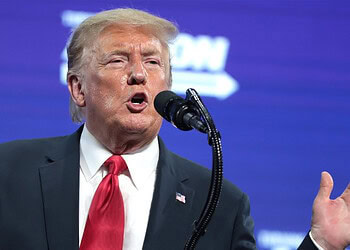
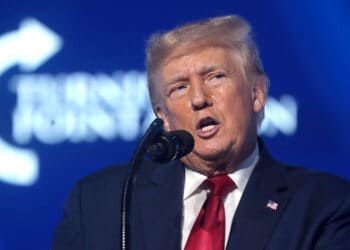
A new study published in Social Semiotics sheds light on how President Donald Trump uses pointing gestures to connect with his audience, emphasize his message, and reinforce his populist identity. The research shows that different types of pointing gestures are associated with specific words and phrases, creating a distinct communication style. This approach allows Trump to appear relatable, engaging, and authoritative all at once.
Christopher Hart, a professor of linguistics at Lancaster University, conducted the study to better understand the role of body language, specifically hand gestures, in political communication. While much research has focused on the words politicians use, less attention has been paid to the nonverbal aspects of their speeches and public appearances.
“I am interested in what defines the communicative style of right-wing populism more generally. While much has been written about the language of right-wing populism, much less has been written about the non-verbal ways that right-wing populists communicate,” explained Hart, the author of Language, Image, Gesture: The Cognitive Semiotics of Politics.
“One thing that has been observed is that populist politicians make greater use of the body as a communicative resource than non-populist politicians. And this is particularly the case for Donald Trump. The present study is part of a larger research programme looking at co-speech gestures in the spoken performances of right-wing populist politicians. I focussed here on Trump as a canonical example of a right-wing populist whose body-movements have attracted the attention of media commentators but which not been systematically analysed from a scientific perspective.”
“However, advances in gesture research within language-related cognitive science make it possible to properly investigate the non-verbal or co-verbal aspects of political communication. Pointing was of particular interest for several reasons, including the frequency with which it occurs in Trump’s live performances but also its essential functions in identifying people, groups and places which are obviously important for politics.”
To carry out his study, Hart selected a sixty-minute video recording of a campaign rally held in Buffalo, New York, on April 18, 2016, during the primaries leading up to the presidential election. This rally, with its more than eleven thousand attendees, offered a lively setting where Trump’s style could be observed in full display.
Hart chose this event in part because New York is a familiar environment for Trump, which meant that his unique mix of language and body language—often associated with the local culture—was particularly evident. The video, which is publicly available online, provided a rich source of data because it captured the full range of Trump’s spontaneous gestures in a high-energy, less controlled setting compared to formal television debates.
The video, approximately 60 minutes long, was analyzed using a “gesture-first” approach. Hart identified every instance of hand-pointing, excluding gestures that didn’t seem to have a clear target or weren’t directly related to the meaning of Trump’s words. He then categorized these pointing gestures based on their direction: outward (away from the body), inward (toward the body), upward, and downward. He also noted other features, such as whether the gesture involved one or both hands, whether the fingers were spread or together, and whether the hand made contact with the body.
To understand the meaning and function of these gestures, Hart also analyzed the words Trump spoke at the same time. He identified the specific words or phrases that coincided with each pointing gesture and categorized them based on their grammatical and functional role. These categories included things like first-person pronouns (“I,” “me”), second-person pronouns (“you”), third-person references (“he,” “she,” “they”), location words (“here,” “there”), and words related to time, numbers, or comparisons. Another researcher also analyzed the video to ensure that the analysis was reliable.
The study’s findings reveal a strong and systematic relationship between Donald Trump’s pointing gestures and the content and purpose of his speech, supporting the idea that these gestures are not random but rather integral to his communication style.
“Trump is an avid pointer, which sets him apart from other non-populist leaders,” Hart told PsyPost. “His use of pointing in a live setting has probably been carried over from his previous career in the entertainment industry.”
One of the most prominent findings was the association between the direction of the pointing and the grammatical person being referenced. When Trump pointed outward, away from his body, he was most often referring to either the audience directly (“you”) or to third parties (“they,” “them,” specific individuals or groups like the media or protesters). This outward pointing created a dynamic of direct engagement, drawing the audience into the conversation while also enabling Trump to physically single out targets for praise, criticism, or ridicule.
Conversely, inward pointing, directed towards Trump’s own body, was strongly associated with first-person singular pronouns (“I,” “me,” “my”). This occurred particularly when Trump was emphasizing his personal qualities, his commitment to his supporters, or his differences from other politicians.
“Self-pointing is functionally redundant so might not be expected to occur frequently but Trump uses them to contrast himself with other politicians,” Hart said. “Self-points in other contexts do not normally make contact with the chest but Trump’s self-points do make contact with the chest the majority of the time. This might imply sincerity and allow Trump to connect with his audience on an emotional level.”
Downward pointing gestures were frequently linked to locative expressions – words indicating place, such as “here,” “this country,” or “Buffalo.” By pointing downwards, often directly at the ground, Trump connected his broader political messages to the specific location of the rally, making his points feel more immediate and relevant to the audience present.
Beyond these directional patterns, the study also identified the significance of looping gestures – circular pointing motions. These gestures typically occurred with plural pronouns (“we,” “us”) or when referring to the local community. The looping motion appeared to encompass both Trump and his audience, creating a visual representation of inclusivity and shared identity. This aligns with the populist strategy of presenting the leader as “one of the people,” united with them in a common cause.
Finally, pointing gestures, such as repeated “hopping” motions, were often used when discussing time, numbers, sequences, or comparisons, suggesting a visual representation of timelines or comparative scales.
The findings highlight that “pointing is not random: pointing direction (outward, inward, upward, downward) correlates systematically with specific speech categories and serves specific functions,” Hart explained. “For example, points directly down to the ground occur with locative expressions and reinforce the relevance of political policies for the live audience by highlighting the location (‘here’) where their impact is or will be felt.”
“When looping is added to a point it signals inclusivity and defines Trump and his audience as belonging to the same place or social group. Through pointing, Trump is able to entertain his audience, direct their attention, build rapport with them and align himself with them as a man of the people.”
But the study, like all research, has limitations. The investigation focused solely on a single campaign rally of one particular politician, which means that the findings may not fully capture the full range of gestural behavior across different settings or among other political figures. It’s unclear whether these patterns are unique to Trump, common to all populist politicians, or simply a feature of this particular type of speaking situation.
“The study is part of a broader research programme exploring the role of gesture in political communication,” Hart explained. “A follow-up study will explore another gestural form that Trump makes particularly frequent use of: the shrug. Future research will also explore gestural features in the communicative style of other right-wing populist politicians in Europe.”
The study, “What’s the point of Donald Trump? Deictic gestures in the service of right-wing populism,” was published December 24, 2024.