![[Adobe Stock]](https://sp-ao.shortpixel.ai/client/to_webp,q_glossy,ret_img,w_750,h_375/https://www.psypost.org/wp-content/uploads/2025/12/harry-potter-books-750x375.jpg)
New research published in the Personality and Social Psychology Bulletin reveals a psychological split within the political left regarding perceptions of in-group dissenters. The study indicates that self-identified Progressives and Traditional Liberals generate fundamentally different mental images of author J.K. Rowling based on her views regarding gender identity. While Progressives conceptualize Rowling as appearing cold and right-wing, Traditional Liberals visualize her in a warm and positive light.
Political psychology has historically focused on the ideological conflict between the Left and the Right. Scholars have frequently characterized right-wing individuals as more prone to rigidity and hostility toward out-groups. However, recent academic inquiries have shifted focus to the increasing fragmentation within the left-wing itself. This internal division is often categorized into two distinct subgroups: Progressives and Traditional Liberals.
Elena A. Magazin, Geoffrey Haddock, and Travis Proulx from Cardiff University conducted this research to investigate how these two groups perceive ideological dissenters from within their own ranks. The researchers utilized the Progressive Values Scale (PVS) to distinguish between the groups.
This scale identifies Progressives as those who emphasize mandated diversity, concern over cultural appropriation, and the public censure of offensive views. In contrast, Traditional Liberals tend to favor free expression and gradual institutional change over activist approaches.
The primary objective was to determine if the tendency to derogate—or negatively perceive—others extends to members of one’s own political group who hold controversial views. J.K. Rowling served as the focal point for this investigation.
Rowling is a prominent figure who has historically supported left-wing causes but has recently expressed “gender critical” views that conflict with the “gender self-identification” stance held by many on the Left. The researchers sought to visualize how these political orientations shape the mental representations of such a figure.
The researchers employed a technique known as reverse correlation to capture these internal mental images. This method allows scientists to visualize a participant’s internal representation of a person or group without asking them to draw or describe features explicitly. In the first study, the team recruited 82 left-wing university students in the United Kingdom to act as “generators.”
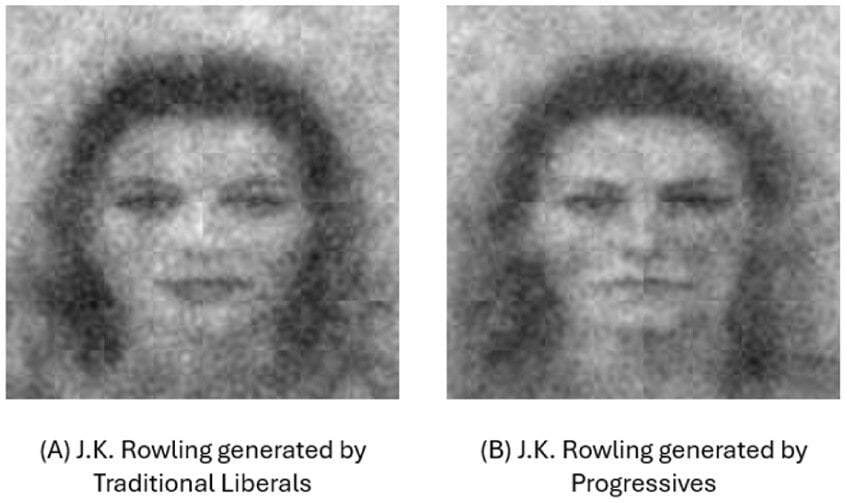
During the image generation phase, participants viewed pairs of faces derived from a neutral base image overlaid with random visual noise. For each pair, they selected the face that best resembled their mental image of J.K. Rowling. By averaging the selected images across hundreds of trials, the researchers created composite “classification images” representing the average visualization of Rowling for Progressives and Traditional Liberals respectively.
A separate group of 178 undergraduates then served as “raters.” These participants evaluated the resulting composite images on various character traits, such as warmth, competence, morality, and femininity. The raters were unaware of how the images were generated or which political group created them.
The results from Study 1 provided evidence of a stark contrast in perception. The image of Rowling generated by Progressives was rated as cold, incompetent, immoral, and relatively masculine. Raters also perceived this face as appearing “right-wing” and prejudiced.
On the other hand, the image generated by Traditional Liberals was evaluated positively across these dimensions. It appeared warm, competent, feminine, and distinctly left-wing. This suggests that while Progressives mentally penalized the dissenter, Traditional Liberals maintained a flattering perception of her.
To ensure these findings were not limited to a specific demographic or location, the researchers conducted a second study with a more diverse sample. Study 2 involved 382 adults from the United States. This experiment aimed to replicate the findings and expand upon them by including abstract targets alongside concrete ones.
Participants were asked to generate images for four different categories. These included specific public figures, such as J.K. Rowling (representing gender critical views) and Lady Gaga (representing gender self-identification views). They also generated images for generalized, abstract descriptions of a “fellow left-winger” who held either gender critical or self-identification beliefs.
Following the generation phase, 301 distinct participants rated the eight resulting composite images. The findings from the second study reinforced the patterns observed in the first. In general, faces representing gender critical views were rated more negatively than those representing self-identification views. This aligns with the general left-wing preference for the self-identification model.
However, the degree of negativity varied by generator type. Progressives consistently generated gender critical faces that were evaluated more harshly than those generated by Traditional Liberals. This held true for both the abstract descriptions and the specific example of J.K. Rowling.
A specific divergence occurred regarding the concrete representation of Rowling. Consistent with the UK study, US Progressives generated a negative image of the author. In contrast, US Traditional Liberals generated an image that raters viewed as warm, competent, and moral. This occurred even though Traditional Liberals generated a negative image for the abstract concept of a gender critical person.
This discrepancy suggests a nuanced psychological process for Traditional Liberals. While they may disagree with the abstract views Rowling holds, their mental representation of her as an individual remains protected by a “benevolent exterior.” They appear to separate the person from the specific ideological disagreement in a way that Progressives do not.
The researchers also noted an unexpected pattern regarding gender perception. In both studies, the images of Rowling generated by Progressives were rated as looking less feminine and more masculine than those generated by Traditional Liberals. This finding implies that the devaluation of a target may involve stripping away gender-congruent features.
There are limitations to this research that context helps clarify. The first study relied heavily on a student population which was predominantly female and white. While the second study expanded the demographic range, both studies focused exclusively on the issue of gender identity. It remains unclear if this pattern of intra-left derogation would apply to other contentious topics, such as economic policy or foreign affairs.
Future research could explore these boundaries by using different targets of dissent. It would be valuable to investigate whether these visual biases persist if a dissenter apologizes or recants their views. Additionally, further study is needed to understand the “masculinization” effect observed in the Progressive-generated images.
These findings provide evidence that the political left is not a monolith regarding social cognition. The distinction between Progressives and Traditional Liberals involves more than just policy disagreements. It appears to involve fundamental differences in how they visualize and socially evaluate those who deviate from group norms.
The study, “The Face of Left-Wing Dissent: Progressives and Traditional Liberals Generate Divergently Negative and Positive Representations of J.K. Rowling,” was authored by Elena A. Magazin, Geoffrey Haddock, and Travis Proulx.