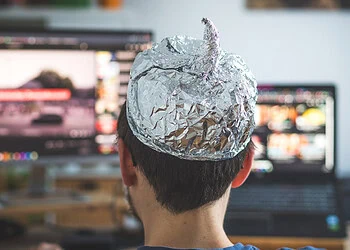
Republican and Democratic partisans tend to disparage each other’s intelligence more than each other’s morality, according to new research to be published in Personality and Social Psychology Bulletin. The findings provide new details about political polarization in the United States.
“In recent years, there has been an alarming increase in animosity between political opponents,” said study author Rachel Hartman (@RachelXHartman), a PhD student at the University of North Carolina at Chapel Hill and member of the Deepest Beliefs Lab and the Center for the Science of Moral Understanding.
“Many researchers have focused on bridging moral divides between liberals and conservatives to reduce feelings of antipathy, but that seems to assume that the conflict is a moral conflict. I felt that that assumption is worth testing. If the conflict isn’t even about morality, then we might be wasting time trying to get people to see past their differences.”
Across four studies, the researchers found that liberals and conservatives both view each other as more unintelligent than immoral.
Hartman and her colleagues first set out to examine whether perceiving one’s political rivals as unintelligent and perceiving one’s political rivals as immoral were two distinct factors. They recruited 481 Americans from Amazon’s Mechanical Turk platform and used a statistical technique known as factor analysis to confirm that this was the case.
Next, Hartman and her colleagues investigated how North Carolinians perceived the unintelligence and immorality of liberals and conservatives shortly after a statewide vote on six amendments to the North Carolina constitution in 2018. In the study, 360 North Carolina residents read the six amendments, and were informed that conservatives generally supported the amendments while liberals generally opposed them. The participants were then asked why liberals and conservatives voted the way they did.
Liberal participants were more likely to perceive conservatives as unintelligent and immoral for supporting the amendments, while conservative participants were more likely to perceive liberals as unintelligent and immoral for opposing the amendments. Importantly, however, both liberals and conservatives rated unintelligence as a greater factor than immorality.
For their third study, the research team surveyed a nationally representative sample of 633 Americans. In line with their previous studies, they found that self-identified Democrats and Republicans rated each other as more unintelligent than immoral. Democrats’ judgments of Republicans tended to be more negative than Republicans’ judgments of Democrats.
Hartman and her colleagues also examined meta-perceptions. In their final study, they recruited 176 Americans from Amazon’s Mechanical Turk and asked them to rate how they thought the average Democrat perceived the average Republican and vice versa. Participants accurately thought that Democrats and Republicans viewed each other as more unintelligent than immoral, but they exaggerated the magnitude of disparagement.
“I want to be careful not to overclaim and draw conclusions beyond what we actually tested. Our main finding is that political opponents see each other as more unintelligent than immoral,” Hartman told PsyPost.
“We don’t have the data yet to support any specific recommendations for how people should change the way they engage with political opponents. But dismissing others as being unintelligent, misinformed, or brainwashed seems demeaning and dehumanizing. When you come across someone on the opposite side of an issue, try to communicate your reasons for holding your belief, and listen when they talk about their own reasons.”
“Very smart people can disagree with each other — that’s often a good thing! Having a well-functioning democracy means having a plurality of ideas that people can come together to discuss civilly,” Hartman added.
Like all research, the study includes some limitations. For example, it is unclear how well the findings generalize to political contexts outside the United States. The researchers also noted that is possible that momentous events, such as the storming of the Capitol on January 6, 2021, could significantly alter people’s political perceptions. Future research is also needed to examine ways to effectively reduce polarization.
“As I alluded to above, we haven’t yet taken the next step of applying this work to interventions for reducing animosity,” Hartman said. “There’s some work from our center suggesting that recognizing that people have good reasons for their beliefs reduces animosity, but we would still like to directly test whether we can change perceptions of intelligence and the extent to which doing so is beneficial. It’s also likely that, while political opponents see each other as more stupid than evil overall, there may be particular issues or contexts where that difference goes away, or is even reversed.”
“As psychologists, our work focuses on a psychological understanding of partisan animosity, and the interventions we work with work at the level of changing the way people think about and interact with each other,” Hartman added. “But partisan animosity is a structural problem, and there’s only so much we can do at the individual level. To enact lasting change, our institutions and media environments need to change as well.”
The study, “People See Political Opponents As More Stupid Than Evil”, was authored by Rachel Hartman, Neil Hester, and Kurt Gray.