New research reinforces the potential dangers of consuming alcohol in situations where paying attention to surroundings is crucial, such as behind the wheel of a car. The study, published in the journal Psychopharmacology, found that alcohol reduced subjects’ attention to distractor stimuli on a visual task, particularly when the distractor signaled a high reward.
It is no secret that alcohol consumption influences attention and cognitive processing. While studies suggest that alcohol reduces a person’s attention to visual and auditory distractions, it is unclear whether alcohol lowers attention to all distractions. Study authors Poppy Watson and her team wondered how alcohol would influence attention toward distractor cues that contain reward-related information.
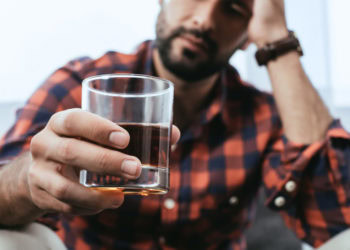
The researchers designed a controlled lab experiment where 58 undergraduate students in Australia would partake in a visual search task. After learning the procedures of the visual task and going through practice trials, the students were then given either two alcoholic drinks (alcohol condition) or two non-alcoholic drinks that were made to look and taste like alcohol (placebo condition). The drinks in the alcohol group were measured out while taking into account each participants’ body mass index (BMI), so as to reach the legal alcohol limit for driving in Australia. While consuming the drinks, the students went through several rounds of the visual distractor task while their eye movements were recorded.
The search task asked students to visually locate a diamond among four circles as quickly as possible on each trial. Some trials included distractor cues which indicated how much of a reward participants could gain from each trial — for example, a blue distractor circle indicated a high reward and an orange distractor circle indicated a low reward. Importantly, if participants looked at the distractors they would lose this reward. Thus, although the distractor cues contained information about a potential reward, looking at them was counterproductive.
Interestingly, the researchers found that the students who had consumed alcohol were less likely to look at the high-reward distractor cues compared to those who had no alcohol. However, the two groups did not differ in their attention paid to the low-reward cues. Similarly, those in the alcohol group made fewer rapid, impulsive eye movements to the distractor cues, and this effect was especially pronounced when it came to high-reward distractors.
The authors say their findings partially conform to the perspective that alcohol reduces overall processing capacity, making additional cognitive resources necessary to process a task at hand. This means fewer resources remain for attending to salient stimuli like the distractor reward cues.
However, the differences between the two groups were concentrated on the high-reward distractors, suggesting that alcohol might produce a more specific effect on the information processing of motivationally-relevant stimuli. The study’s authors propose that future studies should investigate this possibility.
“Presumably, we have evolved an attentional system that prioritises rapid and automatic processing of highly salient events—that is, an “impulsive” system—because rapid detection of such events confers advantages in terms of maximising rewards and avoiding danger,” the researchers say, noting that this system seems to be disrupted with the consumption of alcohol. “In situations which may require rapid changes in behaviour in response to incoming sensory information (for example, while driving), this reduction in processing efficiency could potentially have catastrophic consequences.”
Watson and her team emphasize that the alcohol group demonstrated measurable changes in attention, despite the fact that most of them did not consume enough alcohol to prevent them from legally driving a car.
The study, “Reduced attentional capture by reward following an acute dose of alcohol”, was authored by Poppy Watson, Daniel Pearson, and Mike E. Le Pelley.