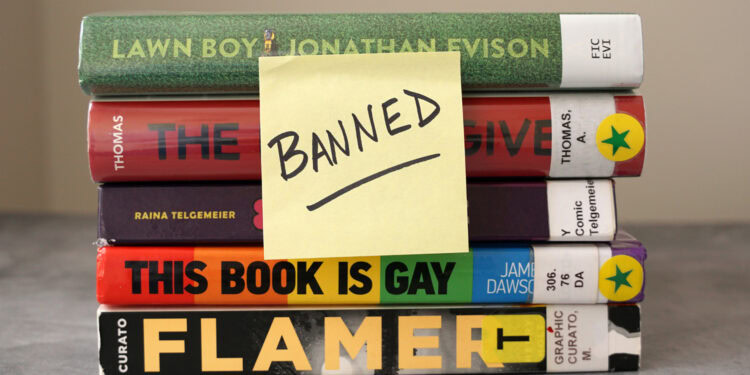

A new study published in PLOS ONE has found that Americans across the political spectrum tend to support censorship when literature conflicts with their own ideological values, even though most say they oppose censorship in general. The research challenges the notion that support for literary censorship in the United States is divided neatly along ideological lines.
The researchers conducted this study in response to the sharp rise in public campaigns to censor books, particularly those aimed at young readers. In recent years, efforts to ban books have surged, driven by concerns over race, gender identity, sexual orientation, and American history. These efforts are often portrayed as deeply partisan: conservative groups have targeted books with LGBTQ+ characters or discussions of racism, while progressive critics have taken aim at older texts perceived as racially or culturally insensitive.
Historically, calls for censorship in the U.S. had bipartisan roots. In the mid-twentieth century, liberals and conservatives often found common ground in wanting to protect children from sexually explicit or violent material. But recent controversies suggest a shift. Instead of being rooted in concerns about psychological harm or developmental readiness, modern book challenges are increasingly tied to ideological values and cultural identity.
Yet, the researchers point out that while public discourse is filled with claims about one side being more censorious than the other, few empirical studies have tested whether such claims hold true among the broader voting-age population. Their goal was to investigate whether ideological divisions truly shape public attitudes toward literary censorship — or whether both sides are similarly motivated by political values when it comes to restricting access to literature.
“In recent years, there has been a deluge of attempts to censor literature from both the left and the right. Moreover, as recent examples suggest—from Sparrow and Vine by Sophie Lark to Texas’s Senate Bill 12, which took effect this month—these attempts show no signs of dying down. Today, book censorship is very much a real-world problem that needs to be understood with the tools provided by social science,” said study author Adam Szetela of Cornell University, the author of That Book Is Dangerous! How Moral Panic, Social Media, and the Culture Wars Are Remaking Publishing.
The first part of the research involved a survey of 864 U.S. adults conducted through an online platform. Participants were presented with 15 statements related to children’s literature and asked to express their level of agreement. Some statements were designed to reflect liberal values, such as concerns about books written by white authors that center on marginalized characters. Others aligned with conservative views, such as objections to books featuring LGBTQ+ characters or criticisms of traditional American values.
The results showed broad opposition to censorship overall. Most participants — regardless of political identity — disagreed with the idea of removing books just because they might offend some parents. There was also strong disapproval of book burning and censoring titles without reading them.
However, when participants were presented with specific ideological examples, clear differences emerged. Conservatives were more likely to support censoring books with LGBTQ+ themes or portrayals of racism, while liberals were more likely to oppose publishing books written by white men about marginalized characters or books promoting Christian values. In other words, both groups showed a tendency to support censorship of material that clashed with their values, even if they claimed to oppose censorship more broadly.
Importantly, the researchers found that these patterns held even after adjusting for demographic differences such as age, income, religion, education level, and whether the participant was a parent. Ideological alignment remained the strongest predictor of which books participants were willing to censor.
The survey also included ideologically neutral statements, such as removing a book that mentions suicide or responding to complaints from parents. On these items, conservatives were more likely than liberals to support censorship. At the same time, conservatives were also more likely to say they believed they were more tolerant of controversial books — a belief that did not align with their responses.
In the second part of the study, the researchers conducted a controlled online experiment to examine how participants responded to ideological literary criticism. Participants read a series of short poems that had been pretested to be free of obvious political content. Some participants were then shown criticisms of the poems, drawn from both liberal and conservative viewpoints, as well as neutral or technical criticisms. Others read the poems without any accompanying criticism, which served as a baseline.
Liberal criticisms included accusations of racism, sexism, homophobia, or antisemitism. Conservative criticisms framed the poems as anti-Christian, anti-American, anti-family, or man-hating. The criticisms were randomly assigned so that each participant saw one liberal, one conservative, one technical, and one positive review across the four poems.
The researchers then measured how participants responded. Did they agree with the criticism? Did they like the poem less? Did they support or oppose the decision to publish it?
Interestingly, the results showed that most participants were more influenced by liberal criticisms than conservative ones. On average, participants were more than twice as likely to agree with liberal criticisms compared to conservative ones. They were also more likely to report disliking a poem after reading a liberal criticism and more likely to question whether it should be published.
However, this difference in influence was not driven by participants’ ideological identities. Liberals and conservatives responded similarly to both types of criticism. The key factor seemed to be the criticism itself: left-leaning critiques had a stronger effect across the board, regardless of the participant’s political beliefs.
When participants were not exposed to any criticism, liberals rated the poems more favorably and were more supportive of their publication than conservatives. This matches the pattern seen in the survey, where conservatives tended to be more censorious even when the content was ideologically neutral.
The researchers suggest that the stronger influence of liberal criticism may reflect the dominance of liberal voices in the field of literary criticism, especially in academic and publishing settings. Many participants may have been more inclined to defer to liberal critics, either because they were more familiar with this kind of critique or because they viewed these critics as more authoritative.
While the study provides evidence for selective censorship preferences among both liberals and conservatives, it also has limitations. The survey and experiment were conducted online, and although the researchers adjusted for demographic imbalances, the sample may not fully capture the diversity of the U.S. population. Self-reported ideology and beliefs are also imperfect measures and can be shaped by many subtle factors.
Another limitation is the use of children’s literature as the focus for the first study. While this choice is rooted in the historical context of bipartisan support for protecting children from inappropriate content, attitudes toward adult literature may show different patterns. Future studies might explore whether ideological selectivity changes when the content is aimed at adults rather than children.
The experiment focused on responses to poetry, a literary form that may not evoke the same level of emotional engagement or controversy as novels or non-fiction books. It also did not measure long-term changes in opinion, only immediate reactions. Additional studies could explore how repeated exposure to ideological criticism affects beliefs over time.
Finally, the authors suggest that future research might explore the psychological processes behind this selective censorship. One possibility is that people are more likely to accept criticism when it aligns with their values, a pattern known in social psychology as biased assimilation. Another is that people tend to associate with others who share their beliefs, a process called homophily. These social dynamics may help explain why both sides are drawn to censor content they find threatening or offensive, even while claiming to support free expression.
“The study ties into concerns that I explore via interviews in my book that I had come out in August from MIT Press and Penguin Random House,” Szetela added.
The study, “The polarization of literary censorship in the U.S.,” was authored by Adam Szetela, Shiyu Ji, and Michael Walton Macy.