Subscribe
The latest psychology and neuroscience discoveries.
My Account
  • Mental Health
  • Social Psychology
  • Cognitive Science
  • Neuroscience
  • About
No Result
View All Result
PsyPost
PsyPost
No Result
View All Result
Home Exclusive COVID-19

Countries led by women have not fared better during the COVID-19 pandemic, study finds

But having a more feminine society appears to reduce coronavirus deaths

by Eric W. Dolan
February 14, 2021
in COVID-19, Political Psychology
Prime Minister of Iceland Katrín Jakobsdóttir. (Photo credit: Arctic Circle)

Prime Minister of Iceland Katrín Jakobsdóttir. (Photo credit: Arctic Circle)

Share on TwitterShare on Facebook

While some women-led countries are faring better than men-led countries amid the COVID-19 pandemic, new research published in the scientific journal PLOS One indicates that this trend is not universally true.

The findings suggest that the perception of women leaders excelling over their male counterparts in the wake of the coronavirus outbreak is the result of Western media bias. The study also found that countries with higher levels of egalitarianism do tend to have a lower rate of COVID-19 fatalities.

“My primary field is political linguistics, and it struck me this past spring that much of the reason why popular media was focused on the successes of women world leaders was that they were particularly visible in their public outreach to their constituents, in some cases specifically talking to the children in their countries,” explained study author Leah C. Windsor, a research assistant professor at the University of Memphis.

“Women leaders and women more broadly face what’s called the ‘gender double bind’ — contemporary culture punishes women for being too masculine and aggressive, and also for being too feminine. Women leaders can neither be perceived as too strong, or too weak.”

“However, during pandemics, they are rewarded for these characteristics. They can be strong and decisive on questions of hard security, like closing borders and instituting stay-at-home orders, and then can also be gentle and reassuring to their constituents,” Windsor said.

The researchers analyzed the success of 175 countries in containing COVID-19 using data from Our World in Data, the World Bank, Freedom House, and the World Health Organization. After controlling for factors such as GDP per capita and percent of the population over age 65, they found no evidence that countries led by women tended to have less COVID-19 fatalities than countries led by men.

“The perception that women world leaders have done better vis-a-vis COVID-19 cases and deaths largely comes from the fact that other researchers and the media have focused primarily on OECD countries, whereas we looked at the entire global sample of countries,” Windsor told PsyPost. “The cases people tended to focus on were New Zealand and Iceland — two remote island nations with relatively small populations, where borders are easy to control.”

However, the researchers did find evidence that cultural dimensions influenced COVID-19 fatality rates. Countries tended to perform particularly well when they had a woman leader as well as cultural values that support female leadership.

Google News Preferences Add PsyPost to your preferred sources

“A society’s culture matters the most to how well it does during the pandemic,” Windsor explained. “More egalitarian countries with less gender bias, longer-range policy focus, greater tolerance for uncertainty and ambiguity, and collectivist mentalities tend to do better, because everyone understands that their behavior affects others’ well-being. Second, more egalitarian countries that have female leaders have the fewest deaths and cases from COVID-19.”
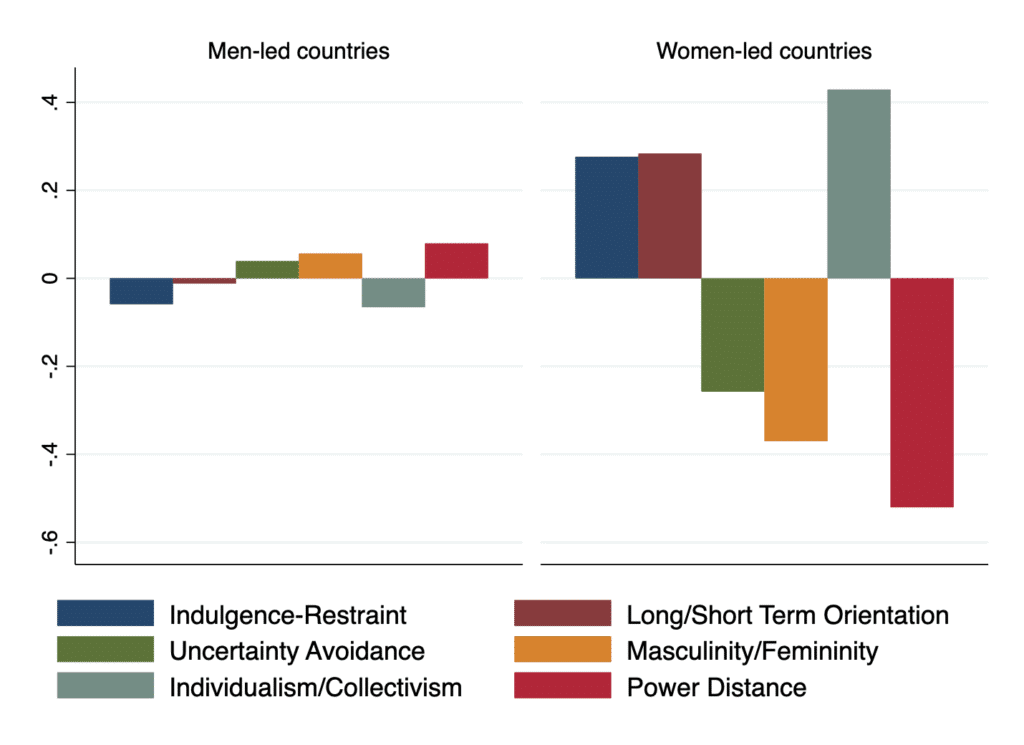
The findings indicate that “countries with more egalitarian cultures will rebound quicker and have less profound negative consequences — and many of these are led by women,” Windsor added.

“The most important point is that having a more feminine society — with less power distance between individuals (like bosses and employees), with long term orientation, with collectivist (we’re all in this together) rather than individualist (you’re on your own), and with greater tolerance for ambiguity and uncertainty (which is useful during a rapidly developing and changing pandemic),” Windsor said.

“More feminine societies are more likely to elect women leaders — it’s easy to focus on leadership at the top but it also matters that people in countries all work together to stop the spread of COVID-19. Country culture is important alongside leader sex/gender.”

The study, “Gender in the time of COVID-19: Evaluating national leadership and COVID-19 fatalities“, was authored by Leah C. Windsor, Gina Yannitell Reinhardt, Alistair J. Windsor, Robert Ostergard, Susan Allen, Courtney Burns, Jarod Giger, and Reed Wood.

Previous Post

Exaggerated threat expectancies linked to suicidal thoughts and behaviors in U.S. gun owners

Next Post

Research sheds light on the cultural and psychological correlates of religion

RELATED

Pro-environmental behavior is exaggerated on self-report questionnaires, particularly among those with stronger environmentalist identity
Climate

Conservatives underestimate the environmental impact of sustainable behaviors compared to liberals

March 5, 2026
Common left-right political scale masks anti-establishment views at the center
Political Psychology

American issue polarization surged after 2008 as the left moved further left

March 5, 2026
Evolutionary psychology reveals patterns in mass murder motivations across life stages
Authoritarianism

Psychological network analysis reveals how inner self-compassion connects to outward social attitudes

March 5, 2026
Republicans’ pro-democracy speeches after January 6 had no impact on Trump supporters, study suggests
Conspiracy Theories

Trump voters who believed conspiracy theories were the most likely to justify the Jan. 6 riots

March 5, 2026
Scientists discover psychedelic drug 5-MeO-DMT induces a state of “paradoxical wake”
Business

Black employees struggle to thrive under managers perceived as Trump supporters

March 4, 2026
Self-interest, not spontaneous generosity, drives equality among Hadza hunter-gatherers
Political Psychology

X’s feed algorithm shifts users’ political opinions to the right, new study finds

March 3, 2026
Exaggerated threat expectancies linked to suicidal thoughts and behaviors in U.S. gun owners
Political Psychology

Republican rhetoric on mass shootings does not change public opinion on gun reform

March 2, 2026
New research: AI models tend to reflect the political ideologies of their creators
Authoritarianism

Right-wing authoritarianism is linked to belief in the paranormal, independent of cognitive style

February 26, 2026

STAY CONNECTED

LATEST

Conservatives underestimate the environmental impact of sustainable behaviors compared to liberals

American issue polarization surged after 2008 as the left moved further left

Psychological network analysis reveals how inner self-compassion connects to outward social attitudes

New neuroscience study links visual brain network hyperactivity to social anxiety

Trump voters who believed conspiracy theories were the most likely to justify the Jan. 6 riots

Simple blood tests can detect dementia in underrepresented Latin American populations

Psychologists clash over the safety and effects of the cry it out parenting strategy

Exploring the motivations for cannabis use during sex

PsyPost is a psychology and neuroscience news website dedicated to reporting the latest research on human behavior, cognition, and society. (READ MORE...)

  • Mental Health
  • Neuroimaging
  • Personality Psychology
  • Social Psychology
  • Artificial Intelligence
  • Cognitive Science
  • Psychopharmacology
  • Contact us
  • Disclaimer
  • Privacy policy
  • Terms and conditions
  • Do not sell my personal information

(c) PsyPost Media Inc

Welcome Back!

Login to your account below

Forgotten Password?

Retrieve your password

Please enter your username or email address to reset your password.

Log In

Add New Playlist

Subscribe
  • My Account
  • Cognitive Science Research
  • Mental Health Research
  • Social Psychology Research
  • Drug Research
  • Relationship Research
  • About PsyPost
  • Contact
  • Privacy Policy

(c) PsyPost Media Inc