
Republican criticism of epidemiological models of the spread and impact of COVID-19 do not appear to have much effect on the public’s trust in science and support for science-based policy, according to a new study published in Science Advances. But this is not the case for Democratic criticism.
The difference could come down to the public’s expectations: Republicans who criticize COVID-19 models are seen as acting in alignment with their party, while Democrats who do so appear to be less ideologically motivated because they are bucking their party.
“The COVID-19 pandemic thrust scientific research into an emerging threat into the public limelight,” said study author Douglas L. Kriner, the Clinton Rossiter Professor in American Institutions at Cornell University.
“Given the novelty of the virus, scientific guidance and projections were almost destined to be shrouded in uncertainty and to result in reversals as new findings and data yield a revised and more complete picture. This opens the door to politicization with potentially lasting consequences for public trust and confidence in science generally.”
The findings of the new research are based on a series of survey experiments conducted in May and June with more than 6,000 Americans.
Participants showed reduced support for science after reading that “some Democratic Governors have questioned the accuracy” of COVID-19 models. But reading that “some Republican Governors have questioned the accuracy of these models” had little negative impact on participants’ opinions.
In fact, reading that Republican governors had questioned the models appeared to result in a backfire effect — increasing both support for science and the use of the COVID-19 models among Democratic participants. Surprisingly, Republican support for COVID-19 science also had little effect.
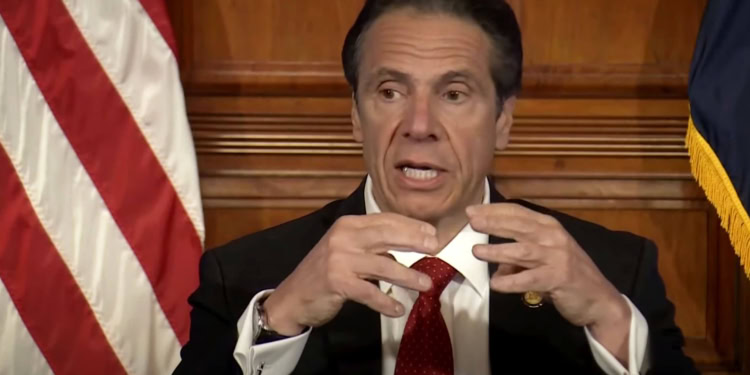
The researchers found similar results after using actual statements from Democratic Governor Andrew Cuomo of New York and Republican Senator John Cornyn of Texas. When shown a quote by New York Gov. Andrew Cuomo downplaying COVID-19 forecasting, support for using the models dropped by 13% and support for science in general decreased as well.
“Criticisms of science from Republicans don’t have much influence on public opinion because such criticism is baked into most people’s expectations. Democrats, however, are in a trickier situation. Criticism of models projecting COVID-19’s spread, for example, from a Democrat can erode support for using models to guide economic reopening and trust in science more broadly – even when questioning the utility of science was not the intended effect,” Kriner told PsyPost.
The researchers also found that messages about COVID-19 models that acknowledged nuance and uncertainty were less persuasive than messages that emphasized deterministic and fatalistic outcomes. But scientific reversals in those predictions were associated with reductions in public trust in science.
“The public struggles to understand the inherent uncertainty in COVID-19 science and this opens opportunities for elites to politicize it. Messages that downplay uncertainty and catastrophize the consequences of failing to heed scientific guidance can rally public support in the short term — however, it may be detrimental in the long run as new data challenges old understandings and recommendations,” Kriner explained.
Co-author Sarah Kreps suggested scientists should sidestep uncertainty altogether, since this approach could backfire if projections prove incorrect. “Instead, they should acknowledge that models are simplifications of reality and our best estimate based on a lot of moving parts,” she said.
“This issue is constantly evolving and so it would be fascinating to see how contrasting arguments and presentations of uncertainty affect public opinion today, after three-four more months of living the pandemic. Also, COVID-19 science may be even more politicized today than it was in May-June of 2020, potentially creating new dynamics,” Kriner added.
The study, “Model uncertainty, political contestation, and public trust in science: Evidence from the COVID-19 pandemic“, was authored by Sarah E. Kreps and Douglas L. Kriner.