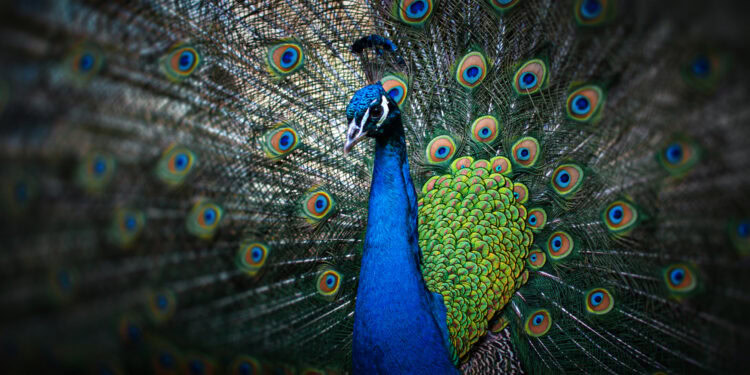
Decorative traits used to attract mates tend to evolve more rapidly than physical weapons used to fight rivals, according to new research published in Proceedings of the Royal Society B. Combining a mathematical model with data from 531 species in 10 animal groups, the researchers found that ornaments evolved faster overall, and their model suggests this is largely because mating preferences in the opposite sex drift unpredictably across generations. In the researchers’ framework, those shifting tastes create a moving evolutionary target for ornaments, whereas the physical demands of male-male competition keep weapons anchored to a steadier evolutionary pace.
Many of nature’s most elaborate features, from giant antlers to intricate courtship calls, persist not because they help an animal survive longer, but because they improve its odds of reproducing. Biologists call this evolutionary process sexual selection, and it operates through two primary channels.
Direct competition within the same sex, most often males fighting or intimidating rivals for access to mates, favors the evolution of weapons: physical structures capable of overpowering opponents or inflicting bodily harm, such as tusks, spurs, leg spines, and enlarged canine teeth. Mate choice, most often females choosing among prospective partners, favors the evolution of ornaments: visual, acoustic, or anatomical traits that appeal to a chooser’s senses, such as vibrant feathers, specialized vocal pitches, expandable throat fans, and elongated eye stalks.
Traits shaped by sexual selection often change faster over evolutionary history than ordinary body parts, yet biologists have debated how the pace of ornament evolution compares with that of weapons. When females favor a flashy male decoration, their offspring inherit genes from their father for the exaggerated ornament alongside genes from their mother for preferring it. Building on an idea first proposed by biologist Ronald Fisher, a 1981 mathematical modeling study indicated that this genetic pairing can trigger rapid, self-reinforcing bursts of evolutionary change.
Don’t miss the next big psychology finding
Every morning, PsyPost sends a short briefing on the most interesting new peer-reviewed research in psychology and neuroscience.
Even when genetic links between preferences and ornaments are modest, the authors of the new study point out that if being picky carries little survival penalty for females, random genetic changes from generation to generation can nudge female tastes in new directions and subject male ornaments to shifting evolutionary pressures.
Combat weapons face a different set of pressures. Rival males can lock into evolutionary arms races of adaptation and counter-adaptation, and some theorists have proposed that male-male competition might spark runaway escalation of its own, though other scientists, including members of the new study’s team, have challenged that idea. Weapons also must remain effective in actual fights, which may limit the range of forms they can take.
Cross-species comparisons have also suggested that the two trait types follow distinct evolutionary rules. For example, a 2019 comparative study of primates, which supplied part of the canine tooth dataset reanalyzed in the new research, found that species with more elaborate ornaments tended to have smaller testes relative to body size, whereas species with larger canine weapons tended to have larger ones.
Mohammadali Dashtbali and Jonathan M. Henshaw of the University of Freiburg, William L. Allen of Swansea University, and their colleagues set out to compare the evolutionary speeds of ornaments and weapons directly.
“The initial idea came from an excellent paper by Erin McCullough, Christine Miller, and Doug Emlen, ‘Why sexually selected weapons are not ornaments,’” Allen, an associate professor of evolutionary and sensory ecology and one of the study’s joint senior authors, told PsyPost. “Among its several important contributions was the proposal that the evolutionary dynamics of weapons should differ fundamentally from those of ornaments. In particular, because the Fisher process — positive feedback between female mating preferences and male ornament traits — does not operate in the same way for weapons, the authors predicted that weapons should evolve more slowly than ornaments. They also noted that this prediction had never been tested.”
“We thought this was a fascinating idea because it makes a clear, testable prediction about one of the fundamental differences between two major forms of sexual selection,” Allen added. “Our aim was therefore to develop a theoretical framework for asking whether ornaments and weapons should evolve at different rates, and then test that prediction using comparative data from across the animal kingdom.”
For the theoretical part of the project, for which all mathematical code, datasets, and analysis files were posted publicly online, the researchers expanded on the 1981 coevolution model to track three inherited traits across generations: male ornament size, male weapon size, and female preference strength for the ornament. The model assumed an effective population size of 1,000, roughly the number of individuals contributing genes to each new generation.
All three traits had a baseline level best suited for everyday survival, meaning that growing an oversized ornament or weapon, or paying the costs of being a picky chooser, reduced survival fitness. Larger weapons always gave males a steady mating advantage regardless of female tastes, whereas a larger ornament helped or hurt a male’s mating prospects depending on the average female preference in the population during that generation.
Alongside predictable selection from survival costs and mating benefits, the team incorporated genetic drift, the random, chance shifts in gene frequencies that occur across generations simply because finite populations do not pass down every gene in exact proportion. Over thousands of generations, this interplay between stabilizing survival pressures and random genetic drift caused population trait averages to bounce back and forth around a long-term balance point, allowing the researchers to measure short-term evolutionary speed from the width of those fluctuations.
Across a wide range of simulated conditions, the mathematical model predicted that male ornaments evolve faster than male weapons. Weapons remained relatively stable near their long-term balance point because their competitive payoff did not depend on shifting preferences in the opposite sex, whereas ornaments fluctuated widely whenever low preference costs allowed genetic drift to move average female tastes over time.
Holding female preferences artificially fixed in the model caused ornaments to slow down and match the evolutionary pace of weapons, and although strong genetic links between ornaments and preferences sped up evolution through mutual feedback, drifting preferences alone were enough to accelerate ornament evolution even without strong genetic coupling. Ornaments continued to outpace weapons in supplementary simulations where weapons shared moderate genetic links with ornaments and preferences, while enlarging the overall population weakened genetic drift and slowed fluctuations across all traits.
Still, the model identified specific conditions under which weapons evolved faster than ornaments. That reversal occurred when strong female preferences carried a heavy survival cost that kept preferences from drifting, or when growing and maintaining weapons was much cheaper for males than producing ornaments.
To test whether real animal lineages match these theoretical dynamics, the team compiled published trait measurements and time-calibrated evolutionary family trees, branching diagrams that use genetic and fossil evidence to map how species are related and estimate when they split from common ancestors. Their final sample spanned 531 unique species across 10 datasets, with individual datasets ranging from 17 to 103 species.
Many animal structures serve dual functions in both combat and courtship, such as the enlarged claw of a male fiddler crab, so the researchers limited their sample to groups where prior work indicated a trait functioned primarily as either a weapon or an ornament. Weapon datasets covered traits used in same-sex competition that can inflict physical harm on rivals and that have not been shown to sway female mate choice, whereas ornament datasets covered continuous traits shown to influence opposite-sex mating decisions without physically injuring same-sex competitors.
To account for broader biological differences such as generation time, each weapon-bearing animal group was matched with the most closely related ornament-bearing group available, producing five paired comparisons. The first two pairs matched leg spine length in leaf-footed bugs with eye-stalk span in stalk-eyed flies, and bite force in anole lizards with the length of the throat bone supporting colorful display fans in agamid lizards. The other pairs matched leg spur length with neck-feather color in landfowl such as pheasants and grouse; tusk length in even-toed hoofed mammals with vocal pitch in carnivorans; and canine tooth length with vocal pitch in primates.
After placing all measurements onto a standardized statistical scale, the scientists used evolutionary regressions to separate trait size from overall body size, alongside a parallel set of analyses on traits unadjusted for body size. They then compared evolutionary speeds using two models of trait change along a family tree: a Brownian motion model, which treats evolution as an unbounded random walk, and an Ornstein-Uhlenbeck model, which pairs random fluctuations with a stabilizing pull back toward an optimal trait size.
Across the 10 datasets, the stabilizing Ornstein-Uhlenbeck model fit the species data better than the unbounded random-walk model for five groups and performed similarly for four others, trailing the simpler model only for anole lizard bite force. When adjusted for body size, ornaments evolved faster than weapons in four of the five matched animal pairs under both evolutionary models, with the insect comparison standing out as the lone exception where leaf-footed bug leg spines evolved faster than stalk-eyed fly eyespans. Combining all five pairs under the better-supported Ornstein-Uhlenbeck model indicated that ornaments evolved at roughly twice the pace of weapons overall, with a standardized evolutionary rate estimate of 0.129 for ornaments compared with 0.064 for weapons.
Even with that overall gap, estimated evolutionary speeds varied widely across the 10 datasets, ranging from 0.02 to 0.19 under the stabilizing model. “We observed large differences in the rate of trait evolution in different groups of animals, only some of which was explained by whether the trait was a weapon or ornament,” Allen noted.
Meanwhile, the difference between ornaments and weapons in the strength of the stabilizing pull back toward an optimal trait value was not statistically significant. In the authors’ reading, this pattern suggests that weapons do not necessarily experience tighter selection against poorly performing forms than ornaments do. The researchers also note that because female preferences could not be measured directly across the 531 species, shifts in optimal ornament size generated by drifting preferences may be absorbed into the higher fluctuation rate estimated for ornaments.
When the combined datasets were evaluated under the unbounded Brownian motion model, or when traits were analyzed without adjusting for body size under either model, the overall rate difference between ornaments and weapons was not statistically significant. Because overall body size is not expected to evolve at different speeds in weapon-bearing versus ornament-bearing animals, the authors suggest that leaving body size in the measurements may dilute differences between the sexual traits themselves.
“More broadly, we think the study illustrates how combining theoretical and comparative approaches can reveal mechanisms that would be difficult to identify from either approach alone,” Allen explained. “The theory generates a prediction, while the comparative analysis allows us to ask whether that prediction is reflected in patterns of evolution across real animal groups.”
“Our paper shows how evolution acts on the two main kinds of sexually selected traits – weapons and ornaments – in different ways, and that this affects the rate of trait evolution,” he said. “More generally it shows how evolutionary models can help us understand the diversity of animal life in the past and present, and allow us to predict what might happen in the future.”
There are a few things to keep in mind when interpreting these findings. Most notably, the overall twofold rate advantage for ornaments in the cross-species data emerged only under the stabilizing model and only after statistically removing body size using regression residuals, a common comparative method that the authors acknowledge can introduce statistical biases into evolutionary rate estimates.
Focusing strictly on traits that function primarily as either weapons or ornaments also meant excluding the many animal structures, such as the enlarged claws of fiddler crabs, that serve simultaneously in male combat, female attraction, or defense against predators, leaving open how fast multipurpose traits evolve. In addition, two of the matched animal comparisons spanned vast stretches of evolutionary time, with the two lizard families splitting roughly 146 million years ago and the ancestors of leaf-footed bugs and stalk-eyed flies diverging about 351 million years ago. Differences in population sizes or species diversification rates may have influenced those comparisons and contributed to the reversal seen in insects.
On the theoretical side, the mathematical model simplified natural populations by tracking just one ornament and one weapon in a well-mixed group with fixed genetic variation and no mechanical representation of fighting performance. Future research that incorporates multiple courtship signals, realistic combat biomechanics, local mate availability, and evolutionary episodes where traits are lost altogether could shed further light on how sexual selection shapes trait diversity across the animal kingdom.
“There are several directions we would like to pursue,” Allen said. “One is to understand in more detail why sexually selected traits evolve at different rates in different groups, and how ecological and behavioral factors influence these dynamics.”
The study, “Ornaments evolve faster than weapons,” was authored by Mohammadali Dashtbali, Louisa Hutton-Adams, Megan Watts, Jonathan M. Henshaw, and William L. Allen.
