Subscribe
The latest psychology and neuroscience discoveries.
My Account
  • Mental Health
  • Social Psychology
  • Cognitive Science
  • Neuroscience
  • About
No Result
View All Result
PsyPost
PsyPost
No Result
View All Result
Home Exclusive Cognitive Science

Here is what goes wrong in the brain when someone can’t spell

by Johns Hopkins University
February 2, 2016
in Cognitive Science
Photo credit: Johns Hopkins University

Photo credit: Johns Hopkins University

Share on TwitterShare on Facebook

By studying stroke victims who have lost the ability to spell, researchers have pinpointed the parts of the brain that control how we write words.

In the latest issue of the journal Brain, Johns Hopkins University neuroscientists link basic spelling difficulties for the first time with damage to seemingly unrelated regions of the brain, shedding new light on the mechanics of language and memory.

“When something goes wrong with spelling, it’s not one thing that always happens — different things can happen and they come from different breakdowns in the brain’s machinery,” said lead author Brenda Rapp, a professor in the Department of Cognitive Sciences. “Depending on what part breaks, you’ll have different symptoms.”

Rapp’s team studied 15 years’ worth of cases in which 33 people were left with spelling impairments after suffering strokes. Some of the people had long-term memory difficulties, others working-memory issues.

With long-term memory difficulties, people can’t remember how to spell words they once knew and tend to make educated guesses. They could probably correctly guess a predictably spelled word like “camp,” but with a more unpredictable spelling like “sauce,” they might try “soss.” In severe cases, people trying to spell “lion” might offer things like “lonp,” “lint” and even “tiger.” With working memory issues, people know how to spell words but they have trouble choosing the correct letters or assembling the letters in the correct order — “lion” might be “liot,” “lin,” “lino,” or “liont.”

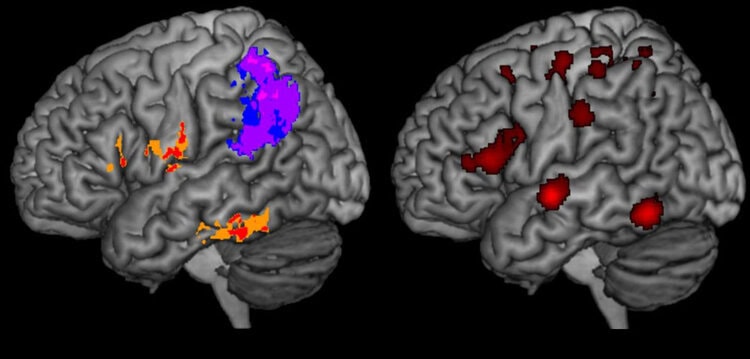
The team used computer mapping to chart the brain lesions of each individual and found that in the long-term memory cases, damage appeared on two areas of the left hemisphere, one towards the front of the brain and the other at the lower part of the brain towards the back. In working memory cases, the lesions were primarily also in the left hemisphere but in a very different area in the upper part of the brain towards the back.

“I was surprised to see how distant and distinct the brain regions are that support these two subcomponents of the writing process, especially two subcomponents that are so closely inter-related during spelling that some have argued that they shouldn’t be thought of as separate functions,” Rapp said. “You might have thought that they would be closer together and harder to tease apart.”

Though science knows quite a bit about how the brain handles reading, these findings offer some of the first clear evidence of how it spells, an understanding that could lead to improved behavioral treatments after brain damage and more effective ways to teach spelling.

Google News Preferences Add PsyPost to your preferred sources
Previous Post

Psychologists discover the most common relationship dealbreakers

Next Post

Seeing exemplary peer work can undermine performance

RELATED

How common is anal sex? Scientific facts about prevalence, pain, pleasure, and more
Cognitive Science

New psychology research reveals that wisdom acts as a moral compass for creative thinking

March 6, 2026
Hemp-derived cannabigerol shows promise in reducing anxiety — and maybe even improving memory
Alcohol

Using cannabis to cut back on alcohol? Your working memory might dictate if it works

March 5, 2026
Chocolate lovers’ brains: How familiarity influences reward processing
Cognitive Science

A single dose of cocoa flavanols improves cognitive performance during aerobic exercise

March 4, 2026
Heart and brain illustration with electrocardiogram waves, representing cardiovascular health and neurological connection, suitable for psychology and medical research articles.
Cognitive Science

Fascinating new research reveals your heart rate drops when your brain misperceives the world

March 4, 2026
Colorful digital illustration of a human brain with neon wireframe lines, representing neuroscience, psychology, and brain research. Ideal for psychology news, brain health, and cognitive sciences articles.
Cognitive Science

New research on acquired aphantasia pinpoints specific brain network responsible for visual imagination

March 3, 2026
Traumatic brain injury may steer Alzheimer’s pathology down a different path
Cognitive Science

Growing up with solid cooking fuels linked to long-term brain health risks

March 1, 2026
The disturbing impact of exposure to 8 minutes of TikTok videos revealed in new study
Cognitive Science

Problematic TikTok use correlates with social anxiety and daily cognitive errors

March 1, 2026
Why most people fail to spot AI-generated faces, while super-recognizers have a subtle advantage
Artificial Intelligence

Why most people fail to spot AI-generated faces, while super-recognizers have a subtle advantage

February 28, 2026

STAY CONNECTED

LATEST

New research sheds light on the psychological recipe for a grudge

Eating ultra-processed foods is not linked to faster mental decline, study finds

Hypocrisy and intolerance drive religious doubt among college students

A single dose of DMT reverses depression-like symptoms in mice by repairing brain circuitry

Apocalyptic views are surprisingly common among Americans and predict responses to existential hazards

A psychological need for certainty is associated with radical right voting

Blocking a common brain gas reverses autism-like traits in mice

New psychology research sheds light on why empathetic people end up with toxic partners

PsyPost is a psychology and neuroscience news website dedicated to reporting the latest research on human behavior, cognition, and society. (READ MORE...)

  • Mental Health
  • Neuroimaging
  • Personality Psychology
  • Social Psychology
  • Artificial Intelligence
  • Cognitive Science
  • Psychopharmacology
  • Contact us
  • Disclaimer
  • Privacy policy
  • Terms and conditions
  • Do not sell my personal information

(c) PsyPost Media Inc

Welcome Back!

Login to your account below

Forgotten Password?

Retrieve your password

Please enter your username or email address to reset your password.

Log In

Add New Playlist

Subscribe
  • My Account
  • Cognitive Science Research
  • Mental Health Research
  • Social Psychology Research
  • Drug Research
  • Relationship Research
  • About PsyPost
  • Contact
  • Privacy Policy

(c) PsyPost Media Inc