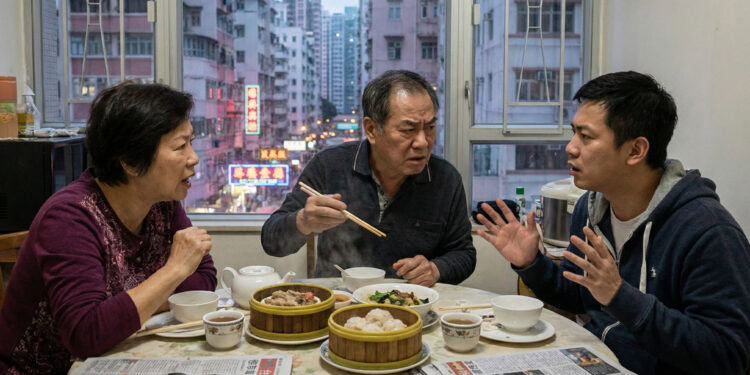
A recent study published in the Journal of Social and Personal Relationships suggests that political disagreements within families can harm relational and individual mental health by breaking down positive communication. The research provides evidence that maintaining open and respectful dialogue is necessary to protect family bonds and personal well-being when relatives hold conflicting political or moral views.
Political polarization often transforms everyday decisions into highly charged emotional and moral conflicts. In regions experiencing intense political division, mundane choices like where to shop or eat can become politicized and create ongoing stress within families. Much of the previous research on family political conflict has focused on strict binary divides, such as liberals opposing conservatives or pro-government supporters opposing anti-government activists.
Yet, in highly polarized environments, political neutrality is not always seen as a peaceful middle ground. People who identify as neutral often hold strong views that criticize both sides, or they may be viewed by politically active family members as failing to take a stand against injustice.
“The motivation for this study stems from the long-standing political conflicts in Hong Kong Special Administrative Region (HKSAR), beginning with the 2014 ‘Umbrella Movement’ and intensifying during the 2019 social unrest,” explained study author Branda Yu, a research assistant professor in the Department of Social Work and Social Administration at The University of Hong Kong, who conducted the research in collaboration with Christian Chan
“We observed an unprecedented level of family conflicts due to political discordance, including instances of estrangement, which felt even more intense than the political divides often reported in the West. We were driven to understand how these deep-seated political disagreements affect family relationships and personal well-being, especially as navigating such discord is a relatively novel challenge for families in HKSAR.”
“This research builds upon our 2021 study, conducted two years after the 2019 social unrest, which found that 5.7% of respondents remained estranged from family members due to political conflict, and approximately 42% reported significant political disagreements within their families. These highlight the enduring impact of political polarization in HKSAR. Ultimately, our work seeks to understand the resilience of family bonds in the face of political disagreement.”
To investigate these family dynamics, the researchers recruited 586 ethnic Chinese residents of Hong Kong. This region experienced massive social unrest in 2019, creating a deep political divide between a pro-democracy, anti-government movement known as the “yellow” camp, and a pro-government, pro-police establishment known as the “blue” camp. Because housing costs in Hong Kong are exceptionally high, many young adults live with their parents, making family political tension a daily reality for many residents.
The sample included 492 young adults with an average age of about 24, and 94 parents with an average age of about 55. Participants completed an initial online survey that asked them to rate their own political stances and the perceived political stances of their parents or adult children. The researchers categorized these parent-child pairs, or dyads, into different groups based on their political alignment on a spectrum from the yellow camp to the blue camp, as well as a neutral middle ground.
The survey measured how much participants felt their family members differed from them in their support for the local government, the police, and anti-government protesters. Participants also completed standardized questionnaires to assess their levels of positive family communication, overall family functioning, and psychological distress. Positive family communication was defined as sharing ideas, expressing emotions, making joint decisions, and showing mutual respect.
Psychological distress was measured by asking participants about their recent experiences with symptoms of depression, anxiety, and stress. The scientists also accounted for factors like gender, educational background, whether the family members lived together, and how often they used online social forums. A subset of 200 participants completed a second survey two weeks later to track how communication and mental health changed over time.
The researchers found that families with differing political views reported greater divides in their support for the government and police compared to families where members shared the same politics. This was true even for pairs where one person was partisan and the other was neutral. Participants in families with a yellow-neutral divide or a yellow-blue divide reported poorer family functioning and less positive communication overall.
When looking at the data collected over two weeks, the researchers identified how political differences translated into family and personal problems. A decline in positive communication served as the primary bridge linking political disagreement to increased psychological distress. For individuals in yellow-neutral and yellow-blue pairs, the reduction in respectful and affectionate communication explained the deterioration in family functioning.
Families dealing with a blue-neutral divide, however, did not experience the same drop in family functioning. Individuals in these pairs actually showed a slight reduction in psychological distress over time, which suggests that not all types of political disagreement place the same strain on a family.
“In the context of HKSAR’s ‘Yellow’ (pro-democracy) and ‘Blue’ (pro-government) divide, we expected discordance between Blue and Neutral individuals to mirror other forms of discordant parent-child pairs,” Yu told PsyPost. “However, we found that those strongly aligned with the Yellow camp tend to view Neutral family members in ways similar to those aligned with the Blue camp. This pattern reflects a much more complex and polarized landscape, in which neutrality itself is often viewed through a biased lens.”
In other words, the findings suggest that supporters of the anti-government movement might view neutrality as a moral failure to side with the oppressed. This aligns with Moral Foundations Theory, a concept suggesting that political views are rooted in core psychological values like fairness, loyalty, and harm prevention. When someone views their political stance as a moral duty, staying neutral can be seen as betraying those foundational values.
As a result, neutral family members may face similar levels of tension and frustration from their politically active relatives as those who hold directly opposing views. Without communication strategies that emphasize mutual respect, minor daily hassles can escalate into significant psychological distress. Families experiencing this intense political discord tend to express less affection, which ultimately undermines the supportive qualities of the parent-child relationship.
“The key takeaway is that political disagreement harms families primarily because it leads to a decline in positive communication, particularly when political differences are interpreted as clashes of core moral values,” Yu explained. “Our findings highlight the importance of navigating these conflicts by emphasizing respect for divergent views. By maintaining open, constructive dialogue while acknowledging differing values, family members may preserve emotional closeness and safeguard their well-being, even when they disagree on politics.”
While the study offers a detailed look at family political conflict, there are some limitations to consider. The participants were recruited through social media advertisements, resulting in a sample that was primarily younger and highly educated. This means the findings might not fully represent the experiences of the broader population or families from different socioeconomic backgrounds.
Additionally, the study relied on the reports of a single family member to describe the entire parent-child relationship. Because parents and adult children can sometimes perceive the same relationship differently, gathering data from both sides of the family would offer a more complete picture of these communication breakdowns.
“We are expanding this work in several directions, including whether these divided views are driven by moral intuitions and how they affect family relationships cross-culturally, and also parent-adult child interactions within these discordant families,” Yu said. “In addition, we are working on ongoing projects focusing on intergenerational communication.”
The study, “Intrafamilial political discordance impacts familial and psychological well-being through reduced positive communication,” was authored by Branda Yee-Man Yu and Christian S. Chan.