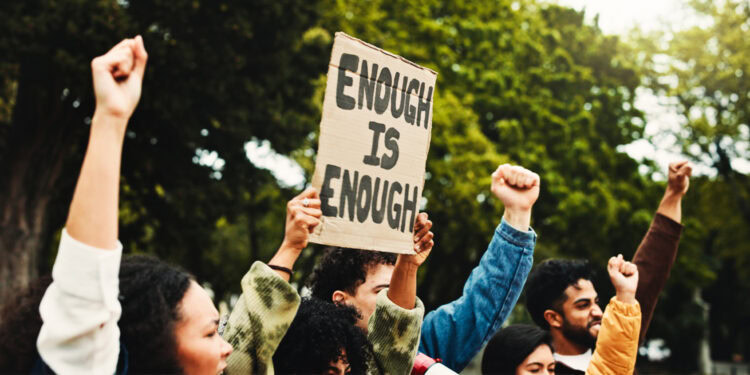

When Americans feel angry about the state of the country, their gender and racial identities appear to shape whether they channel that emotion into formal campaigns or street protests. A recent study reveals that angry Black women and white women participate across a wider variety of political avenues than their male counterparts. The research was published in Public Opinion Quarterly.
Political scientists study emotion to understand what drives people to become politically active. Anger often acts as a catalyst. It encourages individuals to take action against perceived threats by volunteering for campaigns, donating money, or attending demonstrations. Emotion bridges the gap between holding an opinion and actually doing something about it.
However, people only turn to formal electoral politics if they believe the system will respond to their voices. Political scientists refer to this belief as political efficacy. Historical barriers, ongoing discrimination, and unequal access to resources mean that different demographic groups experience distinct levels of political efficacy. As a result, groups view the available pathways for political change in fundamentally different ways.
Past research established a gap between how white and Black Americans express political anger. Those earlier studies found that white Americans generally channel their anger into electoral participation, such as campaigning. In contrast, Black Americans often turn toward non-electoral participation, like protesting, largely because of historical exclusion and lower trust in the formal political system.
Sara Morell, a political scientist at The College of New Jersey, and Marzia Oceno, a political scientist at Florida International University, suspected this racial divide missed a piece of the puzzle. They wanted to see how gender overlaps with race to shape political behavior.
Feminist movements and civil rights movements have distinct histories of using protests, boycotts, and campaigns to push for change. Because Black women and white women possess different historical relationships with the political establishment than men, the researchers expected to find distinct patterns in how these groups act when provoked by political events.
To test these expectations, the researchers analyzed data from a large survey conducted around the 2020 presidential election. The sample included 6,661 adults who identified as white or Black and male or female. The survey asked respondents how angry, outraged, or irritated they felt about how things were going in the country. The researchers controlled for factors like age, education, and household income.
The 2020 survey then measured electoral participation. Respondents reported whether they tried to persuade others to vote a certain way, attended online or in-person rallies, or wore political buttons. They also noted if they had worked for a campaign or donated money to a political group. Finally, the survey tracked self-reported voter turnout for the November election.
The researchers found distinct differences in how anger predicted campaign involvement across the four groups. As expected, white men who reported high levels of anger were much more likely to engage in formal electoral activities. They focused on persuading voters, attending online rallies, and donating money. Black men largely did not show increased electoral participation when angry, and were actually less likely to report working for a campaign.
The patterns looked entirely different for women. Both white women and Black women showed higher levels of electoral participation when they felt angry. This suggests that women utilize a broad set of formal political tools when they feel threatened or upset by national conditions.
Black women, in particular, reported the highest average levels of anger in 2020. This intense emotion translated directly into the largest measured increase in campaign engagement among all four groups. Angry Black women were highly mobilized to persuade others, wear political buttons, and work for campaigns. The results point to Black women’s central role as active organizers in modern electoral politics.
For both white men and white women, anger did not predict whether they actually cast a ballot. The researchers suggest this is because voting is a baseline expectation for many politically active people. Anger instead motivates individuals to take on political activities that require more time and effort than the standard act of voting, such as volunteering or donating.
Next, the researchers analyzed a separate large panel survey to measure non-electoral participation. This study tracked 3,529 adults across two periods. The first wave occurred immediately after the 2020 election, and the second wave occurred after the 2022 midterm elections.
This second survey focused on activities outside of formal campaigns. Respondents reported whether they had attended a protest or a political rally. They also indicated if they had signed an online petition, posted a political message online, or boycotted a product for political reasons over the previous year.
Once again, white men followed expected historical patterns. Their anger did not lead to higher rates of non-electoral participation in either 2020 or 2022, aside from a slight increase in boycotting during the 2022 wave. White men typically rely on the formal electoral system, rather than outside pressure, to express their grievances.
Black men showed a delayed response in their non-electoral participation. In 2020, their anger was not statistically significant in predicting protest or petition activity. By 2022, however, angry Black men were substantially more likely to engage in non-electoral activities, primarily by signing petitions and posting political messages online.
Women again showed much broader avenues of engagement. White women were highly likely to translate their anger into non-electoral action during both 2020 and 2022. They frequently signed petitions and boycotted products. During the 2022 wave, which followed the Supreme Court decision overturning federal abortion protections, white women reported the highest levels of anger among all groups and maintained their high rate of non-electoral activity.
For Black women, anger was consistently linked to one specific form of non-electoral action. In both 2020 and 2022, angry Black women were uniquely motivated to attend protests. They were the only group to show a persistent link between anger and physical protesting across both survey waves. This finding aligns with the historical centrality of Black women in civil rights and social justice demonstrations.
The researchers note a few limitations to keep in mind when interpreting these results. The surveys asked respondents about their general anger toward the state of the country, rather than asking them to identify the specific issues making them angry. Because the data lacks this specificity, it is impossible to know exactly which policies or events drove different demographic groups to the streets or the campaign trail.
The lack of issue specificity makes it difficult to explain some unexpected results, such as why Black men’s anger did not lead to higher protest attendance in 2020. That year featured massive nationwide protests against police brutality, an issue with profound relevance to Black men. The researchers suspect that for some groups, anger might need to combine with other psychological factors to trigger physical action. A strong sense of community fate or intense personal interest might be necessary to push an angry individual to join a physical protest.
Future research should investigate whether specific sources of anger change how people choose to participate. The researchers also recommend expanding this intersectional approach to include Hispanic and Asian American populations. Understanding how overlapping identities influence political emotion helps reveal the diverse ways Americans fight for their political interests.
The study, “The Intersectional Anger Gap: How Race and Gender Condition the Impact of Anger on Participation,” was authored by Sara Morell and Marzia Oceno.