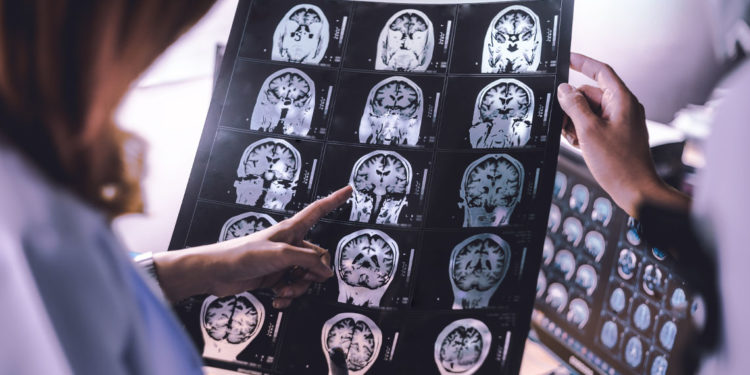
New research has mapped lesions to specific brain regions to risk of depressive symptoms. The findings, published in the journal Brain, suggest that two brain networks might be important targets for new therapies to treat depression.
“It is well documented that brain lesions can lead to depressive symptoms, but not in everyone,” study author Nicholas T. Trapp, assistant professor and director of the Interventional Psychiatry and Psychiatric Neuromodulation Program at the University of Iowa. “The literature suggests that lesioning certain brain regions can place patients at a greater risk of developing mood symptoms than others. However, this literature is mixed (not all studies find the same thing) suggesting that a larger sample size would be needed to detect any significant or reproducible findings.”
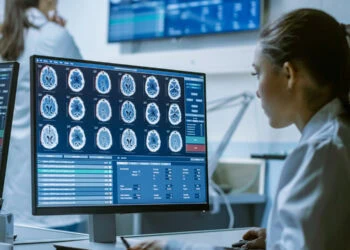
For their study, the researchers analyzed brain imaging scans and depression scores from 526 patients who had acquired localized areas of brain injury from a stroke or other type of traumatic brain injury. The data came from two large patient registries: the Patient Registry of the Division of Behavioral Neurology and Cognitive Neuroscience at the University of Iowa Department of Neurology and the Vietnam head injury study, which is affiliated with researchers at Northwestern University.
The patients’ data allowed Trapp and his team to investigate whether the location of the brain lesions were associated with levels of depression experienced by the patients in the months following the brain injury.
“At the University of Iowa, we have a large registry of patients who have had brain lesions and extensive neuropsychological testing, collected over decades. Aaron Boes, Dan Tranel, Ken Manzel, and Joel Bruss (authors on the paper) have spent years collecting and analyzing this data,” Trapp said. “We teamed up with researchers at Northwestern University and the Shirley Ryan AbilityLab (primarily Jordan Grafman) to examine one of the largest lesion datasets to date to ask the question: are there certain brain regions that are more associated with depression than others when lesioned?”
“This was an interesting question to me because the findings could help us to better understand the brain regions involved in the development of depression or mood disorders, and to identify regions of interest to focus on in future treatment trials using targeted brain stimulation technologies.”
The brain regions most strongly associated with increased depression included the bilateral anterior insula and dorsolateral prefrontal cortex. These regions coincided with the nodes of the brain’s salience network, which is involved in monitoring the environment and helping to prioritize actions.
“This is a very interesting area of the brain involved in autonomic functioning, salience, and attention shifting, which has not been implicated in most similar studies, potentially because of the way prior analyses have been done or because of smaller sample sizes,” Trapp explained.
The brain regions that were associated with reduced depression included the right orbitofrontal cortex, the right medial prefrontal cortex, and right inferolateral temporal lobe. These regions are part the default mode network, which is active during times of rest and introspective thought. Studies suggest that the DMN helps to process self-referential information and autobiographical memories. It has also been linked to mind-wandering and daydreaming.
“This network is implicated in depressive rumination and has been shown to be dysfunctional in various cognitive and neuropsychiatric disorders,” Trapp noted.
The findings demonstrate that “not all lesions are created equal when it comes to association with depression symptoms,” Trapp told PsyPost. “Some regions are associated with a higher depression symptom burden than others. Interestingly, some brain regions seem to be associated with report of less depressive symptoms after lesioning as well. This doesn’t mean the patient is not impaired, but could mean that emotion processing has been altered in a way that causes the patient to report less depression.”
“Additionally, depression does not localize to one spot in the brain. This study suggests that there are unique brain networks, involving many parts of the brain, that are involved in emotion processing, and lesioning ‘hubs’ of different networks can be associated with differential report of mood symptoms.”
But as with any study, the new research includes some caveats.
A standardized questionnaire, known as the Beck Depression Inventory, was used to assess depression in the patients. Trapp noted that the “timing of when they were assessed was variable, and we can’t comment much on the longitudinal trajectory of their symptoms. Also, we cannot assume that major depressive disorder, or ‘clinical depression,’ is the same as depression after a brain lesion, although there is some evidence to suggest similar brain mechanisms are at play.”
“Additionally, this study focuses on a fancy multivariate correlation analysis between a lesion and depressive symptoms. This study does not prove that the lesion caused the depression, which is an important caveat. The population in this study was predominantly White, and so further work needs to be done studying other demographic groups.”
“Next steps will be to determine if this finding can be replicated in other samples, and potentially investigating the implicated brain regions with brain stimulation-based studies that can offer more causative inferences,” Trapp told PsyPost.
“This was a team effort! My collaborators and co-authors on this project deserve a lot of the credit for creating this finished product,” he added. “And the most important contributors are the patients who donated their time, often at points in their life where they were suffering, and remained generous and other-centered to proceed with participation in research.”
The study, “Large-scale lesion symptom mapping of depression identifies brain regions for risk and resilience“, was authored by Nicholas T. Trapp, Joel E. Bruss, Kenneth Manzel, Jordan Grafman, Daniel Tranel, and Aaron D. Boes.