People across three very different societies—Scotland, Pakistan, and Papua—show notable cultural and age-related differences in how much they prefer decorated objects, according to a new study published in Evolutionary Psychology.
Human ornamentation has existed for tens of thousands of years, appearing in archaeological sites spanning North Africa to Australia. Theories as to why ornamentation is so widespread have ranged from perceptual processing advantages, social identity, and costly signaling, to evolved aesthetic tendencies.
Many prior studies have focused on prehistoric records or Indigenous groups far removed from Western influence, leaving open the question of whether modern cultural shifts, particularly Western minimalism, have altered people’s underlying preferences for ornamentation.
To address this gap, Piotr Sorokowski and colleagues examined whether cultural environment and age shape people’s appreciation for decorated versus plain objects. Their approach was grounded in evolutionary psychology and developmental research showing that even across diverse societies, children often draw, adorn, and embellish objects spontaneously. This raises the possibility that preference for ornamentation might emerge early in life and only later be molded or suppressed by cultural norms.
The researchers recruited 215 parent-child dyads across three cultural contexts: Scotland (the most WEIRD location), Pakistan (moderately WEIRD), and Papua (a minimally Western-influenced region). Dyads were recruited online in Scotland and Pakistan through an international research company, and in person in Papua via snowball sampling.
The final sample included 84 dyads from Scotland, 88 from Pakistan, and 43 from Papua (Dani and Yali tribes in the Baliem Valley and Yalimo Highlands). Adults, who completed the task first, and children completed the same object-choice paradigm independently.
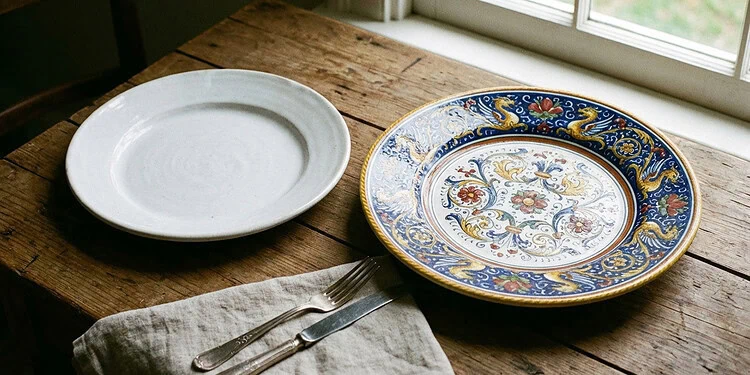
Each participant viewed six pairs of images representing everyday items: three plates and three shirts. In every pair, one item appeared in a plain design while the other incorporated a simple ornament such as a floral motif, leaf pattern, or abstract line drawing. The researchers selected objects expected to be universally recognizable and culturally neutral to facilitate comparable interpretation across societies.
Participants indicated which object they preferred for each pair, and the presentation order and left-right positioning of ornamented items were systematically varied to reduce patterns and side biases. Demographic data, including age, sex, and place of residence, were also collected. From the six choices, the researchers derived three preference scores for each participant: one for ornamented plates, one for ornamented shirts, and one aggregated score reflecting overall ornamentation preference.
Across all analyses, strong cultural differences emerged. Participants from Papua showed the highest preference for ornamented objects, followed by participants from Pakistan, while Scottish participants demonstrated the lowest enthusiasm for decoration. These differences were robust across plates, shirts, and overall scores. The results support the idea that cultural context, particularly Western minimalism, suppresses ornamentation preferences.
The researchers also observed age differences, but primarily within the Scottish sample. Children generally preferred ornamented objects more than adults. This pattern was strongest in Scotland, where it was significant for both shirts and the aggregated preference score. In Pakistan, the difference was more modest and found only for shirts; in Papua, adults and children showed similarly high enthusiasm for ornamented designs. Correlations also revealed moderate similarity between parents and children within dyads, and ornamentation preference tended to decline with age in the Scottish sample.
A key finding is that children across cultures, especially in the Western sample, favored ornamentation more than adults, suggesting that younger individuals may display a more “baseline” or biologically rooted preference before cultural norms exert their influence. The authors argue that Papuan adults may be closer than Western adults to this natural preference level, given their similarity to children’s choices.
One limitation is that only two object types (plates and shirts) were used; broader categories such as home décor, architecture, or sculpture were not tested.
Overall, the findings suggest that humans may possess an evolutionarily grounded inclination toward ornamentation, one that can be dampened, but not erased, by cultural forces such as Western minimalism.
The research, “Is Ornamentation a Universal Human Preference? Cross-Cultural and Developmental Evidence From Scotland, Pakistan, and Papua,” was authored by Piotr Sorokowski, Jerzy Luty, Wiktoria Jędryczka, and Michal Mikolaj Stefanczyk.