

Scientists have uncovered strong evidence suggesting that as we age, our brains may tap into unused regions to help maintain cognitive function despite the natural decline that comes with getting older. The research, published in the journal eLife, shows that older adults who perform better on cognitive tasks may be benefiting from this unique form of brain adaptability, particularly within a region involved in visual attention.
The study was driven by a desire to understand why some older adults maintain better cognitive function than others and how the brain compensates for the loss of its tissue over time. As we age, our brain’s structure changes, leading to potential declines in cognitive performance. However, not everyone experiences these declines to the same extent.
Previous research hinted at the possibility that some brains might counterbalance age-related losses by recruiting other brain areas for help. A team of researchers led by scientists at the University of Cambridge in collaboration with the University of Sussex aimed to explore this compensatory mechanism further, hoping to shed light on potential interventions to support cognitive health in the aging population.
Study lead Kamen Tsvetanov, an Alzheimer’s Society Dementia Research Leader Fellow at the University of Cambridge, said: “Our ability to solve abstract problems is a sign of so-called ‘fluid intelligence’, but as we get older, this ability begins to show significant decline. Some people manage to maintain this ability better than others. We wanted to ask why that was the case – are they able to recruit other areas of the brain to overcome changes in the brain that would otherwise be detrimental?”
To investigate these mechanisms, the researchers enlisted 223 healthy adults, ranging in age from 19 to 87, from the Cambridge Centre for Ageing & Neuroscience project. These participants underwent functional magnetic resonance imaging (fMRI) scans, a type of brain scan that measures and maps the brain’s activity by detecting changes in blood flow.
During the scanning session, participants were asked to complete a modified version of the Cattell Culture Fair Intelligence Test, specifically adapted for use in the scanner environment. This test involved a series of “odd-one-out” puzzles that varied in difficulty, challenging the participants to identify the unique item among a set of four based on various properties such as shape or pattern. The task was designed to stimulate specific brain regions associated with fluid intelligence and to assess how these areas might recruit additional support from other parts of the brain.
As expected, the researchers found that overall performance on the cognitive tasks declined with age. However, the analysis of brain activity offered new insights into how the brain might adapt to maintain cognitive function.
A key discovery was the identification of two brain regions — the cuneal cortex and the frontal cortex — where increased activity correlated with both advancing age and cognitive performance levels. This pattern of brain activity suggested that these regions might be stepping in to help counterbalance the decline in cognitive functions typically seen with aging.
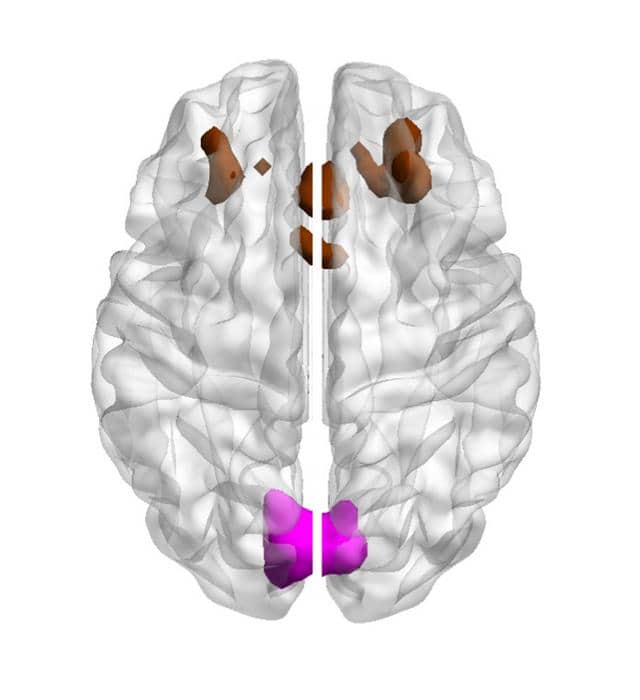
However, upon further analysis using multivariate Bayesian decoding, a technique that assesses whether specific patterns of brain activity contain additional information useful for performing tasks, a significant distinction between these two regions emerged.
The cuneal cortex, a region involved in visual attention, showed a remarkable pattern: the additional information contained within its activity patterns increased with age. This suggests that older adults, especially those performing better on cognitive tasks, might be leveraging this area of the brain more effectively to maintain cognitive performance. This increased reliance on the cuneal cortex could reflect a strategic adaptation of the brain, potentially facilitating a more focused attention to the visual aspects of the puzzles used in the study.
Contrastingly, the frontal cortex did not show the same pattern of age-related increase in task-relevant information. Despite initial indications that this area might also be contributing to compensatory mechanisms, the deeper analysis revealed that its increased activation with age did not translate into a meaningful boost in performance on the cognitive tasks.
This finding challenges the notion that all increases in brain activity with age are beneficial or compensatory. Instead, it suggests that the brain’s response to aging is nuanced, with some regions offering genuine support to cognitive processes and others perhaps reflecting the increased effort required to achieve similar levels of performance seen in younger adults.
Importantly, the study controlled for possible confounding factors, such as changes in brain blood flow due to aging, reinforcing the conclusion that these effects were related to neural activity and not just age-related vascular changes.
Despite these significant findings, the research is not without its limitations. For instance, the study’s design does not allow for a clear understanding of whether the increased activation in the cuneal cortex is a direct cause of improved cognitive performance or simply associated with it. Moreover, the researchers note that future studies could benefit from incorporating measures like eye-tracking to better understand the relationship between eye movements, attention, and cognitive performance.
Looking ahead, the team suggests further research to explore other brain regions and their potential compensatory roles in aging. Additionally, there’s a call for more longitudinal studies—research that follows the same individuals over time—to better understand how these brain changes develop and whether specific interventions could enhance cognitive resilience in older adults.
“Now that we’ve seen this compensation happening, we can start to ask questions about why it happens for some older people, but not others, and in some tasks, but not others,” said Ethan Knights from the Medical Research Council Cognition and Brain Sciences Unit at Cambridge. “Is there something special about these people – their education or lifestyle, for example – and if so, is there a way we can intervene to help others see similar benefits?”
The study, “Neural Evidence of Functional Compensation for Fluid Intelligence in Healthy Ageing“, was authored by Ethan Knights, Richard N. Henson, Alexa M. Morcom, Daniel J. Mitchell, and Kamen A. Tsvetanov.