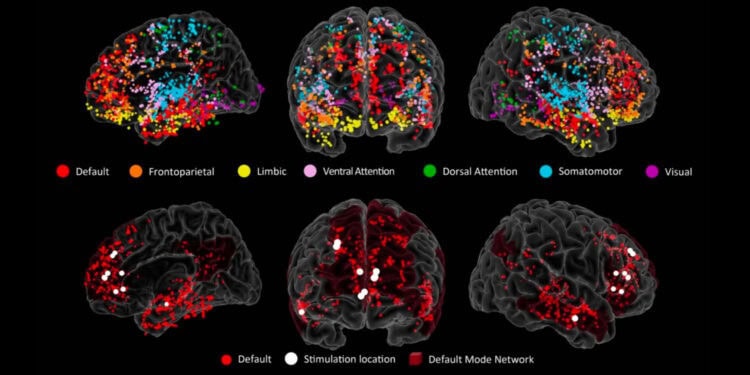

Creativity is one of the most enigmatic and celebrated human capacities, driving everything from artistic expression to scientific innovation. But what actually happens in the brain when we think creatively? A recent study led by researchers from the University of Utah Health and Baylor College of Medicine sheds new light on this question, revealing that the brain’s Default Mode Network (DMN) plays a critical and causal role in generating creative ideas.
The study, published in the journal BRAIN, found that when participants engaged in a task requiring creative thinking—specifically, coming up with novel uses for everyday objects—the DMN became highly active. Furthermore, when researchers temporarily dampened activity in specific regions of the DMN, the participants’ creative abilities noticeably diminished, even though other cognitive functions, such as mind wandering, remained unaffected. This discovery not only strengthens the association between the DMN and creativity but also demonstrates that the network is essential for the generation of original ideas.
The DMN is a complex network of brain regions that is most active when we are at rest, lost in thought, or daydreaming. The DMN has been associated with introspective processes like recalling memories, envisioning the future, and considering the thoughts of others. It has also been implicated in a range of mental health conditions, such as depression, where the network appears to be overactive.
While numerous studies using brain imaging techniques like functional MRI have linked the DMN to various cognitive functions, including creativity, these studies have largely been correlational. They showed that DMN activity often accompanies creative thought, but they could not prove that the DMN is necessary for creativity to occur. This study aimed to move beyond correlation to establish a direct causal relationship between DMN activity and creative thinking.
To explore the role of the DMN in creativity, the researchers recruited 13 participants who were undergoing treatment for epilepsy at Baylor St. Luke’s Medical Center. These participants had intracranial electrodes implanted in their brains for clinical monitoring. This unique setup allowed the researchers to record electrical activity from specific brain regions with high temporal and spatial precision while the participants performed various cognitive tasks.
The participants were asked to perform three different tasks while their brain activity was recorded. The first was a creative thinking task known as the Alternate Uses Task, where participants had to list as many novel uses as possible for everyday objects like a chair or a paperclip. The second task was a mind-wandering task, where participants simply let their thoughts roam freely while focusing on a neutral visual stimulus. The third task was a sustained attention task, which served as a control to compare against the creative and mind-wandering tasks.
The researchers focused on two specific types of brain waves: theta waves, which are associated with long-range communication between brain regions, and gamma waves, which are linked to local neural activity. They also used electrical stimulation to temporarily disrupt the activity in specific regions of the DMN to see how this would affect the participants’ performance on the creative thinking task.
Participants were asked to complete three distinct tasks while their brain activity was recorded: a creative thinking task known as the Alternate Uses Task, a mind-wandering task, and a sustained attention task. The Alternate Uses Task required participants to generate as many novel uses as possible for common objects, such as a chair or a paperclip. The mind-wandering task involved participants fixating on a neutral visual stimulus while allowing their thoughts to wander freely. The sustained attention task served as a control, requiring participants to focus on a simple visual cue and respond accordingly.
The researchers focused on analyzing two specific types of brain waves: theta waves, which are associated with long-range communication between brain regions, and gamma waves, which are linked to local neural activity. By examining the patterns of these brain waves, the researchers could infer how different regions of the DMN and other brain networks interacted during the tasks. Additionally, in a subset of participants, the researchers used electrical stimulation to temporarily disrupt activity in specific regions of the DMN. This allowed them to observe how dampening DMN activity affected participants’ performance on the creative thinking task.
The findings revealed that the DMN plays a critical role in creative thinking. During the Alternate Uses Task, the DMN exhibited a distinctive pattern of activity: it became highly active when participants were presented with an object and asked to think of novel uses for it. As participants generated and evaluated their ideas, the DMN synchronized with other brain networks involved in executive functions, such as decision-making and problem-solving. This synchronization suggests that the DMN helps generate creative ideas, which are then evaluated and refined by other cognitive processes.
Importantly, when the researchers disrupted DMN activity using electrical stimulation, participants’ ability to come up with creative ideas was significantly impaired. Their responses became less original and more predictable, indicating that the DMN is not just associated with creativity but is necessary for generating novel ideas. Interestingly, the disruption did not affect participants’ performance on the mind-wandering task, suggesting that the DMN’s role in creativity is distinct from its involvement in other forms of introspective thought.
These findings provide strong evidence that the DMN is crucial for creative thinking, particularly in the generation of original ideas. The study also highlights the distinct roles that different brain networks play in creativity, with the DMN working in concert with other regions to support the complex cognitive processes involved in creative thought. By demonstrating a causal link between DMN activity and creativity, the researchers have opened new avenues for understanding the neural basis of creativity and its potential clinical implications.
While the findings of this study are compelling, there are some limitations that should be acknowledged. First, the study was conducted with a small sample size of 13 participants, all of whom were undergoing treatment for epilepsy. Additionally, the study focused on a specific subset of brain regions within the DMN, and it is likely that other regions and networks also play important roles in creativity.
The study, “Default mode network electrophysiological dynamics and causal role in creative thinking,” was authored by Eleonora Bartoli, Ethan Devara, Huy Q Dang, Rikki Rabinovich, Raissa K Mathura, Adrish Anand, Bailey R Pascuzzi, Joshua Adkinson, Yoed N Kenett, Kelly R Bijanki, Sameer A Sheth, and Ben Shofty.