![[Adobe Stock]](https://sp-ao.shortpixel.ai/client/to_webp,q_glossy,ret_img,w_750,h_375/https://www.psypost.org/wp-content/uploads/2025/05/happy-man-750x375.jpg)

A new study published in the Journal of Experimental Psychology: General provides a more nuanced understanding of how people’s cultural background and sexual orientation jointly shape their preferences for facial femininity or masculinity. The researchers found that people from different cultures and sexual orientations have distinct preferences for facial features, and that these preferences are also influenced by the gender and ethnicity of the faces being judged. Surprisingly, across all groups studied, there was little evidence of a preference for masculine male faces.
The study was designed to fill a gap in the existing literature on facial attractiveness. Previous research has shown that people often find faces with more feminine or masculine features attractive, and that these preferences can influence important outcomes such as romantic interest and even job prospects.
However, much of that research has been limited to heterosexual, White participants in Western countries, and most of it relied on faces that were also White. The new study expands on this work by including participants from two distinct cultures—White British and East Asian Japanese—and by including bisexual participants alongside heterosexual and gay or lesbian individuals.
“Judgements of people’s attractiveness have important consequences. Attractiveness of course influences behaviour in sexual/romantic contexts, but also how people are perceived more generally,” said study author Thora Bjornsdottir, an assistant professor of psychology at the University of Stirling.
“This is referred to as the ‘halo effect,’ the phenomenon whereby people who are seen as more attractive are also seen more positively in various other ways, such as being viewed as friendlier and more successful. Given this, understanding what people find attractive is important to understand.”
“Lots of previous research shows that how feminine/masculine faces look strongly predicts their attractiveness,” Bjornsdottir explained. “However, most of this research has focused on what White heterosexual people find attractive in White faces – and that doesn’t necessarily generalize to other groups of people. Here, we wanted to test a more diverse sample to gain a better understanding of what different kinds of people find attractive in faces.
“We therefore recruited bisexual, gay/lesbian, and heterosexual women and men from the UK and Japan, and asked them to make judgements of East Asian and White faces’ attractiveness. Importantly, we experimentally manipulated the faces’ degree of femininity/masculinity.”
The researchers recruited over 1,500 participants: 1,018 White British individuals and 574 East Asian Japanese individuals, aged 18 to 40. The sample included a roughly equal number of men and women, and participants were categorized as heterosexual, bisexual, or gay/lesbian. The researchers used face images from the Chicago Face Database, selecting 160 unique faces—40 each of East Asian and White men and women. These images were digitally altered to create more masculine or more feminine versions of each face.
Each participant completed two different tasks. In the first, a forced-choice task, participants were shown two versions of the same face—one masculinized and one feminized—and asked to choose which one they found more attractive. In the second task, participants could use a slider to adjust the level of masculinity or femininity in a face until they thought it looked most attractive. This interactive method allowed the researchers to assess preferences more precisely and avoid forcing participants to choose between two extremes.
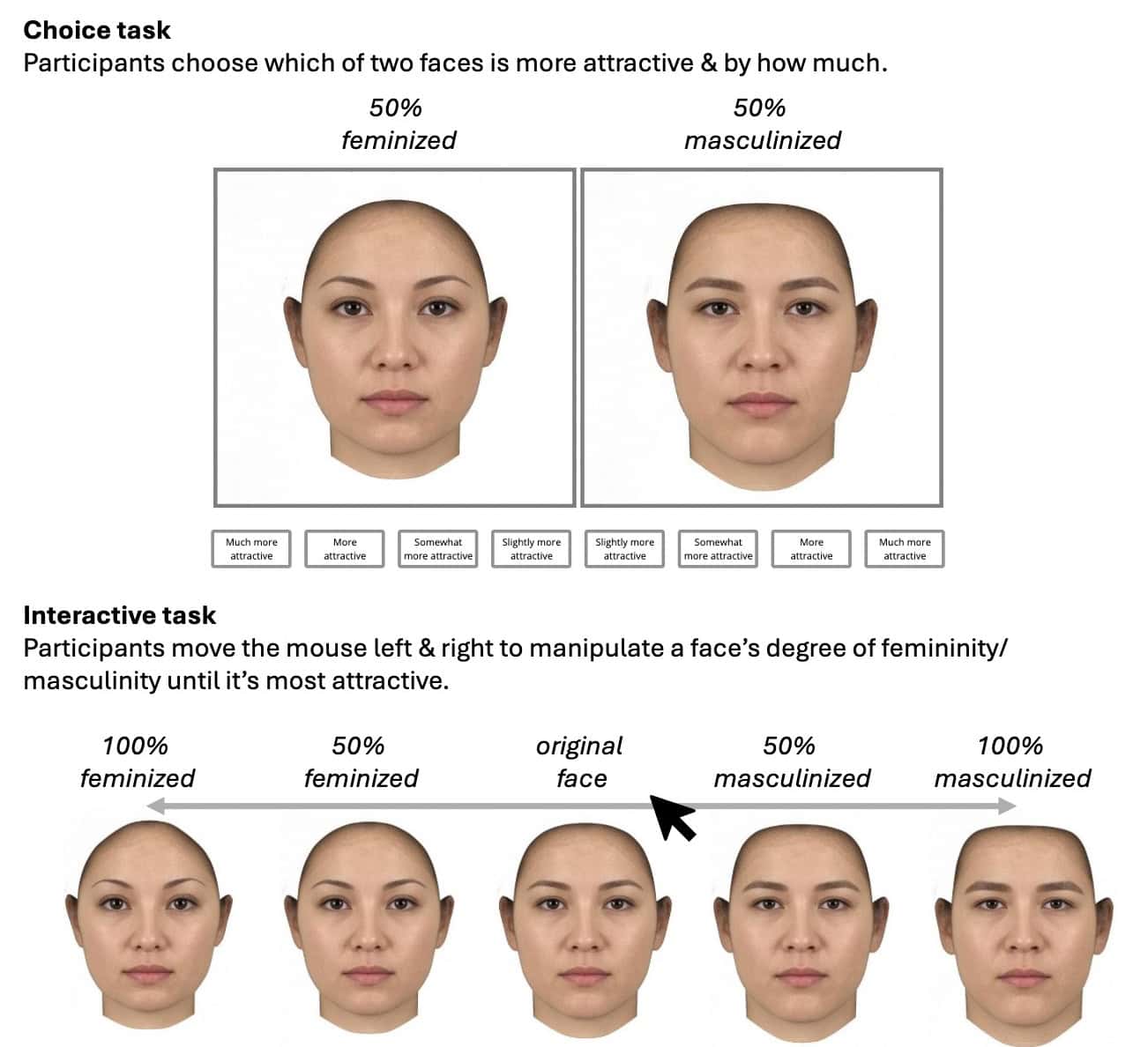
“We were surprised that we didn’t find any evidence for preferences for masculinity in men’s faces,” Bjornsdottir told PsyPost. “Previous research has found that gay men prefer masculinized faces over feminized faces, for example, and research has sometimes shown this pattern among heterosexual women. We didn’t find this for any sexual orientation or culture group – overall, people tended to prefer femininity rather than masculinity in both women’s and men’s faces. But preferences for how much femininity people found most attractive varied by culture and sexual orientation.”
Japanese participants preferred more feminine facial features than British participants did, particularly when judging men’s faces. This cultural effect was evident across sexual orientations and in both the forced-choice and interactive tasks.
The preferences of female participants varied significantly based on both sexual orientation and cultural background. In the United Kingdom, heterosexual women preferred femininity in women’s faces more than lesbian or bisexual women did. Lesbian and bisexual women showed a reduced preference for femininity in female faces, and bisexual women—unlike heterosexual women—also preferred greater femininity in male faces.
Among Japanese women, lesbian participants showed a pattern similar to their British counterparts: less preference for femininity in women’s faces and more preference for femininity in men’s faces. However, Japanese bisexual women stood out for preferring less femininity in both men’s and women’s faces compared to heterosexual Japanese women, indicating that bisexual women’s preferences do not simply fall between those of heterosexual and lesbian women but may reflect a unique pattern shaped by cultural and sexual identity together.
Male participants also showed differing patterns. Heterosexual men across both cultures preferred feminine features in both men’s and women’s faces, while gay men showed no preference for femininity or masculinity in male faces. Bisexual men showed less preference for femininity in women’s faces but did not differ much from heterosexual men when judging men’s faces.
In general, people preferred more femininity in women’s faces than in men’s faces. But how much femininity people preferred in men’s faces depended strongly on their own identity. Women attracted to men (including heterosexual and bisexual women) showed more varied preferences depending on their culture, age, and attractiveness. Lesbian and bisexual women were more likely to find feminine male faces attractive than heterosexual women were.
Preferences also varied depending on the ethnicity of the faces being judged. Across participants, White women’s faces were judged more attractive when they were made more feminine compared to East Asian women’s faces. In contrast, East Asian men’s faces were more attractive when feminized than White men’s faces.
This suggests that people were responding not just to the femininity/masculinity of a face in absolute terms but also in relation to the baseline appearance of that ethnicity. The researchers noted that East Asian faces in their sample were more feminine in shape overall than White faces, which may have influenced how participants adjusted or judged them.
“We found that both culture and sexual orientation simultaneously influence the degree of facial femininity/masculinity that people find most attractive,” Bjornsdottir told PsyPost. “This means that we can’t generalise what one group finds attractive to another group: for example, Japanese heterosexual women found somewhat feminine men’s faces most attractive, but British heterosexual women didn’t show a preference for femininity or masculinity in men’s faces. This further reinforces the idea that there is substantial variability in what people view as attractive, or that beauty is in the eye of the beholder. Here we show that part of what influences the beholder’s eye is their culture and sexual orientation.”
One notable contribution of the study is its inclusion of bisexual participants, who are often excluded from research on attraction. The findings show that bisexual individuals have distinct patterns of preference that are not simply a midpoint between heterosexual and gay or lesbian preferences.
“Our findings provide the first evidence of what bisexual women and men find attractive in faces, as bisexual people are often excluded from research on attraction and relationships,” Bjornsdottir said. “Importantly, we show that what bisexual people find most attractive doesn’t align perfectly with what either heterosexual or gay/lesbian people find most attractive.”
But the study, like all research, has some limitations. “Our sample of Japanese gay and lesbian participants wasn’t as large as the rest of the groups – so we can’t draw very strong conclusions about Japanese gay/lesbian individuals’ facial femininity/masculinity preferences just from this research,” Bjornsdottir noted.
The study also focused only on participants from two cultures and two ethnic backgrounds, which may not reflect global diversity. Future research could include participants from more varied backgrounds and investigate whether similar patterns exist in body preferences or other aspects of physical attraction.
The study, “Preferences for facial femininity/masculinity across culture and the sexual orientation spectrum,” was authored by R. Thora Bjornsdottir, Iris J. Holzleitner, and Keiko Ishii.