Subscribe
The latest psychology and neuroscience discoveries.
My Account
  • Mental Health
  • Social Psychology
  • Cognitive Science
  • Psychopharmacology
  • Neuroscience
  • About
No Result
View All Result
PsyPost
PsyPost
No Result
View All Result
Home Exclusive Conspiracy Theories

New study finds Trump’s tweets intensify anti-vaccine attitudes among his supporters

by Eric W. Dolan
April 3, 2020
in Conspiracy Theories, Donald Trump
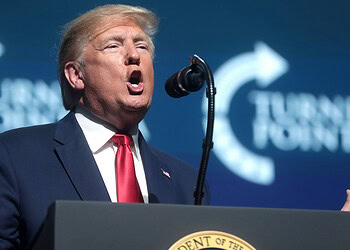
President of the United States Donald Trump speaking at the 2017 Conservative Political Action Conference (CPAC) in National Harbor, Maryland. (Photo credit: Gage Skidmore)

President of the United States Donald Trump speaking at the 2017 Conservative Political Action Conference (CPAC) in National Harbor, Maryland. (Photo credit: Gage Skidmore)

Share on TwitterShare on Facebook
Stay on top of the latest psychology findings: Subscribe now!

New research has found that Americans who voted for Donald Trump in 2016 are particularly prone to anti-vaccination attitudes and that these attitudes can be exacerbated by the president’s tweets. The findings have been published in the Journal of Experimental Social Psychology.

“I’m generally interested in anti-vaccination beliefs because they have the potential to do so much damage. When Trump was elected it also struck me as a curious moment in history, because he was the first U.S. president in modern history to be on the record with anti-vaxx views,” explained study author Matthew J. Hornsey, a professor at the University of Queensland Business School.

Trump had sent dozens of tweets linking vaccinations with autism, such as one in 2014 that read: “Healthy young child goes to doctor, gets pumped with massive shot of many vaccines, doesn’t feel good and changes – AUTISM. Many such cases!”

Hornsey remarked that Trump is “the most conspiracy-minded president in modern history. It was natural to wonder, then, whether Trump supporters were more anti-vaxx than other Americans, and whether Trump’s tweets had the potential to still do damage.”

The researchers first conducted a scientific survey of 518 Americans who voted in the 2016 presidential election. They found that participants who voted for Trump tended to be more conservative and more conspiracy-minded, which in turn made them more likely to express concerns about vaccines and agree with statements such as “Children get more vaccinations than are good for them.”

“There’s a conspiratorial worldview that Trump voters hold more than other people; that it’s commonplace for groups of elites with hidden agendas to band together and conduct elaborate hoaxes on the public in near-perfect secrecy. And the data show that having that worldview makes you much more likely to be anti-vaxx,” Hornsey told PsyPost.

“We then did a study to test whether reading Trump’s anti-vaxx tweets still have an impact on the public.”

In the second study, another 316 Americans who voted in 2016 completed the same scientific survey. About a week later, the participants were randomly assigned to either view Trump’s tweets about vaccines or a view Trump’s tweets about golf. They then reported their levels of concern about vaccination for a second time.

“Trump voters became more anti-vaxx after reading his tweets. So Trump doesn’t just reflect the views of his supporters, he still has the power to shape his supporters’ views,” Hornsey explained.

“We thought that reading Trump’s tweets might shock liberal voters into being less anti-vaxx. But it didn’t. Trump’s tweets made his own supporters more anti-vaxx but had no effect on anyone else. So it was all downside; there was no upside to the tweets, sadly.”

Trump appears to have reversed course on this issue, however.

“Trump has stopped making anti-vaxx statements since he became president. Last year, he even encouraged parents to vaccinate their children in the face of a measles outbreak. We’re hoping this is a permanent change of heart, especially in the wake of COVID-19. Every president since Roosevelt has swung behind the science on vaccination. It’s promising that Trump has stopped backing himself into a corner on this, because his words can save lives,” Hornsey said.

The study, “Donald Trump and vaccination: The effect of political identity, conspiracist ideation and presidential tweets on vaccine hesitancy“, was authored by Matthew J. Hornsey, Matthew Finlayson, Gabrielle Chatwood, and Christopher T. Begeny.


TweetSendScanShareSendPin1ShareShareShare

RELATED

Why some people share conspiracy theories they don’t even believe
Conspiracy Theories

Why some people share conspiracy theories they don’t even believe

November 4, 2024

Research indicates that many individuals who share conspiracy theories online don't actually believe them; instead, they do so for personal gain, to create chaos, incite conflict, or garner attention.

Read more
Artificial intelligence reveals Trump’s language as both uniquely simplistic and divisive among U.S. presidents
Artificial Intelligence

Artificial intelligence reveals Trump’s language as both uniquely simplistic and divisive among U.S. presidents

October 31, 2024

Donald Trump’s speech is uniquely distinct and divisive among modern presidents, marked by shorter, simpler sentences and frequent antagonistic language, especially toward opponents, setting his rhetorical style apart from both Republican and Democratic predecessors.

Read more
Belief in a just world reduces conspiracy theory endorsement when ambiguity tolerance is low
Conspiracy Theories

Belief in a just world reduces conspiracy theory endorsement when ambiguity tolerance is low

October 30, 2024

According to a study published in Personality & Individual Differences, belief in a just world is negatively associated with conspiracy theory endorsement, but only among individuals with low ambiguity tolerance.

Read more
A rare event in Alabama suggests Trump’s MAGA movement can overpower incumbency effects
Donald Trump

A rare event in Alabama suggests Trump’s MAGA movement can overpower incumbency effects

October 30, 2024

A new study has found that in Alabama’s rare incumbent-versus-incumbent GOP primary, alignment with Trump’s MAGA movement outweighed traditional incumbency advantages, leading to a narrow win for the more MAGA-aligned candidate.

Read more
Is autism a factor in conspiracy mentality? New study says no
Autism

Is autism a factor in conspiracy mentality? New study says no

October 28, 2024

A new study published in Cognitive Neuropsychiatry has found no connection between autism and a general tendency to believe in conspiracies.

Read more
Asian workers hit hard by job losses, wage cuts as anti-Asian sentiment rose under Trump, new study shows
COVID-19

Asian workers hit hard by job losses, wage cuts as anti-Asian sentiment rose under Trump, new study shows

October 17, 2024

New research suggests that anti-Asian sentiment, driven in part by Donald Trump’s rhetoric and Fox News coverage, resulted in higher unemployment and wage losses for Asian workers in face-to-face jobs during the COVID-19 pandemic.

Read more
Trump’s election fraud allegations linked to temporary decline in voter turnout
Conspiracy Theories

Trump’s election fraud allegations linked to temporary decline in voter turnout

October 13, 2024

Researchers have found that Donald Trump’s widespread claims of electoral fraud after the 2020 presidential election led to a short-term reduction in turnout among his supporters in Georgia’s 2021 Senate runoff.

Read more
Scientists reveal the impact of conspiracy theories on personal relationships and dating success
Conspiracy Theories

Scientists reveal the impact of conspiracy theories on personal relationships and dating success

October 9, 2024

Conspiracy beliefs can directly reduce relationship satisfaction, especially when not shared by both parties, according to new research. The findings highlight how these beliefs strain interpersonal connections, offering new insights into the social consequences of conspiracy thinking.

Read more

SUBSCRIBE

Go Ad-Free! Click here to subscribe to PsyPost and support independent science journalism!

STAY CONNECTED

RECENT

Dating app study sheds light on memory, attraction, and mate value

Intelligence, socioeconomic status, and gender impact ADHD diagnosis timing

Why some people share conspiracy theories they don’t even believe

New psychology study examines how sadness and fear sharpen self-control

GOP’s midterm hopes faltered as abortion outranked economy among key voters, study finds

New research upends long-held beliefs about romantic love and sexual frequency

Anger more strongly linked to alcohol and tobacco use than illicit drug use

Conservatives are happier, but liberals lead more psychologically rich lives, research finds


  • Contact us
  • Privacy policy
  • Terms and Conditions
[Do not sell my information]

Welcome Back!

Login to your account below

Forgotten Password?

Retrieve your password

Please enter your username or email address to reset your password.

Log In

Add New Playlist

Subscribe
  • My Account
  • Cognitive Science Research
  • Mental Health Research
  • Social Psychology Research
  • Drug Research
  • Relationship Research
  • About PsyPost
  • Contact
  • Privacy Policy