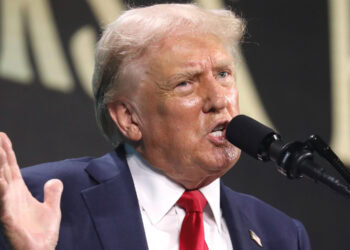
New findings from the journal American Politics Research suggest that knowing someone who contracted COVID-19 weakened the relationship between a person’s ideology and their evaluation of Trump’s leadership during the early stages of the pandemic. Knowing someone with COVID-19 seemed to lead liberals to judge Trump’s response to the pandemic less harshly but lead conservatives to judge Trump’s response more harshly.
During his time as United States president, Donald Trump’s handling of the COVID-19 pandemic was criticized by a large number of citizens. Study authors Jason S. Byers and Laine P. Shay say it is important to uncover factors that might influence citizens’ support for the government’s response to the pandemic. Unsurprisingly, trust in government appears to affect compliance with public health policies
“My co-author and I were interested in this topic for two reasons,” said Shay, an assistant professor of political science at Texas A&M-Corpus Christi. “First, for the first week or so after President Trump declared the pandemic a national emergency, we noticed a few polls showed that President Trump’s approval rating was rising for a brief period.
“Also, at the very beginning (and, again, for a short period), most citizens approved of President Trump’s handling of the pandemic. Prior to the pandemic, his approval rating did not vary for a lengthy time, and it stayed in the mid-40s. Thus, we were interested in learning the factors that were causing this change in his approval rating.”
Byers and Shay conducted a study to explore whether knowing someone with a COVID-19 diagnosis may have influenced the way citizens felt about Trump’s leadership during that time. They suggest that knowing someone with COVID-19 should weaken the impact of a person’s political views on their evaluation of Trump’s response to the pandemic. People who know someone with COVID-19 will likely do more research into the pandemic, better understand the complexity of the situation, and rely less on ideology when evaluating Trump’s leadership. Knowing someone with COVID-19, then, should make liberals less harsh when evaluating Trump, and conservatives more harsh when evaluating Trump.
“There is some evidence that individuals more closely connected to a national event or crisis, such as 9/11, tend to view their leaders in a less political lens,” Shay explained. “We were interested in uncovering whether the same held true for President Trump, who is a more polarizing figure.”
To explore this hypothesis, the researchers analyzed results from two American surveys conducted during the pandemic. The first was a nationally representative survey conducted in March 2020 by ABC News and the Washington Post. The second was a FOX News Survey conducted in May 2020. Both surveys asked respondents whether they approved or disapproved of the way Trump was managing the US response to the COVID-19 pandemic and whether or not they knew someone who had been diagnosed with COVID-19. Respondents also rated their beliefs along a continuum from “very liberal” to “very conservative.”
In the March 2020 survey, 53% said they approved of Trump’s response to the crisis, and in May 2020, 45% approved. As expected, a participant’s ideology was associated with their approval, with conservatives being more likely to approve of Trump’s response than liberals. But, as the researchers expected, knowing someone with COVID-19 weakened this ideology effect.
The most conservative respondents who knew no one with a COVID-19 diagnosis had a 69–82% chance of supporting Trump’s response to the pandemic. But the most conservative respondents who did know someone with COVID-19 had a likelihood of 52–58% of supporting Trump. For the most liberal, those who knew no one with a diagnosis had an 18–20% likelihood of approving of Trump’s response, while those who knew someone with the virus had a likelihood of 32–43%.
A personal connection to the pandemic — in this case, knowing someone with COVID-19 — appeared to decrease the disparity between conservatives’ and liberals’ views of Trump’s handling of the pandemic. Views were decreasingly polarized, with both conservatives and liberals being less likely to see their opinions influenced by their ideologies.
“At least at the beginning of the pandemic, individuals who knew someone diagnosed with COVID-19 viewed President Trump in a less ideological and political manner,” Shay told PsyPost. “This subset of liberal citizens was more likely to give President Trump some leeway and less likely to negatively evaluate him because they recognized this was a new situation with a great deal of uncertainty. This group of conservatives also likely recognized that President Trump made some mistakes, thus, they were less likely to give him high marks on managing the pandemic.”
“Alternatively, those who did not know anyone diagnosed with COVID-19, viewed President Trump as a highly polarizing figure in terms of managing the pandemic.”
The study also suggest that citizens’ perceptions of Trump’s handling of the crisis had political consequences for the upcoming election. According to the ABC News survey, respondents who approved of Trump’s management of the crisis were more likely to say they would vote for him in the 2020 election, and those who disapproved were more likely to say they would vote for Joe Biden. This amounted to a 508% increase in the likelihood of voting for Trump if a citizen approved of his leadership of the crisis.
“President Trump’s handling on COVID-19 probably cost him some votes among certain key constituencies,” Shay said.
The study authors note that the two surveys captured opinions about Trump’s leadership early on in the pandemic and that future studies should investigate how citizens’ opinions may have changed as the crisis evolved.
“We strongly suspect as the parties adopted more contrasting positions on the pandemic, and as partisan views started to grow over salient issues concerning managing COVID-19 in the United States, it is highly likely that the effects of having a friend or family member with COVID start to wane,” Shay said. “Future research should examine how COVID-19 shaped public opinion over time and how some in the public have become exhausted, thus, following fewer COVID-19 precautions.”
The study, “We Have It Totally Under Control? Exploring the Effects of Ideology and Knowing Someone Diagnosed With COVID-19 on Evaluations of President Trump’s Leadership on the Pandemic”, was authored by Jason S. Byers and Laine P. Shay.