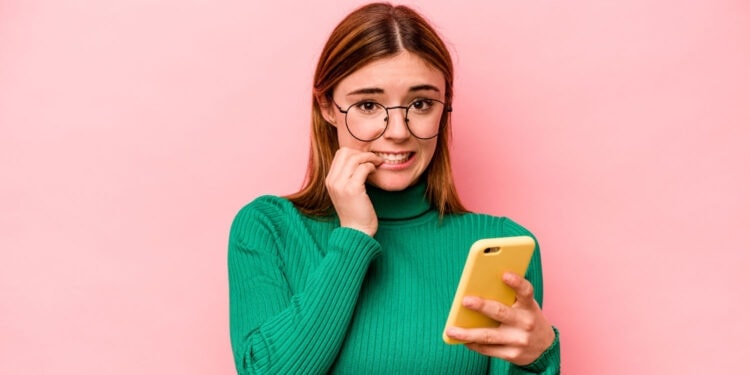

Recent research has shed light on the impact of social media on socially anxious individuals’ romantic lives. The study found that these individuals reported feeling more confident speaking to romantic interests virtually than in person. However, while technology eased the stress associated with forming romantic relationships, it also posed potential barriers. Published in the Family and Consumer Sciences Research Journal, the findings highlight the dual role of social media in the lives of socially anxious people.
Social anxiety involves a deep fear of being judged negatively in social situations, which can hinder the development of romantic relationships. While previous studies indicated that socially anxious individuals often struggle in their romantic relationships, the potential of social media as a tool to mitigate this stress had not been thoroughly examined. This study sought to fill that gap by investigating whether technology could help socially anxious individuals form and maintain romantic relationships.
“My co-author, Abbi Rahm, and I noticed a trend with college students – they were struggling forming new romantic relationships. The students who I taught discussed anxiety trying to talk to someone they were romantically interested in, and Abbi heard about this anxiety with her peers,” explained study author Michael Langlais, an assistant professor at Baylor University.
“Many people we talked to said that because their anxiety was so high, they either refrained from initiating romantic relationships all together or relied on text messaging or social media to start a conversation. Abbi and I were surprised about this anxiety forming relationships with college students, since they are surrounded by potential partners and they are theoretically motivated to form and establish romantic relationships (Arnett, 2000; Erikson, 1968).”
“We noticed, when looking for research articles to answer this question, that there was a research gap that aimed to understand how individuals with social anxiety approached relationship formation. From there, we met and designed to understand how and the consequences of using technology to form relationships with individuals who were socially anxious.
The researchers employed a mixed-methods approach, combining quantitative and qualitative data. They began with an online survey completed by undergraduate students from a large university in the Southeastern United States. Participants answered questions about their social anxiety, use of social media, and experiences with romantic relationships. Out of 276 initial respondents, 242 provided complete responses, with 81 identified as socially anxious.
Participants with moderate to high social anxiety were then invited to engage in anonymous online chats to discuss their experiences with forming romantic relationships. This method was chosen to ease the discomfort socially anxious individuals might feel in face-to-face interviews.
“We had socially anxious individuals participate in an anonymous online chat to help provide honest, stress-free responses to questions for this study,” Langlais explained. “Although individuals were all socially anxious, they appeared comfortable and open regarding their relationship experiences in this chat, while also expressing the benefits and costs of technology with relationship formation.”
The quantitative data revealed several key insights. Socially anxious individuals were more likely to use technology, such as video calls or phone calls, to connect with others rather than meeting in person. They also reported higher levels of anxiety and physiological symptoms, such as increased heart rate and sweating, during face-to-face interactions. Interestingly, socially anxious participants spent less time on platforms like Snapchat and more on Twitter and TikTok compared to their non-anxious peers.
Qualitative data from the online chats further enriched these findings. One of the key themes that emerged was the use of technology as a preliminary tool for gathering information about potential romantic partners. Participants expressed that browsing social media profiles helped them learn more about a person’s interests and personality, which made them feel more comfortable before initiating a conversation. This pre-screening process reduced the uncertainty and fear of negative evaluation that often accompany face-to-face interactions.
Another significant theme was the preference for initiating and maintaining conversations online. Many socially anxious individuals found it easier to communicate via text or social media platforms because these mediums allowed them to carefully craft their responses without the pressure of real-time interaction. This method provided a sense of control and reduced the immediate physiological symptoms of anxiety, such as sweating and increased heart rate, commonly triggered by in-person conversations.
“Since COVID-19, individuals feel more comfortable using text messaging and social media to learn more about potential partners and to initiate romantic relationships, and this is particularly true for socially anxious individuals,” Langlais told PsyPost. “Using technology appears to ease stress for socially anxious individuals when forming romantic relationships.”
However, the reliance on technology was not without its downsides. Some participants mentioned that technology made in-person communication more challenging and uncomfortable. The ease of online interactions sometimes led to difficulties in establishing trust and forming genuine connections when transitioning to face-to-face meetings.
“Although we found that technology was helpful in terms of alleviating stress for participants in this study, socially anxious individuals also said technology could be a potential barrier. Waiting for a response from someone or trying to write the best response could increase feelings of anxiety,” Langlais explained.
“Additionally, relying more on technology makes communicating in-person even more difficult. Abbi and I wonder if this may represent a trend where people will become more anxious in face-to-face situations with a potential romantic partner as a result of relying on technology over time for communication.”
Although this study offers insights into the dual role of technology in the romantic lives of socially anxious individuals, it does have certain limitations. The sample was predominantly white, college-educated females, which may limit the generalizability of the findings. Future research should aim to include more diverse and larger samples to validate these results. Additionally, the cross-sectional design of this study means that causality cannot be determined. Longitudinal studies could offer a clearer understanding of the relationship between social anxiety, technology use, and romantic relationship formation.
“The goal would be to conduct a longitudinal study to understand how relationships with socially anxious individuals evolve and examine how communication in these relationships contribute to the quality of those relationships,” Langlais said.
“Abbi Rahm will be starting her doctoral journey in Human Development and Family Science at the University of Missouri working with Dr. Kale Monk,” he added. “She is excited about this next step in her professional journey!”
The study, “Does social media use help individuals with social anxiety form romantic relationships?“, was authored by Michael Langlais and Abbigail Rahm.