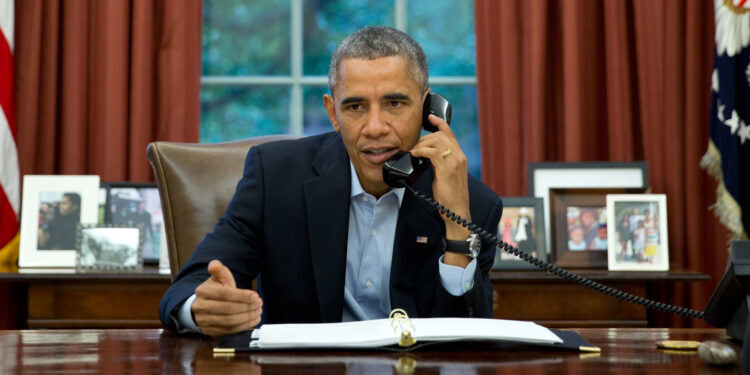

A recent study published in the journal Sociology of Race and Ethnicity reveals that Barack Obama’s reelection in 2012 had a significant impact on the mental health of Black men, though the effects were different depending on their level of education. College-educated Black men experienced improved mental health following Obama’s victory, while those without a college education reported a decline in their mental health during the same period.
The researchers, led by Tony Brown, a distinguished sociology professor at Rice University, set out to investigate how Obama’s reelection influenced the mental health of Black men and women. This study builds on their earlier research into the mental health effects of Obama’s initial election in 2008, which showed that Black men reported fewer days of poor mental health after his victory. However, Brown and his team wanted to understand whether the optimism surrounding Obama’s first election still resonated four years later, particularly among Black men.
“The topic interests me because most individuals agree Barack Obama’s presidency was a milestone moment in U.S. politics and history,” said Brown, the director of the Racism and Racial Experiences (RARE) Workgroup.
“But increasingly, I think most individuals disagree about whether his presidency represented real racial progress or was simply an optical illusion. The topic also interests me because too often social science research focuses on the consequences of structural racism, whereas Obama’s presidency supposedly represented a challenge to structural racism.”
For their study, the researchers analyzed data from the Behavioral Risk Factor Surveillance System, a large, nationally representative survey that collects health-related data from over 400,000 U.S. adults each year. They focused on a sample of 5,521 Black adults surveyed 30 days before and after Obama’s reelection in 2012. The researchers measured the number of poor mental health days respondents reported experiencing during the past 30 days, comparing the periods before and after the election to assess any shifts in mental health.
In addition to mental health outcomes, the study took into account various factors that could influence these outcomes, such as income, education level, gender, and whether the participant lived in a state where Obama won or lost the majority of votes. By controlling for these variables, the researchers aimed to isolate the effects of the reelection itself.
The researchers found that college-educated Black men saw a significant improvement in their mental health, with nearly three fewer poor mental health days reported per month after the election. In contrast, Black men without a college education reported experiencing one additional poor mental health day per month.
The researchers propose several reasons for this divergence. One possibility is that less-educated Black men felt Obama had not lived up to the promises he made during his campaign. These men may have expected Obama to tackle issues like job creation, healthcare access, and systemic inequality more effectively. As these promises went unfulfilled in their eyes, their mental health may have worsened due to feelings of disappointment or relative deprivation—a sense that they were being left behind compared to other groups, including more affluent or educated Black men.
“The average person should consider how elections influence their mental health,” Brown told PsyPost. “Elections can demonstrate health significance. Maybe it’s the stress that political polarization induces. Maybe it’s the thrill when the candidate you support wins. Maybe it’s how people in your local community came together to register others to vote.”
“Social scientists must think more critically about how large-scale socio-political events, like elections, influence individuals’ health. I think the 2024 U.S. presidential election, regardless of which candidate wins, will show mental health significance.”
As for Black women, the study found no significant change in their mental health following Obama’s reelection. This mirrors the results of the earlier 2008 study, where Black women similarly did not experience a measurable mental health boost.
“Lack of a salubrious association between Barack Obama’s presidency and Black women’s mental health surprised me,” Brown said. “In this study and a prior study, it seems only Black men experienced changes in their mental health because of Barack Obama’s 2008 and 2012 election and re-election, respectively.”
Several factors could explain this. For instance, the researchers noted that Black women may have worried about the potential dangers Obama and his family faced during his presidency, particularly the numerous death threats he received. Black women may also have felt uncertain about whether Obama’s presidency would address their specific struggles with both racism and sexism.
“The long-term goals of this line of research are to broaden the notion of social determinants of health to include socio-political shifts, such as elections,” Brown explained. “Far too often, social scientists obsess over micro-level events that influence health, but macro-level events matter too. Consider how Haitian immigrants, who are documented and working hard to build local economies, feel when a U.S. president suggests they are eating the cats and dogs of their neighbors and co-workers. That’s not a micro-level threat, but an insult that must be situated in sociological context.”
The study, “‘Yes We Can!’ The Mental Health Significance for U.S. Black Adults of Barack Obama’s 2008 Presidential Election,” was authored by Tony N. Brown, Alexa Solazzo, and Bridget K. Gorman.