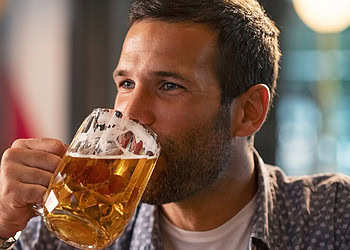
Preliminary research indicates that people under the influence of alcohol are quicker to help someone else. The study, published in the journal Frontiers in Psychology, examined how alcohol consumption influenced the bystander effect.
The “bystander effect” refers to a social phenomenon in which individuals are less likely to help when other people are present.
During the experiments, which took place at actual bars in Amsterdam, a researcher sat down at a table with a participant, and then knocked over a jar filled with breathalyzer mouthpieces while an observer across the room recorded what happened. In some experiments, the researcher and the participant sat by themselves at a table, while in other experiments they were joined at the table by two bystanders.
Among participants who helped clean up the mess, those who consumed more alcohol tended to react faster to the spilled mouthpieces when bystanders were present.
However, alcohol consumption appeared to have no influence on how many mouthpieces were picked up. Nor did it appear to influence the likelihood of participants helping to clean up the spilled mouthpieces.
PsyPost interviewed Marco Van Bommel of the University of Twente about his study. Read his responses below:
PsyPost: Why were you interested in this topic?
Van Bommel: There has been a lot of research on the bystander effect: people help each other less often and less quickly in the presence of others. I first heard about this effect when I saw a video of participants sitting in a room (either with other people or not) while smoke would come under the door. People thought the building would likely be on fire, but if other actors, who were instructed to not do anything, indeed didn’t move, the participant in the study would not move either, and basically risk burning to death or suffocate, rather than going against the norm. Certainly, after that I became more interested in the effect and read about the fascinating classic studies by Latane and Darley in the late 60’s early 70’s, which inspired me to become a social psychologist.
This classic phenomenon from social psychology is also something that is very important in human behavior, and happens a lot more often than one may think. It does not only happen in the classic situations like crime and accidents, but also in much more day to day situations. For instance, when you write an email with a request and address it to several people, diffusion of responsibility by the receiving party is likely to occur. Once you become aware of this, you suddenly realize prominent or encompassing the effect is.
The current study, was inspired by the idea that in many situations a bystander effect type scenario is likely to evolve when alcohol is at play. When people get together in large numbers, there is often alcohol involved, and people become more prone to violent behavior and accidents. To get a more complete understanding on the bystander effect, I thought it would be very interesting to actually study it, there, where a situation of need is likely to occur. Moreover, some previous research shows that disinhibition may attenuate or reverse the bystander effect, thus it is likely that the consumption of alcohol indeed may change the outcome of a bystander effect study.
What should the average person take away from your study?
Perhaps people may want to hear that consuming alcohol is really good for social behavior and society in general, because it makes us more helpful. This is, however, not really a message I want people to take away from this study, as it is unclear how good the quality of help is, and there is ample research that shows alcohol has many downsides.
I would like people in general to understand the bystander effect a little bit better, and how strong the psychological forces are when you are in such a situation. People still tend to underestimate the power of the presence of others on helping. For instance if there is a news item about a person in distress who didn’t receive help, or a Youtube video of something similar, people always comment about how disgraceful and anti-social the non-intervening bystanders are, and that they surely would help if they were in that situation. What I think this study shows is that non-intervening bystanders are not truly anti-social and they probably are jumping to help someone out in need, but that they simple are too inhibited by the presence of others.
Are there any major caveats? What questions still need to be addressed?
The quality and type of helping is not really assessed well. In the current study there was just one type of helping possible: you either help pick up the mouthpieces that were dropped, or you did nothing. Support or cheering is just a little silly for such a simple task. For many other bystander effect situations, however, there are different types of helping behavior. For instance when it comes to intervention during a fight, you could stop the fight being in a reconciliatory/de-escalating way, or simply by being aggressive. The latter often just escalates the situation. Or one can think about a car accident, where a person lies motionless on the street, it is often not helpful or advised to move that person.
In short, it could very well be that people who drink alcohol help faster in the presence of others, but that the help given is of very low quality or makes things even worse.
A final major caveat is causality: in the study we did not randomly assign people to drink a certain amount of alcohol. We therefore cannot be to certain about the type of relation between alcohol and helping behavior. For instance, it could very well be that people who are more prosocial tend to drink more.
The study, “Booze, Bars, and Bystander Behavior: People Who Consumed Alcohol Help Faster in the Presence of Others“, was also co-authored by Jan-Willem van Prooijen, Henk Elffers, and Paul A. M. Van Lange.