![[Adobe Stock]](https://sp-ao.shortpixel.ai/client/to_webp,q_glossy,ret_img,w_750,h_375/https://www.psypost.org/wp-content/uploads/2025/03/LSD-blotter-paper-750x375.jpg)

New research indicates that very low doses of LSD can make the world look blurrier, more colorful, and more dynamic to participants, even without causing full hallucinogenic trips. However, the drug did not appear to change how strongly people experienced a visual illusion that depends on the surrounding scene. The findings were published in Neuroscience of Consciousness.
To make sense of what we see, the visual cortex, the brain region at the back of the head that processes sight, takes the surrounding scene into account. One result is an illusion called contrast surround suppression: a striped pattern looks fainter, or lower in contrast, when it is surrounded by a bold, high-contrast pattern. Scientists think this happens partly because activity in brain cells responding to the surround dampens the response of cells responding to the center.
Classic psychedelics such as LSD and psilocybin produce their effects mainly by activating a type of serotonin receptor, a chemical docking site on brain cells. A study covered by PsyPost in 2022, which analyzed more than 6,000 written accounts of psychedelic trips, linked descriptions of altered sensory perception to areas of the visual cortex rich in serotonin receptors.
Previous experiments suggest that psychedelics can change how strongly the brain relies on visual context. For example, a 2019 study of mice showed that a psychedelic drug reduced surround suppression in the visual cortex.
In humans, however, the effect might go the other direction. A small 2024 pilot study of six volunteers found that a high dose of psilocybin, the active ingredient in magic mushrooms, made a similar contrast illusion stronger, and that people with more intense visual effects showed bigger changes.
Adding to this evidence, a 2025 study found that low to moderate doses of psilocybin made people more susceptible to the Ebbinghaus illusion, in which a circle looks larger or smaller depending on the size of the circles around it. Together, these findings suggest that psilocybin can change how the human brain uses surrounding visual context.
Some people take very small amounts of psychedelics, known as microdoses, in hopes of boosting their mood or creativity. However, a second study covered by PsyPost in 2022 found that repeated LSD microdoses did not reliably improve mood or cognitive performance compared with a placebo, though the higher dose produced small increases in feelings of vigor. The new study tests whether these very low doses might still objectively alter basic visual perception.
The research, led by Lucca Jaeckel, a doctoral student at the Translational Psychiatry Lab at the University of Basel’s Department of Psychiatry, aimed to test whether a low dose of a different psychedelic, LSD, would produce changes like those seen with psilocybin. “There are different theories about how psychedelic drugs cause altered visual perception,” Jaeckel told PsyPost.
“A few studies, two of which investigated psilocybin in humans, have shown alterations in a neural phenomenon called surround suppression, where brain responses to a stimulus at some location in the visual field are suppressed by stimulation in the surrounding area,” he explained. “One way to study surround suppression is through studying visual illusions. The previous studies showed that psilocybin could enhance the illusory amplification of perceived stimulus size and the illusory suppression of stimulus contrast, which are both linked with these surround suppression mechanisms.”
“We wanted to see if LSD microdoses (10 and 20 μg) affect these processes in the same way as psilocybin, using a contrast discrimination task in healthy human participants,” Jaeckel said.
The researchers conducted a randomized, double-blind, placebo-controlled crossover study, analyzing data from 31 healthy adults who completed at least two sessions. Each participant was scheduled for three testing sessions at least a week apart, receiving a placebo in one, 10 micrograms of LSD in another, and 20 micrograms in the third. Neither the participants nor the researchers knew which substance was given on which day until the study concluded. The participants averaged 28 years old, and about half had used psychedelics before.
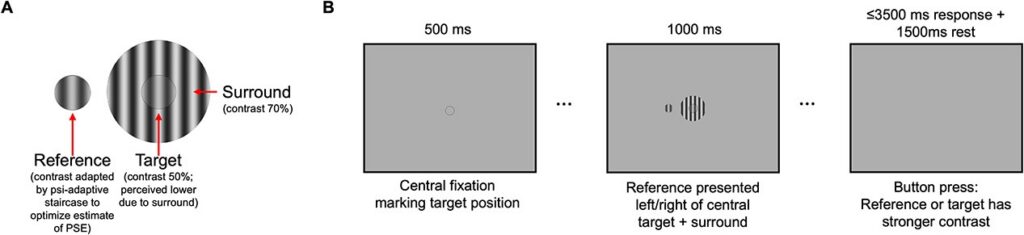
Four hours after taking the dose, the participants completed a visual contrast task on a computer. On each of 100 trials, they saw two circular patches of drifting light and dark stripes for one second. One patch sat in the center of the screen inside a ring of high-contrast stripes, while the other appeared off to the side with no ring.
The participants pressed a key to indicate which patch looked higher in contrast. Because the surrounding ring creates a suppressing illusion, people typically underestimate the contrast of the center patch.
Throughout the testing days, participants also filled out detailed questionnaires about their subjective experiences. They rated how they felt on sliding scales, answering questions about whether their vision seemed sharper or blurrier, brighter or darker, more or less saturated with color, and static or dynamic. They also rated broader psychological feelings, such as whether they felt a sense of boundary dissolution or visionary changes.
These subjective measures were examined in exploratory analyses, meaning they were not part of the plan the researchers registered in advance. On a 100-point scale, ratings of “any drug effect” rose by about 17 points at 20 micrograms and about 5 points at 10 micrograms. The 20-microgram dose also produced a mildly altered state of consciousness, with higher scores for visionary changes, oceanic boundlessness (pleasant feelings such as bliss and insightfulness), and reduced alertness. These increases were small, amounting to roughly 2 to 5 percent of each scale’s maximum.
Visually, participants reported that 20 micrograms made colors look more saturated, made the world seem more dynamic, as if things were in motion, and made their vision blurrier. Even the 10-microgram dose made vision slightly blurrier than placebo, while brightness ratings did not change. These shifts were modest, between about 3 and 7 points on a scale running 50 points in either direction from “normal.”
At the end of each session, participants guessed which treatment they had received. They identified the placebo and the 20-microgram dose at better-than-chance rates, but not the 10-microgram dose.
“There is considerable disagreement as to what dose of a psychedelic constitutes a microdose,” Jaeckel noted. “We used doses of 10 and 20 μg which are often considered microdoses.”
“Some people would argue a microdose is a dose that does not noticeably affect conscious state,” he explained. “Interestingly, our 10 μg dose was not identified as an active dose beyond chance level, yet we could show a small effect of that low dose on subjective visual perception.”
Despite these subjective changes in how the world looked, the objective task results told a different story. Of the 93 completed sessions, 68 sessions from 24 participants met the researchers’ quality criteria; most of the rest were excluded because the responses suggested participants had misunderstood or could not perform the task. In the remaining data, the task reliably produced the illusion, but LSD did not measurably change its strength. A statistical analysis designed to weigh evidence for and against an effect strongly favored no effect of the drug.
The researchers also checked whether participants who reported the biggest changes in their visual perception at 20 micrograms showed bigger changes on the task. They found no correlation, unlike the 2024 psilocybin pilot study, which had linked more intense visual effects to stronger suppression. This suggests that, at these doses, the conscious feeling of altered vision can occur without changes in the brain’s early, automatic filtering of visual contrast.
“Unlike psilocybin, LSD did not affect spatial context-related contrast perception as would be expected from altered surround suppression. At the same time, we did find subjective alterations to visual perception,” Jaeckel said. “This indicates that alterations in surround suppression are not necessary for the perceptual alterations induced by LSD. Nevertheless, it may be that psychedelics affect surround suppression at higher doses where this may affect visual perception.”
As with all research, there are some caveats to consider. Because participants could often tell when they had received the 20-microgram dose or the placebo, expectations may have inflated their subjective ratings. The authors argue that expectations alone are unlikely to explain the visual effects, noting that some sources describe low-dose psychedelics as making vision sharper, the opposite of the blurriness participants reported.
The authors suggest the most likely reason for the lack of an objective effect is the low dose. Based on a direct comparison study, 20 micrograms of LSD is roughly equivalent to 4 milligrams of psilocybin, far below the 25-milligram dose used in the 2024 contrast study and slightly below the 5-milligram dose that affected the size illusion in the 2025 study.
Low doses of LSD may change conscious perception without being strong enough to shift early visual processing. LSD also acts on dopamine receptors in ways psilocybin does not, and the authors speculate that these effects, which may emerge later in the drug’s time course, could have counteracted any change in surround suppression.
There are a few other things to keep in mind regarding the study design. The contrast task was administered four hours after the participants took the drug, past the absolute peak of the drug’s effects. Additionally, participants were asked to avoid caffeine before and during sessions, because caffeine can itself influence brain activity measures and surround suppression. For regular caffeine users, withdrawal or fatigue four hours into the session may have made it harder to maintain focus.
Future studies could build on these findings by testing higher doses of LSD to see if the contrast illusion eventually shifts, or by testing participants earlier in the drug’s timeline. For now, the evidence indicates that while low doses of LSD can make the world seem more colorful, blurry, and dynamic, they did not measurably change how the brain handles this contrast illusion.
“This is the first publication from a larger study investigating how LSD affects how different kinds of context are used toward making choices about perceptual stimuli,” Jaeckel told PsyPost. “So there’ll be more data coming out soon.”
One of the study’s co-authors, Matthias Liechti, serves as a consultant for Mind Medicine, a company developing LSD-based treatments, and Lykos Therapeutics.
The study, “Low-dose lysergic acid diethylamide alters subjective visual perception but not visual contrast surround suppression,” was authored by Lucca F. Jaeckel, Deborah Logvinski, Mika Kanana, Felix Müller, Nicolai Rohner, Anna M. Becker, Matthias E. Liechti, and Philipp Sterzer.