A new study published in Psychology of Popular Media suggests that human romantic attraction to fictional characters may operate through the same psychological mechanisms that drive relationships between real people. The research offers insight into how individuals form deep attachments to non-existent partners in an increasingly digital world.
The concept of falling in love with an artificial being is not a modern invention, the researchers behind the new study noted. The ancient Greek narrative of Pygmalion describes a sculptor who creates a statue so beautiful that he falls in love with it. This theme of attributing human qualities and agency to inanimate creations has persisted throughout history.
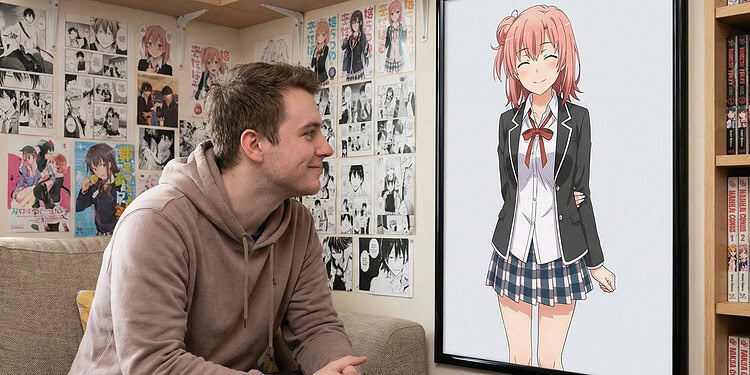
In the contemporary landscape, this phenomenon is often observed within the anime fan community. Fans of Japanese animation sometimes utilize specific terminology to describe characters they hold in special regard. The terms “waifu” and “husbando” are derived from the English words for wife and husband. These labels imply a desire for a significant, often romantic, relationship with the character if they were to exist in reality.
The researchers conducted the new study to better understand the nature of relationships with “virtual agents.” A virtual agent is any character that exists solely on a screen but projects a sense of agency or independence to the audience. As technology advances, these characters are becoming more interactive and realistic. The authors sought to determine if the reasons people connect with these characters align with evolutionary theories regarding human mating strategies.
“Given the popularity of AI agents and chatbots, we were interested in people who have attraction to fictional characters,” said study author Connor Leshner, a PhD candidate in the Department of Psychology at Trent University.
“Through years of research, we have access to a large and charitable sample of anime fans, and it is a norm within this community to have relationships (sometimes real, sometimes now) with fictional characters. We mainly wanted to understand whether a large group of people have the capacity for relationships with fictional characters, because, if they do, then a logical future study would be studying relationships with something like AI.”
To investigate this, the research team recruited a large sample of self-identified anime fans. Participants were gathered from various online platforms, including specific communities on the website Reddit. The final sample consisted of 977 individuals who indicated that they currently had a waifu or husbando.
The demographic makeup of the sample was predominantly male. Approximately 78 percent of the respondents identified as men, while the remainder identified as women. The average age of the participants was roughly 26 years old, and more than half were from the United States. This provided a snapshot of a specific, highly engaged subculture.
The researchers employed a quantitative survey to assess the participants’ feelings and motivations. They asked participants to rate their agreement with various statements on a seven-point scale. The survey measured four potential reasons for choosing a specific character. These reasons were physical appearance, personality, the character’s role in the story, and the character’s similarity to the participant.
The researchers also sought to categorize the type of connection the fan felt toward the character. The three categories measured were emotional connection, sexual attraction, and feelings of genuine love.
The results provided evidence supporting the idea that fictional attraction mirrors real-world attraction. The data showed a positive association between a character’s physical appearance and the participant’s sexual attraction to them. This suggests that visual appeal is a primary driver for sexual interest in virtual agents, much as it is in human interaction.
However, physical appearance was not the only factor at play. The researchers found that a character’s personality was a strong predictor of emotional connection. Additionally, participants who felt that a character was similar to themselves were more likely to report a deep emotional bond. This indicates that shared traits and relatable behaviors foster feelings of closeness even when the partner is not real.
A central focus of the study was the influence of gender on these connections. The analysis revealed distinct differences between how men and women engaged with their chosen characters. Men were significantly more likely to report feelings of sexual attraction toward their waifus or husbandos. This aligns with prior research on male mating strategies that emphasizes visual and sexual stimuli.
Women, in contrast, reported higher levels of emotional connection with their fictional partners. While they also valued personality, their bonds were characterized more by affection and emotional intimacy than by sexual desire. This finding supports the hypothesis that women apply criteria focused on emotional compatibility even when the relationship is entirely imagined.
The researchers also explored the concept of “genuine love” for these characters. They found that feelings of love were predicted by a combination of factors. Physical appearance, personality, and similarity to the self all contributed to the sensation of being in love. This suggests that for a fan to feel love, the character must appeal to them on multiple levels simultaneously.
“People do have the capacity for these relationships,” Leshner told PsyPost. “Sometimes they are based in physical attraction, especially for men, while others are based on platonic, personality-based attraction, especially for women. Overall, people can feel a deep, intimate connection with people who don’t exist on our plane of reality, and I think that’s neat.”
The findings were not particularly surprising. “Everything matches what you’d expect from related theories, like evolutionary mating strategy where men want physical or sexual relationships, while women find more appeal in the platonic, long-term relationship,” Leshner said. “We have ongoing research that helps contextualize these findings more, but until that’s published, we cannot say much more.”
One potential predictor that did not yield significant results was the character’s role in the media. The “mere exposure effect” suggests that people tend to like things simply because they are familiar with them. The researchers tested if characters with larger roles, such as protagonists who appear on screen frequently, were more likely to be chosen. The data did not support this link.
The specific narrative function of the character did not predict sexual attraction, emotional connection, or love. A supporting character with limited screen time appeared just as capable of inspiring deep affection as a main hero. This implies that the specific attributes of the character matter more than their prominence in the story.
These findings carry implications that extend beyond the anime community. As artificial intelligence and robotics continue to develop, human interactions with non-human entities will likely become more common. The study suggests that people are capable of forming complex, multifaceted relationships with entities that do not physically exist.
“Anime characters don’t have agency, nor do they have consciousness, so the extent to which the average person might have a serious relationship with an anime characters is probably limited,” Leshner told PsyPost. “With that said, the same can is true of AI, and the New York Times published a huge article on human-AI romantic relationships. So maybe these relationships are more appealing than we really capture here.”
There are limitations to the study. The research relied on cross-sectional data, which means it captured a single moment in time. This design prevents researchers from proving that specific character traits caused the attraction. It is possible that attraction causes a participant to perceive traits differently.
Additionally, the sample was heavily skewed toward Western, male participants. Cultural differences in how relationships are viewed could influence these results. The anime fandom in Japan, for instance, might exhibit different patterns of attachment than those observed in the United States. Future research would benefit from a more diverse, global pool of participants.
Despite these limitations, the study provides a foundation for understanding the future of human connection. It challenges the notion that relationships with fictional characters are fundamentally different from real relationships. The psychological needs and drives that lead someone to download a soulmate appear to be remarkably human.
“People might either find these relationships weird, or might say that AI is significantly different from what we show here,” Leshner added. “My first response is that these relationships aren’t weird, and we’ve been discussing similar relationships for centuries. The article opens with a reference to Pygmalion, which is a Greek story about a guy falling in love with a statue. At minimum, it’s a repeated idea in our culture.”
“To my second point about the similarities between AI and anime characters, I think about it like this: AI might seem more human, but it’s just Bayesian statistics with extra steps. If you watch an anime all the way through, you can spend up to hundreds of hours with characters who have their own human struggles, triumphs, loves and losses. To be drawn toward that story and character is, to me, functionally similar to talking to an AI chatbot. The only difference is that an AI chatbot can feel more responsive, and might have more options for customization.”
“I think this research is foundational to the future of relationships, but I don’t think people know enough about anime characters, or really media or parasocial relationships broadly, to see things the same way,” Leshner continued. “I’m going to keep going down this road to understand the parallels with AI and modern technologies, but I fully believe that this is an uphill battle for recognition.”
“I hope this work inspires people to look into why people might be attracted to anime characters more broadly. It feels like the average anime character is made to be conventionally attractive in a way that is not true of most animation. It might still be weird to someone with no knowledge of the field if they engage in this quick exercise, but I have the utmost confidence that the average person might say, ‘Well, although it is not for me, I can understand it better now.'”
The study, “You would not download a soulmate: Attributes of fictional characters that inspire intimate connection,” was authored by Connor Leshner, Stephen Reysen, Courtney N. Plante, Sharon E. Roberts, and Kathleen C. Gerbasi.