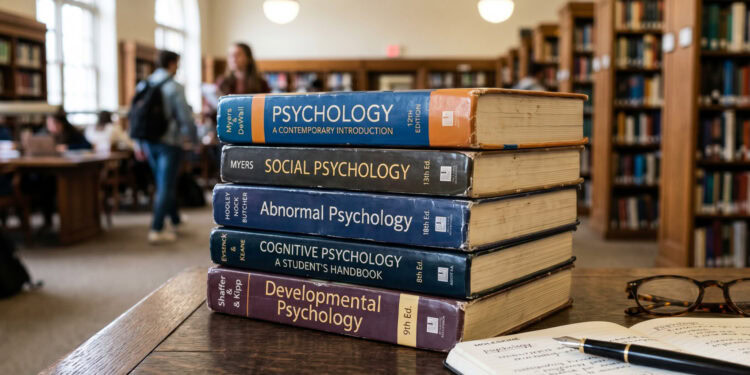

A recent study published in The Journal of General Psychology suggests that many introductory psychology textbooks continue to misrepresent scientific findings and repeat long-standing myths. While there have been modest improvements over the past few years, the research provides evidence that textbooks still struggle to accurately present controversial topics and historical events. This ongoing issue means that college students may be learning an oversimplified or biased version of psychological science.
In recent years, scientists have noticed a troubling trend in how psychology is taught to college freshmen. Many textbooks repeat scientific urban legends, which are famous but factually incorrect stories used to illustrate scientific concepts. Textbooks also tend to exaggerate the level of agreement among scientists on controversial issues, often leaning toward politically progressive viewpoints.
Researchers Jeffrey M. Brown of Texas A&M International University and Christopher J. Ferguson of Stetson University wanted to track whether these known problems were being fixed. They sought to evaluate if publishers had updated their materials to reflect the most accurate scientific evidence.
“I was chatting with my co-author, and he mentioned that he was reading about how the Stanford prison study appeared to be somewhat exaggerated,” Brown explained. “I then mentioned that I read something, some time ago, about the Kittie Genovese case and how the story was also exaggerated and left out some facts.”
Brown noted that the researchers had personal experience with topics like video game violence being covered poorly. He pointed out that textbook writers often misrepresented the strength and consistency of the evidence for one side of an ongoing debate, or simply ignored that a debate existed.
To avoid relying only on their own opinions, Brown and Ferguson first conducted a pilot study to identify which topics were most problematic. They reached out to psychology professors teaching at four-year colleges across the United States. The researchers randomly selected eight universities from each of the fifty states and invited one professor from each school.
Out of 393 solicitations sent out in the spring of 2018, 34 professors responded to the open-ended questionnaire. These professors were asked to list up to ten areas they felt were poorly covered in introductory textbooks. From these responses, the researchers identified eleven commonly mentioned topics for further review.
Some of these topics included historical events like the Stanford Prison Experiment, the Kitty Genovese murder, and the Little Albert experiment. For instance, the Little Albert experiment is frequently cited to explain how humans learn fear, but historical reviews suggest the original study was highly flawed and largely unsuccessful. By treating these events as simple facts, textbooks might be passing down scientific myths.
Another historical myth evaluated in the study was the story of Phineas Gage. Gage was a railroad worker who survived a metal rod blasting through his brain, and textbooks often claim this accident permanently destroyed his personality. The textbooks tend to ignore historical evidence showing that Gage later recovered enough to work a job driving a stagecoach.
Other topics chosen for the study were controversial scientific debates, such as the effects of video game violence, corporal punishment, and evolutionary psychology. The researchers also included brain plasticity, which refers to the brain’s ability to change and adapt as a result of experience. Another topic was stereotype threat, which is the idea that people perform worse on tests when they feel they are at risk of confirming negative stereotypes about their social group.
Armed with this list of eleven topics, the researchers examined 16 introductory psychology textbooks available in 2018. Two independent raters read the sections covering these topics and scored them on a four-point scale. A score of one meant the topic was not included, while a score of four meant the coverage was completely unbiased.
To determine bias for controversial topics, the researchers looked for one-sided coverage that presented a highly debated issue as an undisputed fact. For historical myths, bias was noted if the textbook presented a known falsehood as a factual event. For example, the Kitty Genovese story is often used to demonstrate the bystander effect, with textbooks claiming 38 people watched her murder and did nothing, even though historical records show this version is largely inaccurate.
The researchers found a high degree of bias across the 2018 textbooks. The books performed well on certain biological topics, sometimes by simply leaving them out entirely. In contrast, textbooks were much more likely to contain errors when discussing classic psychology experiments or sensitive social issues like stereotype threat and video game violence.
To see if things had changed, Brown and Ferguson repeated the exact same process five years later. In the spring of 2023, they collected and rated 18 newer introductory psychology textbooks. The scientists used the same scoring method to compare the two batches of textbooks over a five-year period.
The findings from the 2023 textbooks showed mixed results. For some topics, such as video game violence and the Kitty Genovese story, the accuracy of the coverage improved. However, the reporting on other topics, such as corporal punishment and brain plasticity, actually became more biased.
“I was surprised by the number of topics that we found where there still were problems,” Brown noted. “Things seem to have improved somewhat over the past 10 years, but poor reporting of some controversial topics remains.”
A major trend in the 2023 books was an increased tendency to omit problematic topics entirely. Rather than correcting the myths or exploring the nuances of a controversial debate, many textbook publishers simply removed the material. While this reduces the presence of false information, the researchers suggest that it represents a missed opportunity to teach students about the evolving nature of science.
While this research provides a detailed look at textbook accuracy, there are some limitations to consider. First, measuring bias can be subjective, even with a standardized scoring system. Brown pointed out that the biggest limitation is that the findings are based only on the assessment of two psychology professors.
“It would be great if there were some larger, and more honest, effort by groups such as the American Psychological Association to look into this issue,” Brown explained. “Unfortunately, the APA themselves have often released policy statements that were highly biased. So we hope that, in the future, the APA might change course and do better to lead by example, even if that means admitting a research field is muddled, or we don’t have a definitive answer.”
Ultimately, the researchers want students to be aware of these issues. “I would hope that the reader gains an understanding that some of the stories and research detailed in some Introduction to Psychology textbooks are only part of the full story or may not detail that some topics are more nuanced,” Brown stated.
He emphasizes to his own students that these historical controversies still led to robust bodies of research that impacted the field. “But, as they say, not everything you read in a book is true,” Brown added. “Unfortunately, that even goes for textbooks.”
The study, “Have Introductory Psychology Textbooks Gotten Better at Representing Psychological Science?“, was authored by Jeff Brown and Christopher J. Ferguson.