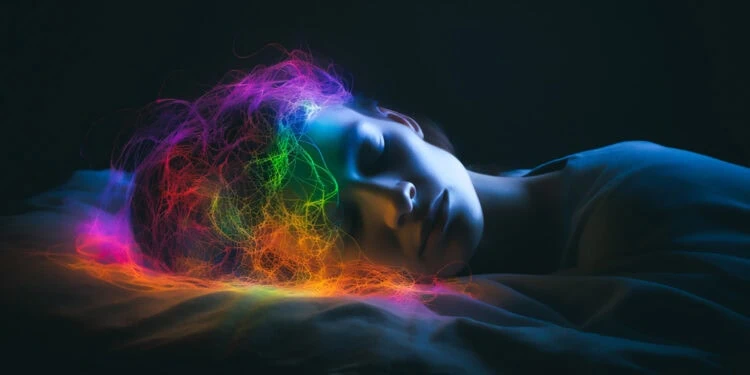

Last night you probably slept for seven to eight hours. About one or two of these was likely in deep sleep, especially if you’re young or physically active. That’s because sleep changes with age and exercise affects brain activity. About three or four hours will have been spent in light sleep.
For the remaining time, you were likely in rapid eye movement (REM) sleep. While this is not the only time your brain is potentially dreaming – we also dream during other sleep stages – it is the time your brain activity is most likely to be recalled and reported when you’re awake.
That’s usually because either really weird thoughts or feelings wake you up or because the last hour of sleep is nearly all REM sleep. When dreams or your alarm wake you, you’re likely coming out of dream sleep and your dream often lingers into the first few minutes of being awake. In this case you remember it.
If they’re strange or interesting dreams, you might tell someone else about them, which may further encode the dream memory.
Dreams and nightmares are mysterious and we’re still learning about them. They keep our brains ticking over. They wash the thoughts from the day’s events at a molecular level. They might even help us imagine what’s possible during our waking hours.
What do scientists know about REM sleep and dreaming?
It’s really hard to study dreaming because people are asleep and we can’t observe what’s going on. Brain imaging has indicated certain patterns of brain activity are associated with dreaming (and with certain sleep stages where dreams are more likely to occur). But such studies ultimately rely on self-reports of the dream experience.
Anything we spend so much time doing probably serves multiple ends.
At the basic physiological level (indicated by brain activity, sleep behaviour and studies of conciousness), all mammals dream – even the platypus and echidna probably experience something similar to dreaming (provided they are at the right temperature). Their brain activity and sleep stages align to some degree with human REM sleep.
Less evolved species do not. Some jellyfish – who do not have a brain – do experience what could physiologically be characterised as sleep (shown by their posture, quietness, lack of responsiveness and rapid “waking” when prompted). But they do not experience the same physiological and behavioural elements that resemble REM dream sleep.
In humans, REM sleep is thought to occur cyclically every 90 to 120 minutes across the night. It prevents us from sleeping too deeply and being vulnerable to attack. Some scientists think we dream in order to stop our brains and bodies from getting too cold. Our core body temperature is typically higher while dreaming. It is typically easier to wake from dreaming if we need to respond to external cues or dangers.
The brain activity in REM sleep kicks our brain into gear for a bit. It’s like a periscope into a more conscious state, observing what’s going on at the surface, then going back down if all is well.
Some evidence suggests “fever dreams” are far less common than we might expect. We actually experience far less REM sleep when we have a fever – though the dreams we do have tend to be darker in tone and more unusual.
Spending less time in REM sleep when we’re feverish might happen because we are far less capable of regulating our body temperature in this stage of sleep. To protect us, our brain tries to regulate our temperature by “skipping” this sleep stage. We tend to have fewer dreams when the weather is hot for the same reason.
A deep-cleaning system for the brain
REM sleep is important for ensuring our brain is working as it should, as indicated by studies using electoencephalography, which measures brain activity.
In the same way deep sleep helps the body restore its physical capacity, dream sleep “back-flushes” our neural circuits. At the molecular level, the chemicals that underpin our thinking are bent out of shape by the day’s cognitive activity. Deep sleep is when those chemicals are returned to their unused shape. The brain is “washed” with cerebrospinal fluid, controlled by the glymphatic system.
At the next level, dream sleep “tidies up” our recent memories and feelings. During REM sleep, our brains consolidate procedural memories (of how to do tasks) and emotions. Non-REM sleep, where we typically expect fewer dreams, is important for the consolidation of episodic memories (events from your life).
As our night’s sleep progresses, we produce more cortisol – the stress hormone. It is thought the amount of cortisol present can impact the type of memories we are consolidating and potentially the types of dreams we have. This means the dreams we have later in the night may be more fragmented or bizarre.
Both kinds of sleep help consolidate the useful brain activity of the day. The brain also discards less important information.
Random thoughts, rearranged feelings
This filing and discarding of the day’s activities is going on while we are sleeping. That’s why we often dream about things that happen during the day.
Sometimes when we’re rearranging the thoughts and feelings to go in the “bin” during sleep, our level of consciousness allows us to experience awareness. Random thoughts and feelings end up all jumbled together in weird and wonderful ways. Our awareness of this process may explain the bizarre nature of some of our dreams. Our daytime experiences can also fuel nightmares or anxiety-filled dreams after a traumatic event.
Some dreams appear to foretell the future or carry potent symbolism. In many societies dreams are believed to be a window into an alternate reality where we can envisage what is possible.
What does it all mean?
Our scientific understanding of the thermoregulatory, molecular and basic neural aspects of dreaming sleep is good. But the psychological and spiritual aspects of dreaming remain largely hidden.
Perhaps our brains are wired to try and make sense of things. Human societies have always interpreted the random – birds wheeling, tea leaves and the planets – and looked for meaning. Nearly every human society has regarded dreams as more than just random neural firing.
And the history of science tells us some things once thought to be magic can later be understood and harnessed – for better or worse.
This article is republished from The Conversation under a Creative Commons license. Read the original article.