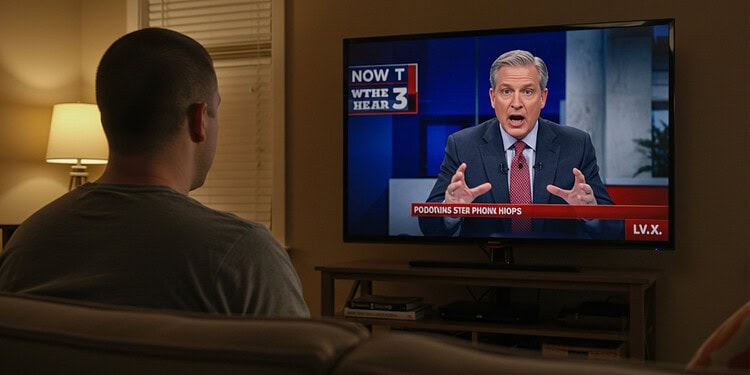

Consuming news from political or religious groups outside of one’s own circle may help soften exaggerated beliefs about how much those groups dislike you. New research provides evidence that watching or reading outgroup media is linked to feeling a greater sense of connection to those individuals, which in turn is associated with assuming they view your group more favorably. The findings were published in Political Psychology.
People often possess exaggerated meta-perceptions, which are beliefs about how another group views their own group. Specifically, individuals tend to overestimate how much the opposing side dislikes them, known as meta-prejudice, and how much the other side views them as unevolved or uncivilized, known as meta-dehumanization. For example, a 2021 study covered by PsyPost indicated that both Democrats and Republicans drastically overestimate the extent to which the opposing political party dehumanizes and holds prejudice against them.
These exaggerated assumptions can fuel real-world hostility. A 2019 set of experiments and surveys found that when people overestimate outgroup negativity, they are more likely to believe the opposing side is motivated by purposeful obstructionism. Correcting these false impressions is an important step in reducing political and social animosity.
“This project stemmed from a recent study which found that Americans have substantially exaggerated perceptions of what the other political group thinks about them,” said Muhammad Ehab Rasul, a research fellow at the Centre for Trusted Internet and Community at the National University of Singapore. “One aspect that really drove us to explore this topic was to understand what is driving these erroneous meta-perceptions, and if there is a way to create more positive meta-perceptions.”
News media consumption plays a major role in shaping these impressions. The researchers wanted to know if traditional news sources could act as a form of mediated contact, helping people form one-sided feelings of familiarity and intimacy with the opposing group, a concept known as a political parasocial relationship. They suspected that these media-driven connections might help correct harsh meta-perceptions, though they noted that outgroup exposure does not always have a positive effect. In fact, a 2018 field experiment found that paying people to follow opposing political views on social media actually increased their political polarization.
“Today, partisan sorting is becoming increasingly common, meaning that people do not have as much direct interaction with those with opposing views than in previous decades,” said Samantha Moore-Berg, an assistant professor of psychology at the University of Utah. “Yet one way that partisans increasingly can access the other side’s perspectives is through the media.”
The research, led by Rasul and Moore-Berg, examined this dynamic across three studies in the United States and Israel. In the first study, the team surveyed 2,707 American adults, measuring how often participants consumed liberal and conservative news media. The researchers asked the participants to guess how warmly the opposing political party felt about them and how evolved the other party considered them to be.
The authors found that consuming news from the opposing political side was generally associated with reduced negative assumptions. For Republicans, watching or reading more liberal news was linked to lower meta-prejudice and lower meta-dehumanization. For Democrats, higher exposure to conservative news was associated with lower meta-prejudice. Interestingly, when Republicans consumed more conservative news, they tended to report higher meta-dehumanization, suggesting that sticking entirely to ingroup media might worsen some negative assumptions.
“Contrary to initial predictions, we found that exposure to outgroup partisan news is associated with more positive meta-perceptions,” Moore-Berg told PsyPost. “Initially, we expected the opposite pattern, as the media often focuses on negative portrayals of outgroup members.”
At the same time, viewing one’s own party’s news did not universally deepen hostility. “One thing that was interesting is that we did not find significant associations between ingroup news media consumption and meta-perceptions,” Rasul noted. “It is expected that this type of exposure should result in more extreme attitudes and meta-perceptions. However, we do not observe these effects in our findings.”
The scientists then tested whether this pattern would hold in a society where the two groups have a vast power imbalance and different levels of media access. The second study involved 969 Jewish adults in Israel, split between secular and ultra-Orthodox individuals. Participants reported their exposure to mainstream secular news and to specific ultra-Orthodox news outlets.
The team’s diverse background proved essential for this phase of the research. “Our researcher composition played a significant role in access to hard-to-reach study populations, such as the ultra-Orthodox participant group in Study 2, and helped us think about the role of the media in intergroup relations,” Moore-Berg said.
Exposure to ultra-Orthodox news was associated with lower meta-prejudice and lower meta-dehumanization for both secular and ultra-Orthodox participants. The relationship between secular news and meta-perceptions was not statistically significant for either group. The researchers suggest that because secular media is the mainstream default, extra exposure to it does little to change the entrenched views of ultra-Orthodox individuals, who often feel stigmatized by those outlets.
“The finding that outgroup news media is associated with lower meta-perceptions of prejudice and dehumanization is stronger and more stable for groups with equal status and power,” Rasul explained. “Our findings suggest that the link between outgroup news media exposure and meta-perceptions of prejudice and dehumanization is stronger and consistent among Democrats and Republicans, but inconsistent among secular and ultra-Orthodox Jews.”
In a final study of 761 American adults, the researchers explored the psychological mechanism behind these media effects. Alongside measuring news habits and meta-perceptions, they asked participants how much they felt a sense of belonging or connection when watching members of the opposing political party on the news.
As in the first study, Democrats who consumed more conservative news reported lower meta-prejudice. More importantly, the data indicated that exposure to outgroup news was linked to a stronger political parasocial relationship. This heightened sense of imagined connection with the opposing group was, in turn, associated with less extreme assumptions about how much the outgroup disliked or dehumanized them.
“The key takeaway from our findings is that consuming the ‘other’ side’s media can be a way to lower the misperceptions we hold about other groups,” Rasul said. “This may occur as we realize that the other side’s perceptions about us are not as extreme as we may believe.”
Moore-Berg pointed out that this benefit extends beyond a single context. “Our results showed that increased exposure to outgroup media was associated with more positive meta-perceptions for both partisans in the U.S. and religious groups in Israel,” she said. “Media may be a cross-group solution to reducing negative meta-perceptions.”
The cross-sectional nature of the data means the authors cannot confirm that watching outgroup news directly causes people to soften their assumptions. It is entirely possible that individuals who already assume the best about their political opponents are simply more willing to tune into outgroup media channels. Tracking news habits over a long period or assigning participants to watch specific networks would help clarify the exact direction of this relationship.
“These associations could be due to selection effects—partisans who are initially more willing to watch outgroup media might have more positive meta-perceptions to start—or could be due to media exposure,” Moore-Berg explained.
The reliance on self-reported media consumption also presents a challenge, as people do not always accurately remember or admit how much partisan news they watch. Additionally, the specific political climate during each survey might have influenced the responses. The first study took place early in the COVID-19 pandemic, a time of unique media habits and shared external threats, which might explain why its results differed slightly from the third study conducted a few years later.
The researchers also noted that their measures did not capture the nuance of what participants were watching. “We only examined general media exposure rather than the specific content within the media that participants consumed,” Moore-Berg added.
Looking ahead, the team hopes to pinpoint the mechanisms driving these results and explore alternative platforms. “It could be that exposure to outgroup views via TikTok, for instance, may affect meta-perceptions differently than say exposure to CNBC or Fox News,” Moore-Berg said.
Rasul hopes these insights can eventually inform broadcasting practices to lower intergroup hostility. “One of the key implications of our study is that media outlets should aim to portray more moderate views of individuals with different religious and political backgrounds and avoid airing extreme opinions,” he concluded.
The study, “The role of partisan news and political parasocial relationships in shaping meta-perceptions: Cross-national evidence,” was authored by Muhammad Ehab Rasul, Boaz Hameiri, Gila Hacohen, Nechumi Malovicki-Yaffe, and Samantha L. Moore-Berg.