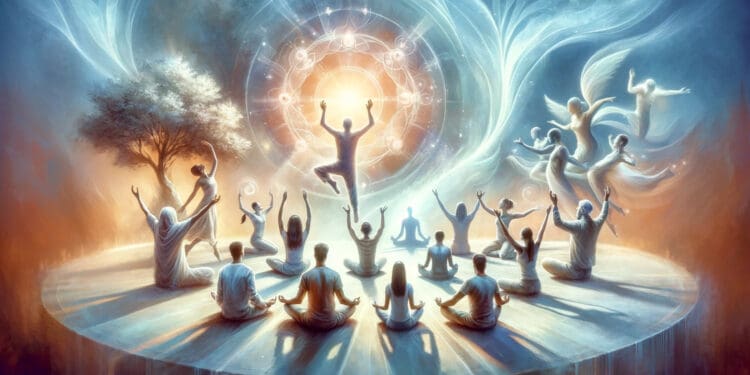

The way we move our bodies and the sacred meanings we attach to these movements can significantly affect our emotions, according to new research published in Psychology of Religion and Spirituality. This insight sheds new light on how simple actions, when imbued with sacred meaning, can enhance positive emotions and reduce negative feelings.
In various religious and spiritual practices, specific body movements and postures are integral parts. For example, the fluid motions in a Sufi’s whirling or the disciplined postures in a yogi’s practice are believed to be more than mere physical activities; they are seen as pathways to higher emotional and spiritual states.
Building on this age-old wisdom, recent psychological research has begun to explore how these physical movements might affect our mental state. Past studies have hinted at the potential of body movements to influence creativity, mood, and even our perception of social concepts like race. However, what was less understood was how the meaning we attach to these movements plays a role in this dynamic.
“Body movements are common in many religious and spiritual settings. Research on embodiment often examines the type of body movements people do (for example, fluid vs. nonfluid body movements) and the way body movements impact cognition and emotion,” said study author Paige A. Freeburg (@paigeafreeburg), the Lab Manager for the Laboratory on Social and Affective Neuroscience at Georgetown University.
“I was interested in understanding not only the effects of the types of movements people do but also the effects of the meaning people give to body movements. To what extent do actual body movements themselves, the meaning behind body movements, and the interaction between body movements and their meaning shape cognition and emotion?”
In the study, which was conducted at Sarah Schnitker’s Science of Virtues Lab at Baylor University, the researchers recruited 422 participants through an online platform, ensuring a diverse representation in terms of gender, age, race, and religious affiliations. The study was designed to observe two primary variables: the fluidity of the participants’ movements and the sacredness of the meaning they ascribed to these movements.
Participants were divided into groups and asked to perform simple tasks: drawing six lines. Some were instructed to draw these lines with fluid motions, while others were guided to use nonfluid, more angular motions. In addition, half of the participants were asked to imbue these actions with sacred meaning — to connect the act of drawing with something spiritually significant to them, like “God,” “humanity,” or “the universe.” The others were asked to focus on more mundane aspects, like hand-eye coordination.
The researchers measured various emotional states of the participants, including positive and negative emotions, mood, and self-transcendent positive emotions, which include feelings like gratitude and compassion. They also assessed creativity and race conceptions (e.g., “I believe physical features determine race”), although these were not the study’s primary focus.
The researchers found that participants who performed fluid movements experienced more positive emotions compared to those who made nonfluid movements. But, more interestingly, those who ascribed sacred meaning to their movements, regardless of their fluidity, reported even higher levels of positive and self-transcendent positive emotions. They also experienced fewer negative emotions.
“We found that attributing sacred meaning to arm movements led to greater experiences of positive and self-transcendent positive emotions (and lower negative emotions),” Freeburg told PsyPost. “This study highlights the importance of taking into account not only the type of body movements people do but also the meaning people give to body movements.”
“For the sacred meaning manipulation, there were no statistically significant differences in any affective or cognitive outcomes between participants who chose a theistic sacred term (e.g., ‘God, ‘a higher power’) and participants who chose a nontheistic sacred term (e.g., ‘humanity,” ‘the universe’),” she noted. “It didn’t matter what participants found to be sacred; as long as something meaningful to them was associated with the arm movements, positive emotions were elicited. This is a step forward in acknowledging a wide range of religious and spiritual experiences in research.”
On the flip side, the study didn’t find significant effects of movement fluidity or sacredness on cognitive outcomes like creativity and race conceptions. This was contrary to what some previous research suggested, highlighting that the relationship between body movements and cognitive processes might not be as straightforward as once thought.
“Contrary to previous research, we did not find that fluid arm movements led to more fluid thinking,” Freeburg said. “This could be because we a) had a larger sample size than previous research, b) used online participants instead of college students, and c) varied our methodology from previous research.”
Interestingly, these effects on emotions were somewhat influenced by the perceived difficulty of the drawing task. Nonfluid movements were rated as more difficult than fluid ones, and when this difficulty was taken into account, the impact of fluid movements on positive emotions and mood diminished.
There are some caveats to consider in interpreting these findings. First, the study’s movements were limited to arm movements and drawing lines, which are relatively small and simple actions. It’s unclear if more complex or whole-body movements would yield similar results. Additionally, the study’s design, while innovative, focused on short-term interactions. The long-term effects of these types of embodied actions in religious and spiritual settings remain unexplored.
Looking to the future, the researchers suggest that further studies should explore a wider variety of movements and contexts, including larger and more holistic body movements that are common in many religious and spiritual practices. It would also be beneficial to examine the long-term effects of these movements and to expand the research to include a more diverse range of participants and settings.
“The sample is primarily White, female, and non-Hispanic,” Freeburg said. “Furthermore, the body movements were small and limited to the arm, so any effects were likely short-lived. Future research should investigate the effects of movements that involve more of the body (e.g., dancing) and thus may be more potent and long-lasting.”
The study, “Meaning Behind the Movement: Attributing Sacred Meaning to Fluid and Nonfluid Arm Movements Increases Self-Transcendent Positive Emotions and Buffers the Effects of Nonfluidity on Positive Emotions“, was authored by Paige A. Freeburg, Patty Van Cappellen, Juliette L. Ratchford, and Sarah A. Schnitker.