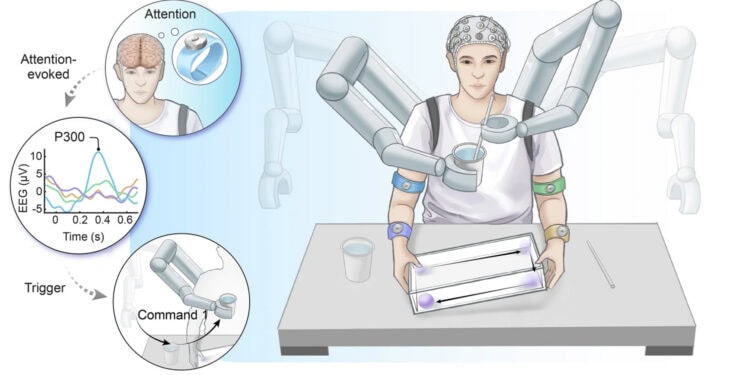
A touch-based brain-computer interface can enable people to command extra robotic arms while simultaneously using their own hands without disrupting their natural physical coordination, according to a new study published in Nature Communications. By focusing their attention on brief vibrations delivered to different spots on their arms, volunteers triggered a brainwave response that selected among four distinct commands while their hands stayed busy with a manual balancing task. After three days of practice, the accuracy gap between moving both hands and sitting still was no longer statistically significant.
A brain-computer interface is a system that measures electrical activity in the brain, often through small sensors resting against the scalp, and translates specific signal patterns into commands for external machines. Much of this research has focused on restoring lost movement after injury or paralysis, as seen in an earlier experiment with a partially paralyzed man who used a shared-control brain interface to coordinate two prosthetic arms and feed himself in under 90 seconds. More recently, engineers have sought to apply brain interfaces to movement augmentation, equipping able-bodied people with extra robotic limbs or fingers so they can carry out tasks beyond the reach of two biological hands.
For first author Tianyu Jia, a postdoctoral researcher in bioengineering in the Faculty of Engineering at Imperial College London, the work drew on a familiar pop-culture image of mind-controlled extra arms. “The initial inspiration came partly from Doctor Octopus, the fictional character from Spider-Man,” Jia told PsyPost. “We wanted to probe the limits of human movement control abilities and turn a science-fiction vision into reality.”
Operating an extra robotic limb alongside active biological arms presents a difficult coordination problem because the body has no spare motor channels waiting to be assigned. One workaround borrows physical input from another body part, as in a 2021 study of healthy adults who learned over five days to steer a wearable robotic thumb using pressure sensors beneath their toes, though that setup occupied their feet and was associated with changes in how the brain represents the natural hand. Decoding movement intentions directly from the scalp avoids tying up another body part, as demonstrated in a 2018 experiment with able-bodied volunteers who triggered a robotic third arm by mentally picturing a hand grasp while balancing a ball with both hands, though that system offered only a single on-off command.
Don’t miss the next big psychology finding
Every morning, PsyPost sends a short briefing on the most interesting new peer-reviewed research in psychology and neuroscience.
Relying on imagined movements has tight limits when a person is already physically active. Picturing one bodily motion while performing another produces overlapping electrical activity in the brain’s motor regions, making it hard for non-invasive scalp sensors to separate multiple extra commands from ongoing natural movement.
To bypass motor brainwaves altogether, Jia, who also holds an affiliation with Tsinghua University, worked with senior author Dario Farina of Imperial College London and their colleagues to build an interface around a sensory brain signal called the P300 response. When a person pays attention to an infrequent target stimulus mixed into a stream of ignored stimuli, the brain produces a positive spike in electrical voltage roughly 200 to 500 milliseconds (thousandths of a second) later. Standard P300 systems trigger this wave by flashing letters or symbols on a screen, which monopolizes a user’s eyesight and makes physical multitasking impractical.
Delivering gentle vibrations to the skin can evoke the same P300 brainwave while leaving both vision and the motor system free. Prior research, including a 2022 training study of healthy volunteers, indicated that multi-day practice improved accuracy and strengthened P300 signals in a four-choice vibration interface, though its separate test of performance under added workload was inconclusive.
The researchers tested whether a touch-encoded brain-computer interface could support four distinct commands without interfering with ongoing two-handed coordination across three separate days of training. Ten right-handed, able-bodied volunteers between ages 23 and 37 (six men and four women), eight of whom had no prior experience with brain interfaces, participated in the study, and the authors posted the dataset and analysis code publicly online. Each volunteer wore an electroencephalography cap lined with 64 scalp sensors to record electrical brainwaves, along with four small tactile vibrators taped symmetrically near the wrist and elbow on both arms so their hands and fingers remained unobstructed.
Each vibrator corresponded to one of four commands and pulsed for 200 milliseconds followed by a 200-millisecond pause in a randomized order, taking 1.6 seconds to cycle once through all four locations. To select a command, a participant silently focused their attention on the pulses at one target vibrator while ignoring the buzzes at the other three sites. Rather than trying to distinguish four separate brainwave patterns, a machine-learning classifier simply watched for a yes-or-no P300 spike and matched its timing to whichever vibrator had just pulsed.
Because brainwave recordings from a single pulse contain background electrical noise, the software averaged the brain’s responses across four consecutive pulses at each vibrator. During each 80-pulse test run, the decoder made its first guess after the 18th pulse and updated its decision every four pulses, allowing up to 16 recognition attempts.
At the start of each daily session, participants completed a 60-second baseline motor test by holding a rectangular plastic tray with both hands and tilting it at a steady, controlled pace to roll a ball sequentially through all four corners. An overhead camera tracked both completed four-corner rotations and incomplete attempts. Following a 15-minute calibration period to train personalized decoders, participants completed 32 live command-recognition runs while sitting still (the single-task condition) and 32 runs while simultaneously rolling the ball around the tray (the dual-task condition), in counterbalanced order.
On the first day, dividing attention between the tray and the arm vibrations lowered brain-interface accuracy, with participants triggering the intended command on 53.1 percent of dual-task runs compared with 68.1 percent of single-task runs. That gap persisted on the second day (56.3 percent versus 77.2 percent). By the third day, dual-task success climbed to 69.7 percent, a gain of roughly 17 percentage points over Day 1. Single-task accuracy reached 79.1 percent on Day 3 (though the overall training effect for the single task rested on the Day 1-to-Day 2 gain), and by that third session the accuracy difference between actively moving both hands and sitting still was no longer statistically significant.
That steady gain in multitasking accuracy over a few sessions stood out to the team. “Operating such an interface is not necessarily a fixed ability and may improve through practice,” Jia noted.
Once the initial averaging window passed, the interface responded at a comparable speed whether or not participants were moving. Across all three days and both conditions, the system needed an average of roughly two recognition attempts (ranging from 1.5 to 2.3 attempts) to lock onto the target command, and differences across days and conditions were not statistically significant.
Examining the scalp recordings offered clues into what supported the dual-task improvement. Typical P300 responses measure about 5 to 10 microvolts, or millionths of a volt. Unlike in earlier stationary vibration studies, the average height of the spike did not change at a statistically significant level across the three training days. Active arm movement also consistently dampened the spike compared with sitting still (averaging 4.7 versus 7.2 microvolts on Day 3).
Because people cannot deliberately strengthen a P300 response the way they can learn a motor skill, the authors looked to signal timing instead. The timing of the P300 peak varied more from pulse to pulse during the dual task than the single task on the first two days. By Day 3, that difference in timing jitter was no longer statistically significant.
Steadier timing from pulse to pulse was associated with taller averaged peaks, giving the software a cleaner signal to detect. The authors suggest that practice helped participants allocate their attention more consistently while moving, offsetting some of the brain’s natural tendency to dial down incoming touch signals during active movement, a phenomenon known as sensory gating.
Operating the touch-encoded brain interface did not impair participants’ natural hand coordination. Across all three sessions, neither the average time per successful four-corner ball rotation nor the overall pace across all rotation attempts differed significantly between the solo baseline test and the live dual-task runs, providing evidence that steady two-handed control remained intact.
In a small, four-person exploratory test, the researchers examined whether the interface could sustain an ongoing command when a user held focus on one vibrator across consecutive time windows. Descriptive results from those four volunteers indicated sustained detection on an average of 91.1 percent of windows while sitting still and 87.0 percent while balancing the ball, with false alarms occurring on 1.6 percent and 5.3 percent of windows, respectively. Because this check measured window-by-window detection on a single held target rather than selecting among four commands, those figures are not directly comparable to the 69.7 percent accuracy in the main experiment.
To illustrate how the system handled physical four-limb coordination, a participant also used the interface to direct two tabletop robotic arms operating along preset safety trajectories while keeping both natural hands occupied with a separate task. In the first demonstration, the user sequentially commanded either robotic arm to pick up and return a ball. In the remaining demonstrations, the user coordinated both robotic arms so that one lifted a cup while the other dropped a straw inside, ran a repeating two-robot ball relay, and stepped a single robotic arm incrementally across a flat workspace.
“People can use a brain-computer interface to issue commands to additional robotic limbs while performing a task with both natural hands,” Jia said. “The human nervous system may be able to accommodate an additional control channel for multitasking, at least in this specific sense.”
There are a few caveats to keep in mind when considering how this approach might perform in everyday settings. Because the decoder had to average several cycles of vibration pulses to separate the P300 brainwave from background noise, triggering an initial command took several seconds rather than matching the rapid reflexes of a biological limb. In addition, the robotic arms executed preprogrammed movement routines rather than giving the user smooth, proportional control over speed and joint angles, and the sustained-attention mode was evaluated descriptively in only four volunteers.
The tray-balancing exercise was also chosen as a smooth, predictable motion that avoided complex finger grip changes or sudden action planning, meaning more demanding manual work could compete harder for mental focus. Wearing buzzing pads for hours raises another practical question: the authors note that prolonged, repetitive vibration can cause the skin and nervous system to adapt and pay less attention to the pulses over time. That could weaken P300 responses during extended operation. Future studies with larger groups, longer training periods, faster single-pulse decoding algorithms, and compact wearable sensors will help determine how practical touch-encoded brain interfaces can be outside the laboratory.
The study, “Concurrent control of natural and robotic limbs through a tactile-encoded brain-computer interface,” was authored by Tianyu Jia, Xingchen Yang, Ciaran McGeady, Yifeng Li, Jinzhi Lin, Kit San Ho, Feiyu Pan, Linhong Ji, Chong Li, and Dario Farina.
